
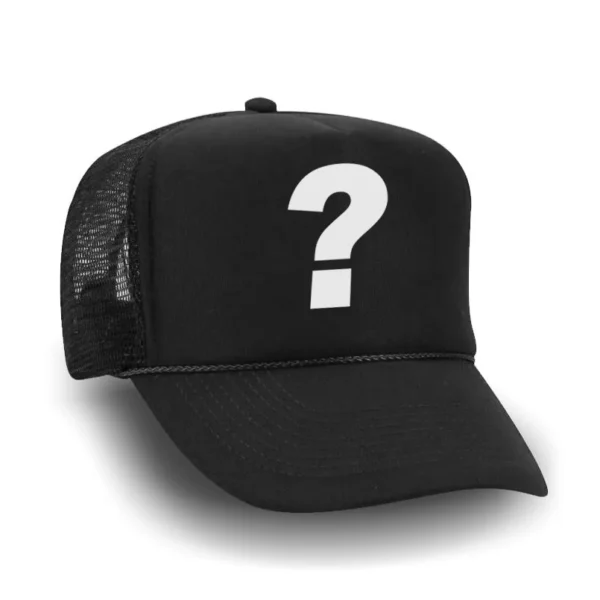
This black mesh-back trucker cap is developed around stripe or check matching at joins, adapted here as precise panel-to-panel alignment on a solid surface. The white front mark and curved construction make crown symmetry, seam tension, visor attachment, and mesh transitions practical approval checkpoints.
Join Matching Still Matters Without Plaid
The supplied image shows a solid-black cap, so there is no visible stripe or check to match. The assigned axis remains relevant because each curved join must meet cleanly, preserve crown symmetry, and prevent the front panel from rotating against the mesh back.
Treat the front crown, side panels, mesh sections, and visor as a mapped assembly. Mark seam intersections, center points, and notch relationships so the production team controls alignment with the same discipline normally used for matching visible stripes or checks.
The Front Crown Sets the Visual Center
The large white question-mark graphic sits on a broad structured front panel. Because its shape is visually simple and high contrast, any crown skew or off-center placement becomes noticeable immediately, especially when the visor is viewed from the front.
Define the front panel centerline before positioning artwork, then confirm equal clearances from the crown seams and lower edge. The sample should be reviewed head-on and from above, since crown shaping can change the apparent center after assembly.
Curved Seams Need Balanced Tension
The front crown transitions through curved joins toward the black mesh back. These curves can pucker, flatten, or pull unevenly when seam allowances, presser-foot pressure, or attachment tension vary, creating a visible break in the cap's intended shape.
Use matched notches and controlled seam allowances for each curved connection. Inspection should check smooth contour, equal left-right seam exposure, and absence of ridges near the crown edge, because a technically closed seam may still distort the cap profile.
Visor Attachment Reinforces Symmetry
The curved visor projects forward from the crown and includes repeated parallel stitching near its edge. Its attachment line becomes a secondary horizontal reference, so uneven insertion or stitch spacing can make the front graphic appear tilted even when the crown panel is centered.
Approve visor curvature, crown-to-visor alignment, edge-stitch spacing, and topstitch tension together. Confirm that the visor sits evenly across the front and that the crown does not lean toward either side when the closure is adjusted.
VeeWen Workflow for This Development Axis
VeeWen can convert the cap reference into an assembly map showing front-crown center, side-panel joins, mesh transitions, visor insertion points, and artwork clearance. This gives sampling and production teams measurable locations for evaluating symmetry instead of treating the cap as a generic accessory.
The development sequence should include a paper or digital panel check, a constructed sample, and a buyer review of the join map. Commercial planning retains MOQ: 100 pieces per style, while shell composition, mesh specification, lining, closure, and testing remain To Confirm.
Trade-Offs and Buyer Approval
A firmer structured crown can hold the white mark and preserve shape, but it may demand more precise forming and seam control. Softer construction may improve flexibility, yet it can make panel drift and graphic misalignment more apparent during wear.
Approve the cap when front and rear joins remain smooth, the graphic stays centered, the visor is level, and mesh transitions are balanced. The buyer should confirm closure preference, materials, dimensions, and final decoration method before production release.
Buyer Questions
Why apply join matching to a solid-black cap?
Solid color removes pattern distractions, making seam placement, crown distortion, visor insertion, and mesh transitions easier to evaluate as alignment problems during development.
What should the cap sample demonstrate?
The sample should demonstrate centered artwork, smooth curved joins, balanced mesh transitions, level visor attachment, consistent edge stitching, and stable crown shaping from multiple viewing angles.
Can the front graphic be replaced?
Yes, the front decoration can change, but its approved size and position must remain linked to the crown centerline and seam-clearance measurements.
Which specifications are still open?
Shell and mesh composition, lining, closure, crown dimensions, visor materials, decoration method, testing, and production timing remain open until formally specified and approved.
Approve the Cap Join Map
Share your target crown profile, closure preference, artwork, and material direction for a join-focused review. VeeWen will organize the panel references and confirm the next checkpoint around MOQ: 100 pieces per style.


Reviews
There are no reviews yet.