

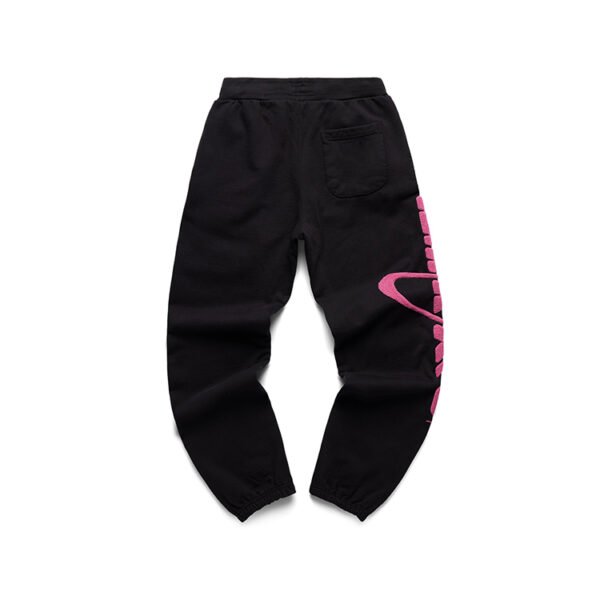


This custom black-pants concept is defined by a raised pink applique graphic rather than a flat decoration. Its commercial success depends on controlling edge behavior and layer bulk so the dimensional surface remains intentional through sewing, handling, and wear.
Relief Creates a Real Edge Problem
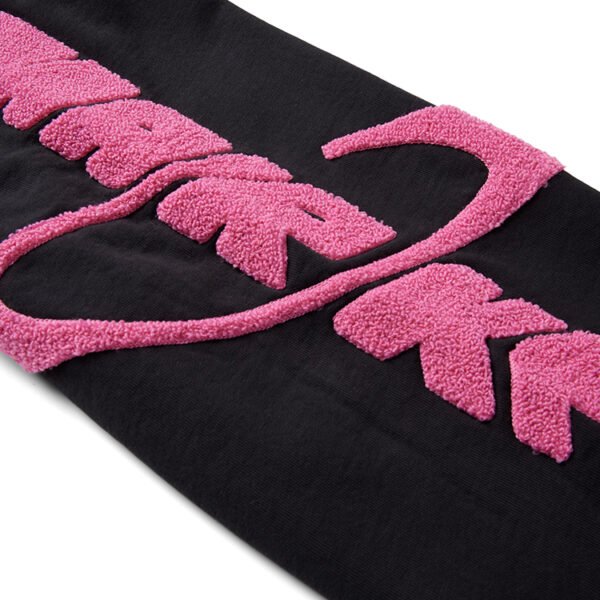
The supplied image shows pink graphic elements sitting visibly above a black textile base, with looped texture that catches light and creates physical relief. That elevation makes the applique more expressive, but it also exposes incomplete edge attachment more readily than flat embroidery.
Curved outlines and pointed sections distribute stress unevenly during sewing, folding, and wear. The development sample should therefore inspect the entire perimeter, not only the center surface, because a secure-looking middle can conceal lifting or distortion near narrow graphic transitions.
Layer Bulk Affects Garment Balance
A raised applique adds another material layer over the base fabric, and its textured loops can increase local thickness beyond the visual outline. Bulk becomes important where the graphic approaches seams, pocket openings, hems, or areas repeatedly compressed during packing and handling.
The buyer should review the applique on the actual trouser block rather than approving it as an isolated swatch. A decoration that behaves comfortably on an open panel may create ridges, seam congestion, or unwanted stiffness when positioned near construction junctions.
Graphic Geometry Needs a Tolerance
The pink motif includes rounded curves, elongated strokes, and pointed forms, creating different edge lengths and turning demands. Each geometry type may require a separate attachment approach or tolerance, especially where narrow points leave little area for secure stitching or bonding.
Artwork approval should include a controlled digital outline and a physical placement sample. The team can then identify which points may soften, widen, or receive a small clearance without changing the recognizable character of the graphic during production.
Texture Changes Handling Requirements
The looped surface visible in the image is tactile and irregular, so it may catch against adjacent materials during sewing, inspection, folding, or packing. Protecting the relief during handling is part of the product-development argument, not merely a finishing preference.
VeeWen should confirm whether the applique is cut from a looped textile, embroidered surface, or another raised construction before selecting attachment equipment and handling controls. The method determines how cleanly the texture survives trimming and how much bulk accumulates at edges.
VeeWen Workflow Checkpoint
VeeWen's workflow should develop the graphic as a construction package: approved artwork, placement coordinates, applique material, edge method, and a bulk map showing nearby seams. That package lets the sample room evaluate decoration and trouser construction as one connected system.
The first buyer checkpoint is a full-garment sample inspected inside and out, with special attention to curved edges, pointed ends, and seam crossings. Comments should identify whether a defect comes from artwork geometry, attachment tension, base-fabric movement, or local thickness.
Approval Before Production Release
Before production release, approve edge appearance, dimensional height, attachment security, hand feel, and the maximum acceptable variation in graphic contour. The black base increases contrast, so even minor pink edge irregularities may remain highly visible to the customer.
The commercial decision is whether the chosen applique method delivers enough visual value to justify its added handling and construction complexity. Once that trade-off is accepted, VeeWen can finalize the pattern, placement file, and inspection priorities for the approved style.
Buyer Questions
Is the pink detail embroidery?
The image confirms a raised, looped textile appearance, but it does not verify embroidery specifically. The attachment construction, backing, and edge-control method require technical confirmation.
Why does applique bulk matter on pants?
Added thickness can interfere with seams, pocket areas, folding, and comfort. Reviewing the decoration on the complete trouser block reveals interactions that an isolated artwork sample cannot show.
Can the graphic be resized?
Yes, resizing can be evaluated, but curves and narrow points may change attachment behavior. Any scale revision should receive a new placement and edge-tolerance review before approval.
What is the minimum order quantity?
The commercial minimum is MOQ: 100 pieces per style. Feasibility depends on approved base material, applique construction, artwork, measurements, trims, and inspection requirements.
Approve the Applique Method
Share the garment block, graphic file, and preferred hand-feel target so VeeWen can review edge security and layer bulk on a complete development sample before production approval.


Reviews
There are no reviews yet.