

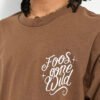
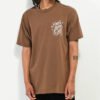

This brown back-graphic T-shirt is developed around directional surface management. If the knit has one-way nap or pile, panel orientation can change reflected shade and hand feel, making cutting strategy part of the product's visual identity. The rear artwork then becomes a second alignment checkpoint.
Why Direction Changes Brown Fabric Appearance
A fabric with nap or pile reflects light according to surface direction. Panels cut against that direction can appear lighter, darker, or different in hand, even when they share the same dye lot. On brown fabric, these shifts may read clearly across the back and sleeves.
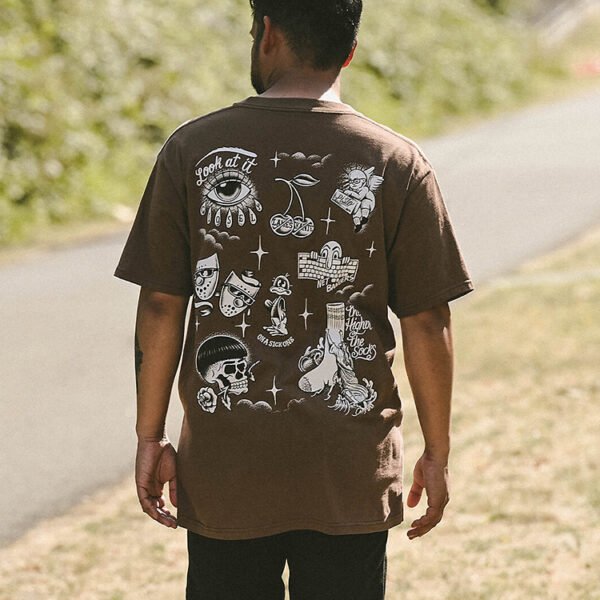
The supplied lifestyle image shows the rear body and sleeves under outdoor light, making surface consistency an important development question. VeeWen should first verify whether the fabric truly has directional behavior before assigning one-way cutting as a mandatory production rule.
One-Way Cutting Protects Panel Continuity
When directional behavior is confirmed, every visible panel should follow the same orientation. That typically reduces marker efficiency because pieces cannot freely rotate, but it protects the intended shade relationship between body, sleeves, and smaller components. The trade-off is material usage against appearance control.
VeeWen can reflect this constraint in the marker review and costing discussion before bulk approval. The buyer should understand that a one-way layout is a construction safeguard for surface continuity, not merely an optional cutting preference.
The Back Graphic Adds a Registration Reference
The image shows a substantial white illustrated graphic centered across the upper back, surrounded by brown fabric. Its scale creates a strong visual frame for checking side-to-side balance, shoulder alignment, and the way the surrounding surface reads under changing light.
During development, VeeWen should review the graphic placement after panels are cut and sewn, not only on a flat print sample. The technical file can record center-back coordinates, artwork width, vertical position, and acceptable placement tolerance for repeatable production control.
Lifestyle Evidence Supports a Relaxed Silhouette
The rear image presents a straight, easy body with sleeves extending away from the upper arm rather than hugging it. This supports a relaxed silhouette direction, although exact measurements, hem width, sleeve opening, and shoulder drop remain unverified from imagery alone.
VeeWen's workflow should translate that visual direction into a measurable fit block before surface decisions are finalized. A sample fitting can test whether the chosen ease changes panel shading, graphic scale, or the perceived balance between the back artwork and body volume.
Balancing Material Yield and Shade Uniformity
One-way cutting can increase fabric consumption and may limit the number of pieces obtained from a given roll width. Allowing rotation may improve yield but introduces the possibility of directional contrast. Buyers should choose based on the surface's actual nap, pile height, and lighting sensitivity.
VeeWen can support this decision with a fabric inspection, directional labeling, and a marker comparison using the approved pattern. The development record should state whether orientation is compulsory, preferred, or unnecessary after physical evaluation of the selected material.
Approval Gate for Directional Cutting
Before production release, the buyer should compare oriented and rotated panels under consistent lighting, then inspect the sewn garment from front, back, and side views. The decision should include shade continuity, hand-feel consistency, marker impact, and the graphic's final registration.
After approval, VeeWen can lock the cutting direction, panel labeling method, artwork coordinates, and fit measurements in the production package. Fabric composition, GSM, finishing, and care instructions should remain open until confirmed by technical source records.
Buyer Questions
Why might this T-shirt require one-way cutting?
Directional nap or pile can reflect light differently when panels are reversed, creating visible shade or hand-feel differences across the finished garment.
Does one-way cutting affect the production quantity?
It can reduce marker efficiency and increase material requirements, so the buyer should review yield implications before approving the cutting method.
Is a directional surface confirmed by the images?
No, the images suggest a matte surface but cannot verify nap or pile direction, which requires physical fabric inspection.
What should be checked on the approval sample?
Check shade continuity, panel orientation, back graphic registration, fit balance, sleeve proportion, material details, and the final marker strategy.
Confirm the Surface Direction Before Cutting
Share the fabric reference, back artwork, fit block, and size range so VeeWen can evaluate orientation with MOQ: 100 pieces per style.


Reviews
There are no reviews yet.