


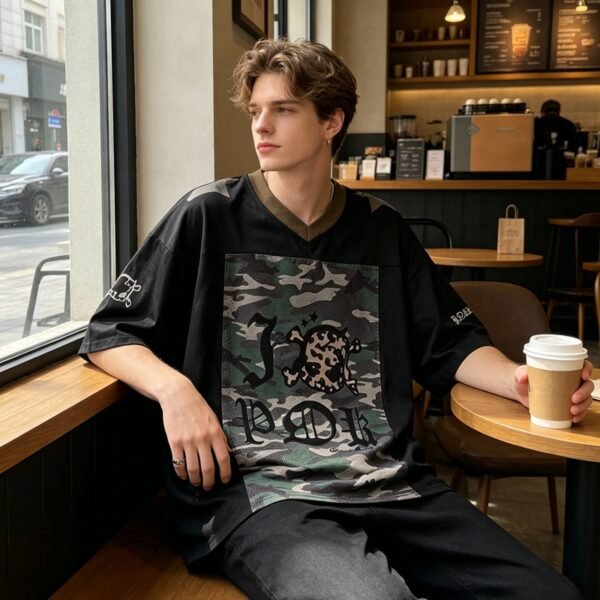

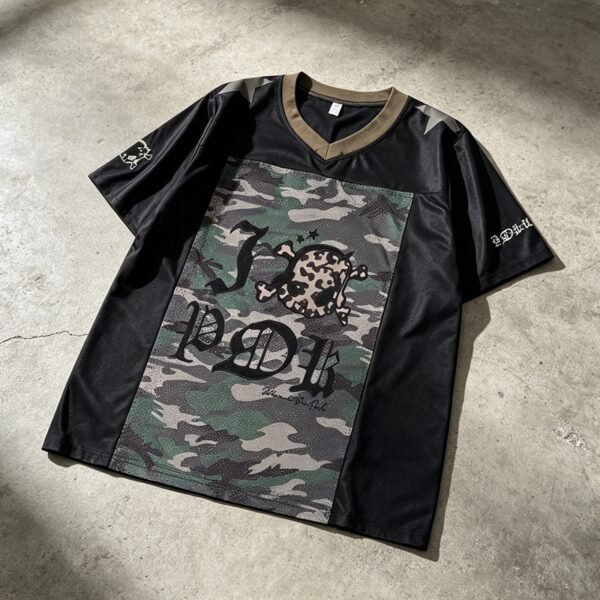


This custom jersey T-shirt is developed around internal comfort supporting external graphic scale. The supplied image shows a black short-sleeve body with a large camouflage number, layered lettering, and sleeve details. VeeWen should therefore approve shell ease and lining behavior together, not treat the lining as a secondary detail.
Shell Ease Frames the Graphic
The back design is broad and vertically organized, with a large camouflage number above contrasting lettering. A relaxed shell gives the artwork room to sit smoothly, while insufficient ease can pull the graphic across the shoulders or distort its proportions.
VeeWen should establish chest, shoulder, sleeve, and body measurements before choosing the internal finish. The buyer should review the back while standing, reaching, and sitting, confirming that graphic placement remains balanced through ordinary garment movement.
Lining Behavior Affects Mobility
Although the supplied image does not expose the inside, the assigned development axis makes internal ease a critical approval point. Any lining, facing, or interior reinforcement must move with the shell rather than create a tighter hidden layer.
A complete sample should be turned inside out during review. Check armhole clearance, shoulder mobility, seam bulk, and whether internal components catch against the shell. Comfort depends on the relationship between visible jersey dimensions and unseen construction choices.
Polyester Reference Is Not a Complete Spec
The source wording references breathable polyester, but that description does not verify exact fiber percentage, knit structure, mesh openness, weight, stretch, or moisture behavior. The image confirms a smooth black appearance and jersey styling, not laboratory performance.
VeeWen's workflow should document composition, knit type, target weight, recovery expectations, and finishing as separate fields. The buyer can then evaluate breathability and hand feel against the intended use without allowing broad source wording to become an unverified claim.
Layered Decoration Needs Movement Testing
The large number appears camouflage-filled, while lettering and smaller marks create multiple visual layers. Digital print and embroidery may respond differently to bending, laundering, and seam proximity, so their combined hand feel must be evaluated across the back panel.
Sampling should include a decorated fabric panel before the complete garment. Inspect print registration, embroidery height, edge clarity, and flex response, then repeat those checks on the finished jersey where lining or internal finishing can change surface tension.
Internal Balance Protects Proportion
The reference presents a substantial back graphic on a relatively clean black ground. If lining ease is too generous, the shell may balloon and weaken the intended number placement; if too limited, the graphic can strain and the wearer loses mobility.
Pattern review should compare shell and internal dimensions at the shoulder, armhole, side seam, and hem. The buyer's checkpoint is a fit sample showing stable proportions from the back, side, and inside, with movement tested before approval.
VeeWen Workflow Makes the Hidden Decision Visible
VeeWen can translate this reference into a staged development brief: confirm the shell fabric, map the graphic layers, define internal construction, and test the complete garment in motion. This sequence directly addresses shell-to-lining balance rather than relying on appearance alone.
Approval should proceed from material swatches to decorated panels, then to a complete sample with the intended interior. Production is ready for buyer authorization when ease, mobility, decoration, and graphic proportion remain coordinated in the same garment.
Buyer Questions
Is a lining confirmed inside this jersey?
No internal lining is visible in the supplied image. Any lining, facing, or reinforcement should be specified and approved through an inside-out sample review.
What does shell-to-lining balance mean here?
It means coordinating internal dimensions with the outer jersey so the garment moves comfortably, avoids hidden restriction, and keeps the large back graphic stable during wear.
Are digital print and embroidery both required?
The source wording references both treatments, but the final combination remains a development decision. Confirm artwork files, decoration zones, hand feel, and cost implications through sampling.
What is the minimum order quantity?
The commercial minimum is MOQ: 100 pieces per style. Final quantities, color breakdown, and production requirements should follow the approved specification and sample.
Approve the Internal Ease Before Production
Share your measurement chart, decoration files, and intended wear context. VeeWen will coordinate shell swatches, internal construction, decorated panels, and movement review before the final jersey approval checkpoint.


Reviews
There are no reviews yet.