
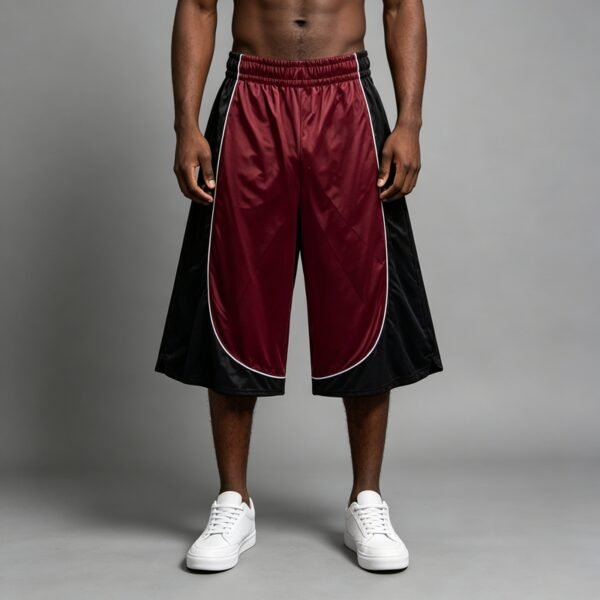


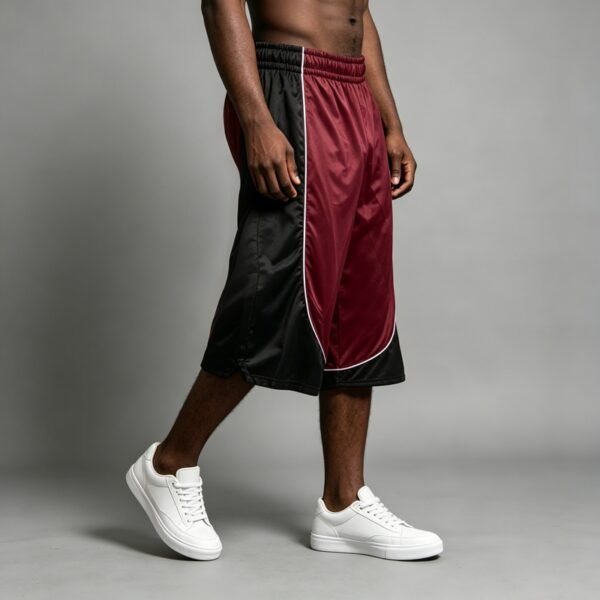


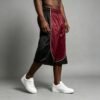
This basketball capri pant should be developed as a movement-and-placement system. The loose leg requires usable stretch direction, while curved color blocks and white piping create long visual lines. VeeWen should validate mobility, grain, and alignment in one assembled sample before production approval.
Stretch Direction Controls Movement
Stretch direction determines whether the trouser body yields across the leg, along the length, or mainly at selected panels. For a loose basketball silhouette, misplaced stretch can cause twisting, restricted stride, or excessive growth at the knee.
The pattern should identify the fabric's usable direction before color-block pieces are cut. VeeWen's sample review should test walking, squatting, and lateral movement while checking whether the waistband stays level and the wide legs return without spiraling.
Color Blocks Must Follow Grain
The supplied image shows burgundy central panels bordered by black sections, creating a strong vertical and curved visual architecture. Each panel must preserve its intended grain so the contrast remains balanced on both legs and does not drift during movement.
Panel placement also affects fabric behavior at the seams. If one section is cut across a different stretch direction, the join may ripple or pull unevenly. Approval should compare left-right symmetry, seam length, and the direction of visible surface movement.
Piping Exposes Tolerance Errors
White piping tracks the boundaries between the burgundy and black panels, making seam accuracy easy to judge. Even small differences in curve, width, or tension can create a broken line that looks misaligned when the wearer stands or moves.
Piping may also restrict a seam if inserted under excess tension, particularly where the leg curves outward toward the hem. The prototype should assess piping flexibility, seam turn, and visual continuity after pressing and movement, with tolerances recorded before grading.
The Elastic Waistband Needs Its Own Balance
The image shows a gathered elastic waistband that contrasts with the smooth, open leg volume. Waistband tension must secure the garment without overpowering the body pattern, because excessive gathering can distort the upper panel edges and change the intended proportion.
Waistband construction, elastic width, and drawcord details are not verified by the source evidence. VeeWen should confirm these choices through fit testing, then check whether the waist returns after extension without transferring strain into the first color-block seam.
Knee-Level Hem Sets the Proportion
The capri hem finishes around the knee, where levelness is highly visible because the leg opening is broad and the contrasting lower panel frames it. Unequal hem lengths or inconsistent panel height can make the silhouette appear tilted.
The lower edge should be reviewed with the garment worn and laid flat. Stretch direction, pressing, and seam handling may change the opening shape. Approval should define hem circumference, side-to-side level, panel exposure, and piping termination before final grading.
VeeWen Development Checkpoint
VeeWen's product-development workflow should begin with a directional fabric map and a panelized pattern, then proceed to a first assembled sample containing every contrast section and piping line. Movement testing should happen before aesthetic approval because fit can change seam geometry.
The buyer's approval gate is a movement sample reviewed for stretch response, grain, symmetry, waistband security, piping continuity, and knee-level hem balance. After sign-off, MOQ: 100 pieces per style applies to the finalized technical package and approved color layout.
Buyer Questions
Which stretch direction should the pattern use?
The correct direction depends on the selected fabric and intended movement. Confirm the usable stretch axis through material testing, then align each panel consistently before cutting.
Why is piping included in the fit review?
Piping follows curved panel seams, so tension or length differences can reveal distortion. Reviewing it during movement confirms that visual alignment survives wear, not only flat inspection.
Are the waistband and drawcord details confirmed?
The image confirms an elastic-looking waistband, but width, construction, drawcord presence, and elastic specification are not verified and remain To Confirm.
What is the commercial minimum?
The exact commercial minimum is MOQ: 100 pieces per style. Feasibility remains dependent on approved fabric direction, panel layout, measurements, grading, and construction details.
Approve the Directional Panel Sample
Share the target measurements, fabric options, color references, and movement expectations. VeeWen can review stretch direction, panel symmetry, piping continuity, and the MOQ: 100 pieces per style requirement.



Reviews
There are no reviews yet.