
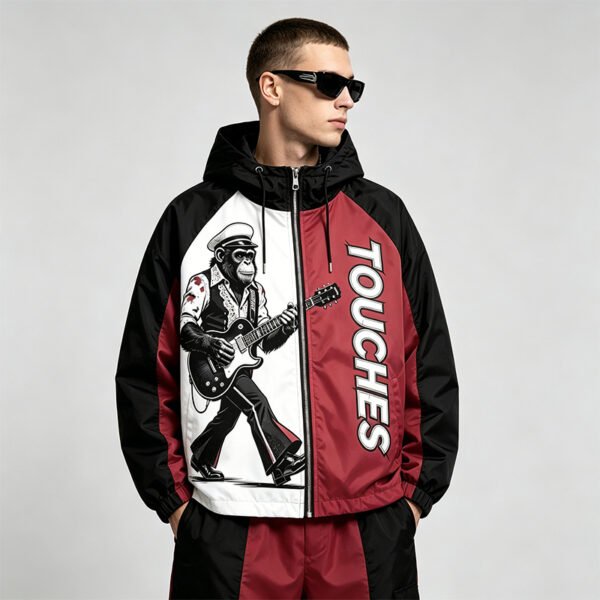

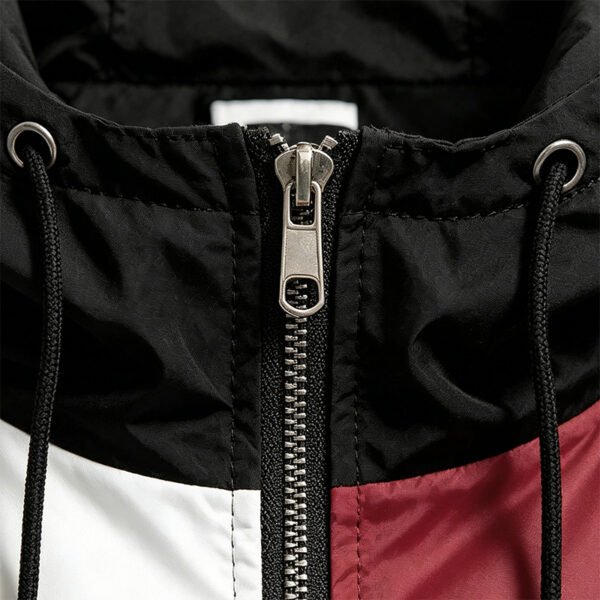










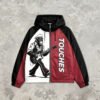
This custom hooded windbreaker is developed around the collar-to-zipper intersection, where neckline geometry, opening control, and front artwork registration must work as one engineered system. The supplied image shows a compact color-block shell, graphic front panels, drawcord hood, elastic cuffs, and a visibly central zipper.
Why the Neckline Controls the Garment
At the upper front, the hood base, neckline seam, and zipper tape converge within a narrow visual zone. Any mismatch can create puckering, uneven tension, or a crooked opening, making this intersection more important than isolated panel accuracy.
The image shows the zipper rising into a structured hooded collar while black shoulder fabric transitions into white and burgundy fronts. That contrast makes alignment immediately visible, so the pattern must control seam allowances and turn-of-cloth consistently.
Graphic Placement Around the Opening
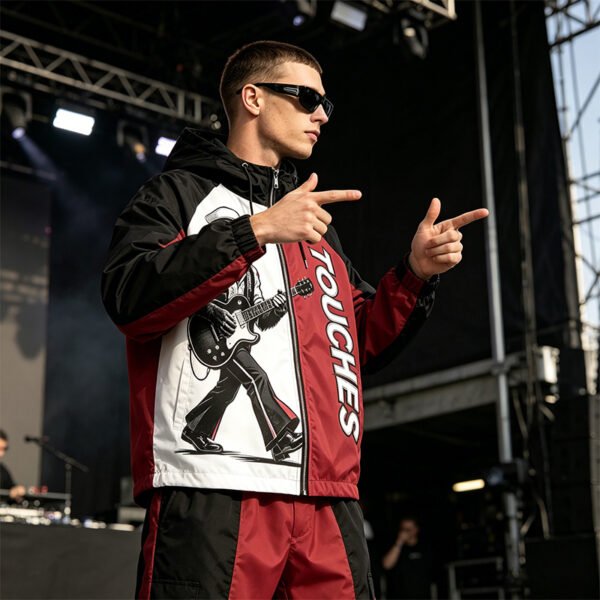
The front artwork occupies the white and burgundy panels beside the zipper, meaning the closure divides a single visual story. Artwork files should therefore include a center-opening reference, safe distance, and mirrored registration points before screen preparation begins.
A large vertical wordmark-style graphic appears beside the opening, while the illustrated figure spans the opposing panel. Development should confirm whether the print crosses seams, stops at panel boundaries, or requires separate placements for repeatable assembly.
Hood and Collar Engineering
The hood is visibly substantial, with drawcords descending over the chest and a neckline that stands above the shoulder line. Its depth, opening circumference, and attachment curve will determine whether the zipper closes smoothly without pulling the hood backward.
For sampling, VeeWen should grade the hood and collar as a connected system rather than scaling each component independently. The approval checkpoint is a closed and open fitting review that checks face clearance, cord exit position, and neckline recovery.
Panel Joins and Windbreaker Behavior
Color blocking creates multiple front and sleeve joins around the zipper, armhole, and side body. Each join adds handling and alignment requirements, especially where lightweight shell fabric can shift during cutting, printing, pressing, and topstitching.
The visible black sleeves and shoulder sections provide a stable frame for the brighter body panels, but their seam relationships should be locked in the technical pack. Buyers should approve panel widths and seam placements before confirming artwork dimensions.
VeeWen Development Workflow
VeeWen's workflow should begin by freezing the front pattern, zipper length, hood attachment, and artwork registration in one coordinated specification. That sequence lets the sample team evaluate the actual collar opening instead of reviewing unrelated components separately.
At the sample checkpoint, the buyer should inspect the zipper path from hem to hood, then review the garment on-body with the hood worn and lowered. Corrections should be recorded by measurement, seam location, and artwork offset for reliable revision.
Approval and Production Handoff
The production-ready decision is not simply whether the jacket looks attractive; it is whether the opening remains straight while the hood moves, the graphic stays intentional, and the collar maintains its shape after handling.
Approve the style after reviewing a complete sample, artwork strike-offs, zipper and cord details, and graded measurements. Confirming these linked elements at MOQ: 100 pieces per style supports a clearer handoff into cutting and assembly.
Buyer Questions
What is the main development risk for this jacket?
The main risk is alignment where the hood, collar, zipper, and front graphics meet. Small pattern or placement errors become highly visible because contrasting panels frame the opening.
Should the artwork be prepared before pattern approval?
Prepare artwork alongside the front pattern, but finalize production files after the zipper line, panel boundaries, and print-safe distances receive buyer approval.
What should the first sample review include?
Review the closed and open zipper, hood movement, neckline comfort, cord exits, cuff tension, panel symmetry, and artwork registration on the actual garment.
What commercial minimum applies?
The commercial minimum is MOQ: 100 pieces per style. Final material, artwork, grading, packaging, and inspection requirements should be documented before production approval.
Approve the Collar-to-Zipper System
Send your artwork, target measurements, and preferred shell references to VeeWen for a coordinated review of the hood, collar, zipper path, panel joins, and production sample checkpoints.



Reviews
There are no reviews yet.