


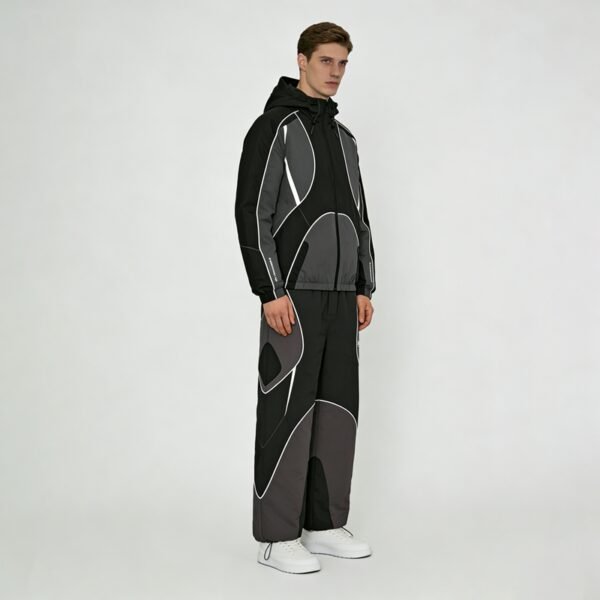


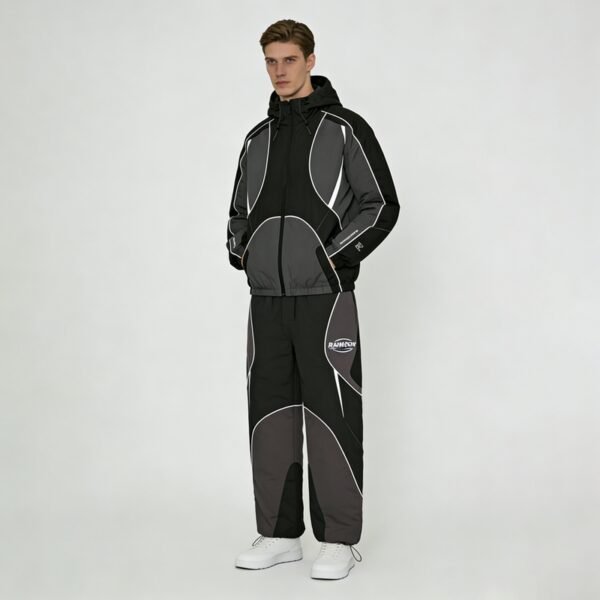
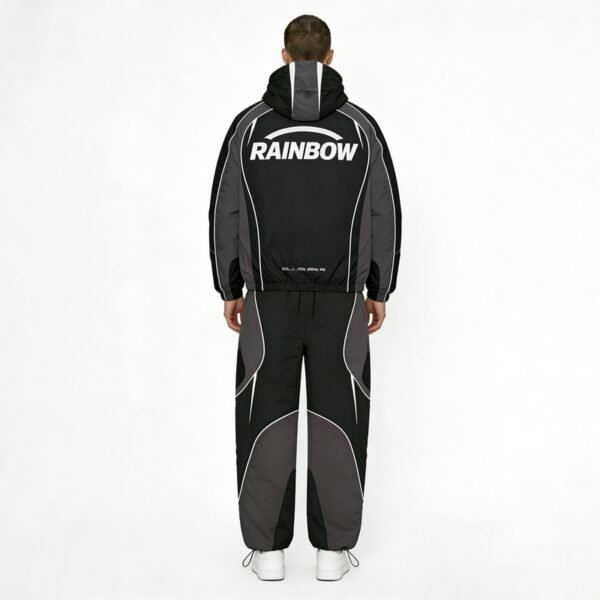


This custom hooded tracksuit is built around proportional continuity across a jacket and matching trousers. The supplied image shows an elongated black silhouette, generous sleeves, wide legs, and curved light piping, making size-set grading the key development decision for preserving visual balance at every approved size.
The Base Size Establishes the Visual System
The supplied image presents a long, controlled silhouette rather than a conventional close-fitting tracksuit. The jacket finishes near the hip with a compact elastic hem, while the trousers fall broadly toward the shoe. That relationship should be documented before grading begins.
A successful base size must establish sleeve volume, hood scale, collar height, jacket length, trouser rise, and leg width together. Adjusting one measurement in isolation can disrupt the intended architecture, especially when piping follows the body's curved lines.
Grading Must Preserve Jacket-to-Trouser Rhythm
The piping creates a visual rhythm that travels around the jacket and trousers, so proportional grading affects more than comfort. If the leg widens faster than the hip panel or the jacket length grows unevenly, the curved lines can appear misplaced at larger sizes.
VeeWen should review grade increments as a complete set, checking body length, chest, sleeve, hood opening, waist, rise, thigh, and hem. The trade-off is between a dramatic oversized silhouette and manageable fit progression across the commercial size range.
Curved Piping Exposes Proportion Errors
Light piping is visually unforgiving because it outlines the black base with continuous curved paths. In the image, the lines frame the sleeves, chest, hip, and lower legs, making even small shifts in seam or panel proportion easy to notice during fitting.
The design can therefore use piping as a diagnostic tool during sampling. If lines drift toward the underarm, knee, or hem, the pattern requires correction before decoration is finalized. Buyers should judge line placement on bodies, not only flat pattern measurements.
Technical Fabric Changes the Fit Response
The source wording identifies a water-resistant nylon blend, while the image shows a smooth technical appearance with structured volume. Such materials may respond differently from sweatshirt fabrics during grading, especially at the hood, elastic hem, sleeve gathers, and wide trouser legs.
A more structured shell can hold the intended shape but may reduce ease at bends and sitting positions. Buyers should confirm drape, noise, lining needs, and finished garment measurements through wear testing before approving the proportion rules for production.
VeeWen Workflow Locks the Size Set in Sequence
VeeWen's workflow should develop the base pattern, grade the full jacket and trouser set, then fit at representative lower, middle, and upper sizes. Each fitting should record silhouette, movement, hood balance, and piping alignment rather than relying on one successful sample.
Once the size set is approved, decoration files and construction notes should reference graded panel landmarks. This keeps embroidery, screen-print areas, and piping routes synchronized with pattern changes, reducing the risk that visual details remain correct only in the original sample size.
Buyer Checkpoint: Approve Proportion Before Decoration
The approval priority is the relationship between jacket volume, trouser width, and continuous piping. The black color makes the silhouette easy to read, while the image's long lines make proportion the defining commercial feature rather than a secondary fit detail.
Before bulk approval, buyers should sign off on a graded measurement chart, fitting photographs, hood opening, sleeve volume, trouser rise, leg width, and piping coordinates. Decoration should follow that approval, because changing proportions later can invalidate placement files and trim allowances.
Buyer Questions
Why is a full size-set fitting necessary for this tracksuit?
The elongated silhouette and curved piping can shift visibly as measurements grade, so representative size fittings confirm balance between jacket, hood, sleeves, rise, and trousers.
Is the water-resistant finish already verified?
The source wording references water resistance, but the exact finish, test method, durability, and composition are not verified and remain subject to development confirmation.
Can the jacket and trousers be sold separately?
They can be developed as coordinated separates if required, but shared color, piping, grading, and trim specifications should remain aligned across both garments.
What is the minimum order for this tracksuit style?
The commercial minimum is MOQ: 100 pieces per style, with final production depending on approved materials, grading, decoration, trims, and construction specifications.
Approve the Graded Silhouette
Share your target size range, base measurements, material reference, and piping artwork with VeeWen to begin coordinated jacket-and-trouser fittings before final decoration approval.


Reviews
There are no reviews yet.