

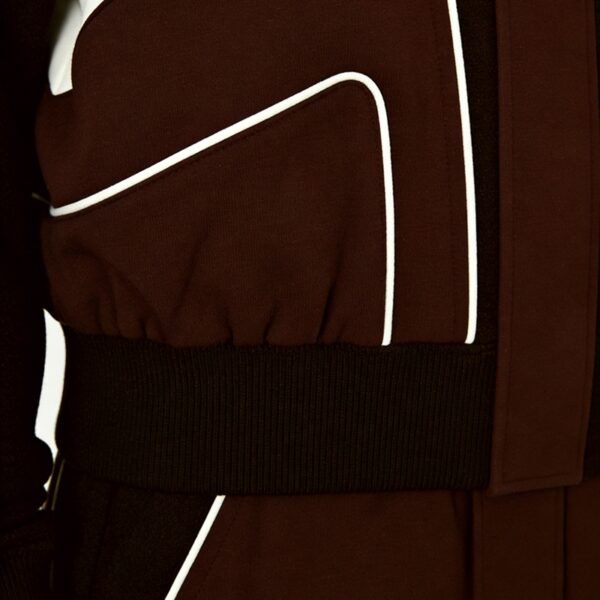


This custom color-block tracksuit is built around raw-edge containment through piping, panel order, and coordinated edge finishes. The supplied front image shows deep brown, black, and white sections framed by narrow light lines, with matching jacket and trouser construction that invites a joined durability review.
Piping Contains the Color-Block Boundary
The durability argument begins where contrasting panels meet. Piping can cover or reinforce a raw edge, creating a defined boundary that limits fraying exposure and keeps the color-block transition visually controlled when the garment flexes, folds, or receives repeated handling.
In the supplied image, light piping outlines jacket panels and continues down the trouser legs. That continuity makes edge containment a set-level issue: the buyer should evaluate matching width, tension, corner behavior, and alignment across both garments before approving the visual language.
Panel Order Controls Stress Paths
The jacket combines dark brown, black, and white sections with angular transitions across the chest and shoulders. Each transition introduces seam intersections where allowances accumulate, so construction order must preserve a flat surface while keeping the piping seated and consistent.
The trousers use long outlined side panels that create uninterrupted vertical routes. VeeWen's technical review should check whether those routes remain straight during walking, sitting, and bending, because a stable outline depends on balanced panel dimensions and controlled handling around pocket or hem areas.
Edge Finishes Need Physical Verification
The image visibly shows finished cuffs and a defined waistband, while the source wording identifies a breathable polyester blend. Neither visual evidence nor wording verifies seam sealing, abrasion performance, wash retention, or exact composition, so those properties must remain open development questions.
A physical sample should expose piping joins, corners, hems, cuffs, and waistband attachments for inspection. Record whether edges roll, flatten, open, or twist after laundering and wear simulation, then use those observations to refine stitch density and reinforcement requirements.
Breathability Cannot Replace Containment
The source description references breathability, but ventilation and edge durability solve different problems. A fabric may feel comfortable while a poorly secured piping channel loosens, catches, or distorts at a high-contact location, particularly along trouser sides and active jacket seams.
Buyer approval should separate handfeel from containment performance. Evaluate air comfort through the selected fabric and evaluate piping through movement, abrasion, and wash checks, ensuring the final specification records both objectives without treating one as proof of the other.
Set Coordination Raises the Approval Bar
Because the jacket and trousers share the same piping language, small construction differences can make the set appear mismatched. The development package should define line width, color tolerance, panel sequence, seam direction, and placement landmarks for each garment rather than relying on a single generic reference.
VeeWen's sample review can compare the two pieces side by side under consistent lighting and on-body movement. This catches piping drift, inconsistent corner shaping, or trouser-leg misalignment before bulk approval, when corrections are easier to document and communicate.
Approval Checkpoint for VeeWen Development
For VeeWen, this style should move through development as an edge-containment study: confirm panel order, choose a piping method, test seam intersections, and review the jacket and trousers together. The exact polyester blend, construction performance, and finishing method should remain provisional until evidence supports them.
The buyer's checkpoint is approval of a complete coordinated sample after piping survives agreed wash and abrasion review with acceptable alignment. Confirm the final tech pack, color references, edge details, grading, and MOQ: 100 pieces per style before order confirmation.
Buyer Questions
Why is piping central to this tracksuit?
Piping frames panel boundaries, conceals or protects selected edges, and establishes visual alignment. Its usefulness depends on secure attachment, smooth transitions, and consistent behavior after wear.
Is the polyester blend composition verified?
No. The source wording identifies a polyester blend but provides no percentages, GSM, or performance data. VeeWen should confirm those details through material documentation and sampling.
Should the jacket and trousers be tested together?
Yes. Shared piping must align across the coordinated set, so side-by-side review helps identify differences in line width, color, panel order, and movement behavior.
What is the commercial minimum?
The commercial minimum is MOQ: 100 pieces per style. Final piping, panel construction, color standards, grading, and material details should be approved before ordering.
Approve the Contained-Edge Sample
Share your panel artwork, piping references, measurements, and wash expectations with VeeWen. We can structure a coordinated jacket-and-trouser sample review around edge security and alignment.


Reviews
There are no reviews yet.