




This custom cropped hooded jacket depends on how canvas changes after coloration, washing, printing, and hem assembly. VeeWen therefore treats finished GSM as the controlling development reference, while pre-process fabric weight remains an input for predicting shrinkage, handle, graphic behavior, and gathered volume.
Why Finished GSM Controls the Jacket.
Pre-process fabric weight describes the canvas before moisture, chemistry, heat, abrasion, and mechanical handling change its structure. Those operations can remove sizing, compact yarns, relax tension, or create shrinkage, so the initial GSM cannot reliably represent the jacket buyers finally handle.
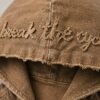
The supplied close-up shows a substantial diagonal weave beneath mottled brown coloration and dark graphics. Pronounced folds along the gathered hem also reveal enough body to hold compressed volume, making post-process weight and hand feel more commercially relevant than an isolated mill specification.
How Wet Processing Changes Fabric Substance.
Spray-dye and washing stages can change moisture regain, dimensional stability, surface friction, and apparent density. If panels shrink while mass changes differently, measured GSM may rise even though the original fabric specification remains unchanged, directly affecting drape, sewing behavior, and wearing comfort.
VeeWen would compare conditioned swatches before processing and after the complete approved wash route. Measurements should use consistent conditioning and cutting methods, while visual review checks whether tonal irregularity resembles the brown reference without allowing uncontrolled staining, harsh transitions, or excessive abrasion.
Graphics Must Be Assessed After the Wash Route.
Dark stars and abstract forms cross areas with visibly uneven coloration, so artwork perception depends on both ink coverage and the washed ground. A heavier finished surface may accept graphics differently, while abrasion or shrinkage can alter edge definition, darkness, and placement relationships.
The buyer should approve artwork scale, distribution, and acceptable variation on processed panels rather than clean unfinished yardage. The image supports scattered stars, broad distressed shapes, and intentionally incomplete coverage, but exact print technology, color standard, and artwork repeat remain development decisions requiring confirmation.
Gathering Converts Weight Into Visible Volume.
The cropped hem compresses the fabric into deep puckers around a visible cord opening. This construction concentrates material locally, meaning excess finished weight may create bulky folds and poor adjustment, while insufficient substance may collapse and lose the intended sculpted streetwear profile.
A hem mockup should test casing depth, cord movement, fold distribution, and recovery at the target finished condition. Rivet or eyelet specifications must suit the processed fabric thickness, because hardware selected against untreated canvas may clamp incorrectly after shrinkage and layered assembly.
VeeWen's Weight-Led Development Workflow.
VeeWen begins this style by recording the proposed base fabric weight as a source reference, then maps each coloration, wash, print, and conditioning stage. Sampling establishes the conversion between incoming material and the finished jacket rather than treating one number as universally transferable.
The approval set should pair measured finished GSM with a sealed hand-feel swatch, processed panel, graphic standard, and assembled hem mockup. This gives pattern, laundry, printing, and sewing teams one connected target while preserving traceability when wash settings or fabric lots change.
Trade-Offs and the Buyer Approval Gate.
A denser finished result can strengthen the cropped shape and emphasize gathered folds, but it may increase stiffness, seam bulk, and hood weight. A lighter result can improve movement, yet may weaken the canvas impression, reduce graphic authority, and flatten the adjustable hem.
Before bulk authorization, the buyer should approve a finished GSM tolerance alongside garment measurements, conditioned hand feel, wash appearance, print coverage, and hem function. If any process changes, VeeWen should recheck the linked result rather than accepting the original greige weight as sufficient evidence.
Buyer Questions
Why not specify only the pre-process fabric GSM?
Pre-process GSM excludes dimensional and mass changes created by washing, coloration, printing, and conditioning. Finished GSM better represents the substance, drape, seam behavior, and gathered volume presented to the buyer.
When should finished GSM be measured for approval?
Measure after the complete approved wet process, printing sequence, drying, and standardized conditioning. The same method should be repeated across samples and production lots so comparisons remain meaningful and traceable.
Can the distressed graphic appearance vary between garments?
Some controlled variation may support the washed visual direction, but acceptable limits require buyer approval. VeeWen should define artwork placement, tonal range, edge character, and prohibited defects using sealed processed references.
What must be approved before bulk production begins?
Approve finished GSM tolerance, conditioned hand feel, garment measurements, wash appearance, graphic coverage, hardware compatibility, and hem adjustment on the complete sample. The exact fabric composition must also be confirmed.
Approve Substance After Every Transformative Process.
Send VeeWen your target silhouette, base fabric reference, artwork files, wash direction, and desired finished hand feel. We will structure sampling around measurable post-process approval points for this jacket. MOQ: 100 pieces per style.

Reviews
There are no reviews yet.