
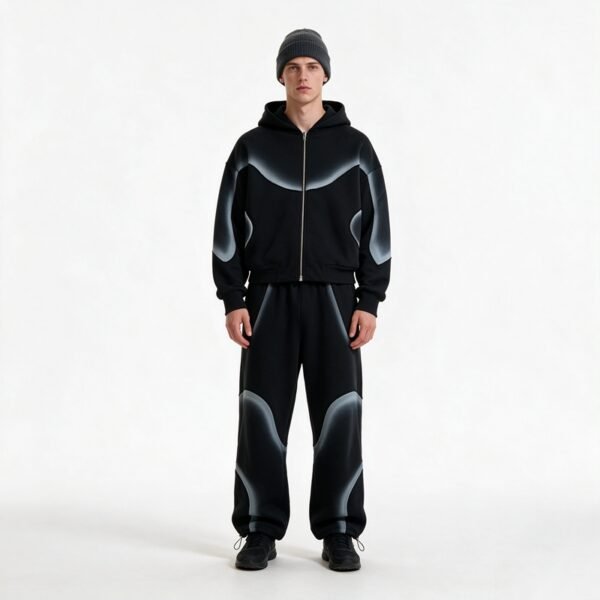
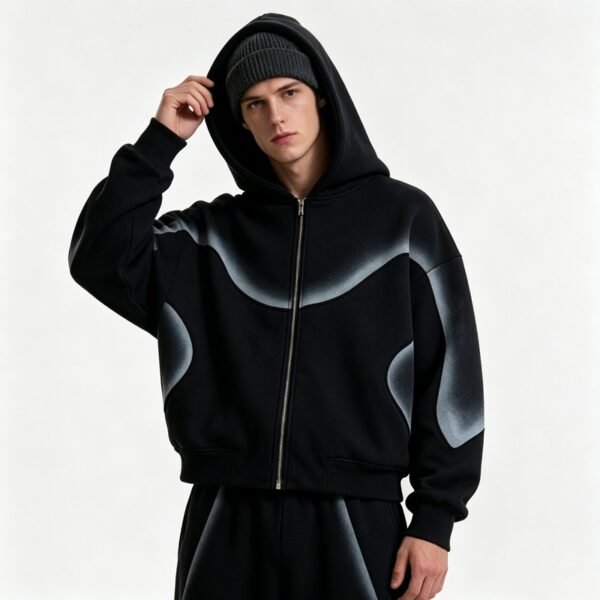
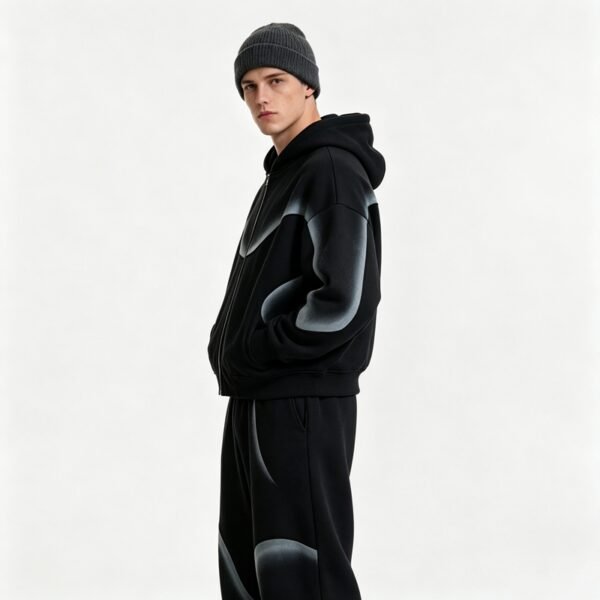
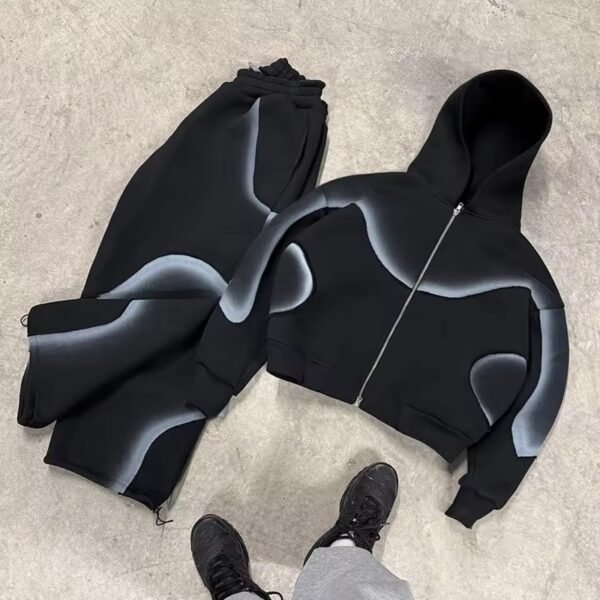


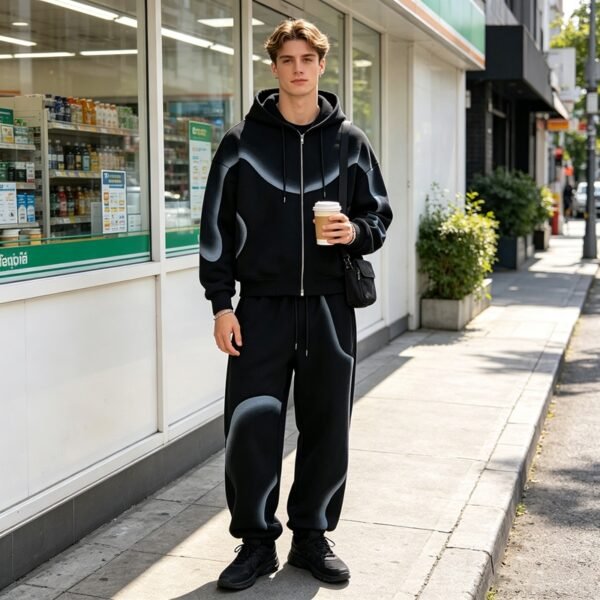
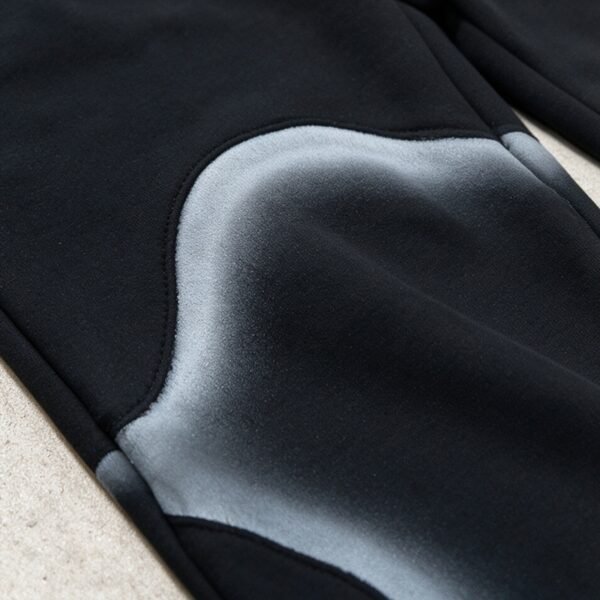





This coordinated hoodie and jogger set is developed around a practical presentation question: how should curved spray effects remain readable when the outfit is folded, packed, and later displayed? VeeWen can engineer placement, sequencing, and approval checkpoints around that retail moment.
The Presentation Problem Begins With the Fold
A matching set can lose its strongest visual idea when folded separately. Here, the grey-blue arcs are distributed across the chest, sleeves, and knees, so folding order determines whether buyers see a coherent system or disconnected marks.
The black base increases contrast, but contrast alone cannot guarantee recognition after packing. A folded hoodie may hide the chest curve while trouser panels remain visible, making pack orientation, tissue placement, and image-led presentation important development decisions.
Curved Dye Placement Requires Sequencing
The main image shows broad, softened fields rather than small isolated graphics. That suggests the placement should be mapped against body panels, seam lines, and fold breaks before dye work begins, especially where sleeves and knees bend away from the front view.
For production approval, VeeWen should separate artwork placement approval from wash and shade approval. The buyer can then judge whether the arcs align visually across sizes without treating natural spray variation as an unexplained construction defect.
Set-Level Continuity Changes the Pack Standard
The hoodie and jogger do not merely share a color; they repeat a curved visual language at different scales. The hoodie carries the strongest upper-body statement, while the joggers echo it around both knees, requiring paired inspection rather than isolated garment review.
A practical packaging standard may specify which side faces outward, how the hood is nested, and whether both trouser legs remain visible. This preserves the intended outfit story while acknowledging that compact folding necessarily conceals some surface area.
VeeWen Workflow: Approve the Retail Moment
VeeWen's product-development workflow should begin with a fold map showing the packed hoodie and jogger positions, followed by a placement sample photographed both open and folded. That evidence directly tests the assigned packaging-versus-presentation axis before bulk cutting is approved.
The buyer checkpoint is not simply approval of a beautiful open image. It is approval of the packed view, unfolded recovery, paired color relationship, and size continuity, with any acceptable spray variation recorded in the final technical comments.
Construction Supports Controlled Presentation
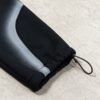
The image identifies a full center zipper, hood, ribbed cuffs, compact hem, drawcord waist, and adjustable trouser ankles. These features help the set hold a stable shape during display, but their final dimensions and attachment specifications require technical confirmation.
Because the dye fields approach edges and articulated areas, trim placement should be reviewed alongside artwork. The team should confirm whether cuffs, drawcords, zipper tape, and hem channels remain clean enough to frame the intended curves after finishing.
Trade-Offs and Buyer Approval
A highly legible folded presentation may require larger exposed panels or a less compact pack, while a tighter package improves handling but hides more of the dye story. The correct balance depends on the buyer's channel, fixture, and photography requirements.
Approve this concept when the fold map supports the desired first impression without forcing the garment into an unstable package. Final sign-off should cover placement tolerances, shade range, folding orientation, and paired-set appearance across confirmed sizes.
Buyer Questions
What is verified from the supplied image?
The image verifies a black matching hoodie and jogger set, grey-blue curved surface effects, a full zipper, hood, ribbed cuffs, drawcords, and adjustable ankles.
Why does folding affect this set's development?
Folding can conceal the chest, sleeve, or knee arcs, changing the first impression. Pack orientation therefore influences whether the coordinated spray language remains visible to buyers.
Can VeeWen develop different dye layouts?
VeeWen can review revised placement maps during development, subject to technical feasibility and approval. Any requested layout should be assessed open, folded, and across size variations.
What order quantity should buyers plan for?
The commercial minimum for this style is MOQ: 100 pieces per style. Final material, trim, placement, and packaging approvals should precede production planning.
Approve the Fold Before Production
Send your target retail format, size range, and placement references to VeeWen. We will frame the fold map, sample review, and approval checkpoints around your required presentation.


Reviews
There are no reviews yet.