

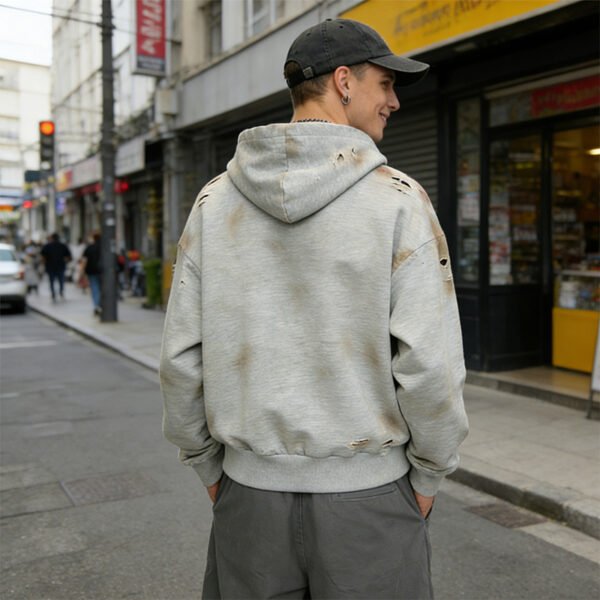
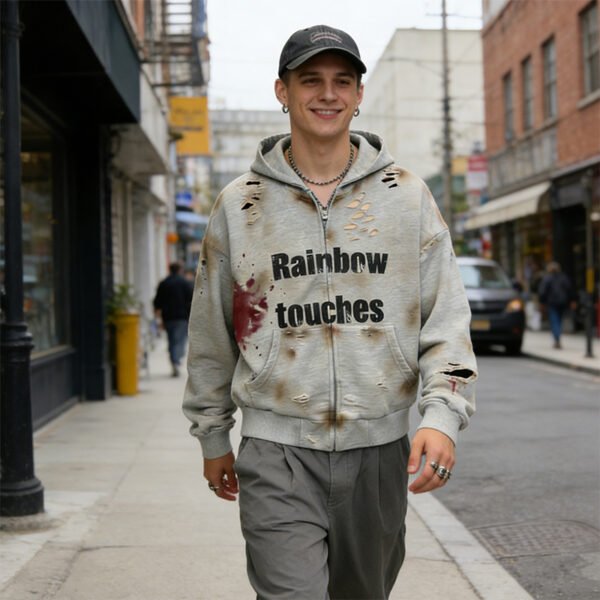







This custom distressed hooded zip sweatshirt is developed around drawcord, eyelet, and channel reinforcement, using the visible hood, metal-look eyelets, exposed zipper, ribbed hem, and controlled distressing as approval checkpoints. The construction brief balances expressive surface treatment with repeatable stress management for wholesale streetwear production.
Reinforcing the Hood Stress Map
A hood drawcord creates repeated pulling force at its exits, while eyelets concentrate load around small openings. Reinforcement should distribute that force through an internal channel, stable seam allowance, and suitable backing without making the hood visibly rigid or flattening its drape.
The supplied image shows the hood sitting over a full front zipper, with eyelet-like details positioned near the neckline. That relationship matters because opening the zipper changes tension across the hood; sampling should verify cord travel, eyelet security, and balanced hood symmetry together.
Separating Damage from Function
Distressing is visible on the shoulders, sleeves, chest, and lower front, but the hood channel and zipper remain functional zones. Keeping abrasion away from critical stitch paths helps prevent decorative damage from becoming premature failure during wear, laundering, packing, or repeated try-on.
The approval brief should define a distress boundary around eyelets, drawcord exits, zipper tape, pocket openings, cuffs, and hem. These boundaries allow the visual team to retain irregularity while production controls placement, penetration depth, and distance from load-bearing construction.
Managing Eyelet and Channel Interaction
Eyelets should be assessed as a system rather than isolated accessories. Their inner diameter, washer coverage, backing, and setting pressure influence cord friction and local fabric distortion, especially when the hood is opened, tightened, or pulled over the head repeatedly.
For this silhouette, the channel should guide the cord cleanly toward both exits without twisting beneath the visible hood edge. A development sample can confirm whether reinforcement remains concealed, whether the cord bunches, and whether the distressed finish exposes hidden support materials.
Preserving Graphic Placement
The front image places large black typography across the chest, alongside red splatter-like marks and scattered abrasions. Because the zipper divides the front, artwork must be positioned with closure alignment in mind so the message remains balanced when the garment is worn open or closed.
Screen-print appearance and distress should be approved together because abrasion can soften edges, interrupt coverage, or expose contrasting base fabric. VeeWen development can separate artwork placement approval from wash and damage approval, then combine them in a controlled final prototype.
VeeWen Development Checkpoint
VeeWen should begin with a construction sheet marking drawcord exits, eyelet locations, channel width, zipper alignment, pocket openings, and protected stitch zones. The first prototype then tests functional reinforcement before the decorative distress package is finalized across the garment.
After fit review, the development team can compare the intended damage map against actual seam behavior and surface response. The buyer checkpoint is a signed sample confirming cord movement, eyelet retention, zipper operation, graphic alignment, and acceptable variation in distressed areas.
Wholesale Approval and Trade-Offs
More reinforcement can improve durability but may increase stiffness, visible bulk, or cost at the hood edge. A lighter internal support may preserve softness while offering less resistance to aggressive pulling, so the choice should reflect the intended wear profile and retail positioning.
The commercial decision is not simply whether the garment looks distressed. Approve the balance between expressive irregularity, comfortable hood movement, dependable closure operation, and repeatable factory execution, with MOQ: 100 pieces per style for the approved specification.
Buyer Questions
What should be approved first on this sweatshirt?
Approve the hood reinforcement map, eyelet setting, drawcord movement, zipper alignment, and protected distress boundaries before finalizing artwork and wash treatment.
Can the distressed appearance vary between pieces?
Some variation may be inherent to controlled abrasion and splatter placement; define acceptable zones, intensity limits, and reference samples before bulk production approval.
Is the fabric composition verified?
No. The supplied evidence identifies a sweatshirt garment visually, but fiber composition, GSM, shrinkage, and recovery require confirmation through the selected material specification.
What is the minimum order quantity?
MOQ: 100 pieces per style. Final feasibility depends on the approved construction, material, artwork, finish, sizing, and production documentation.
Approve the Reinforcement and Distress Map
Send your target measurements, artwork, color references, and finish expectations to VeeWen for a construction-focused development review and sample approval plan for this hooded zip sweatshirt.


Reviews
There are no reviews yet.