

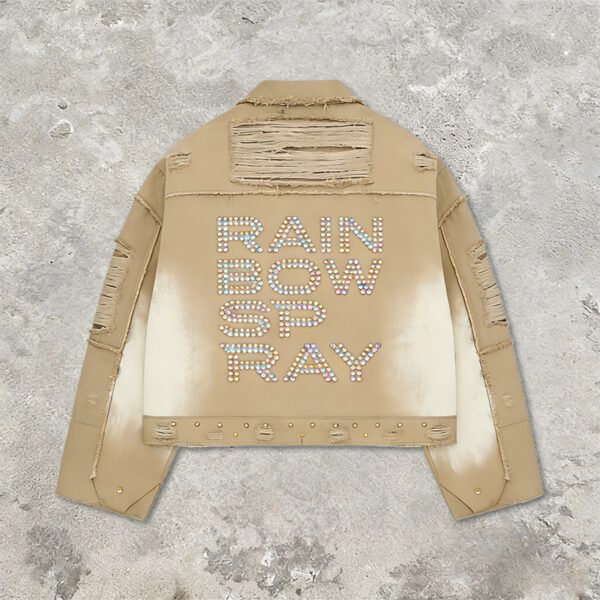


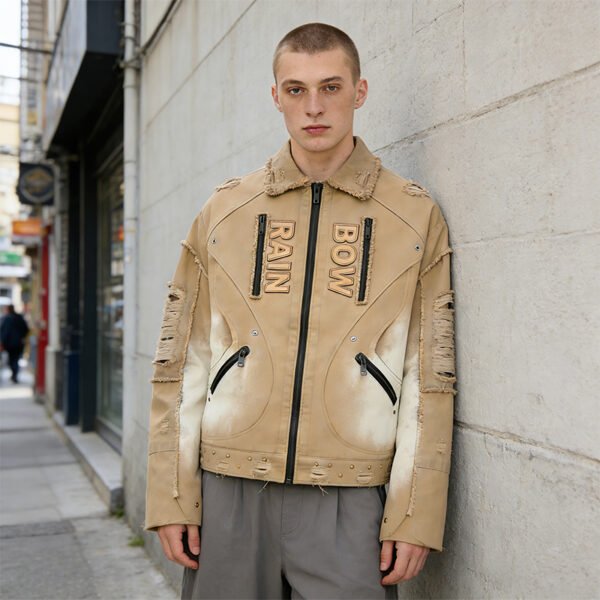
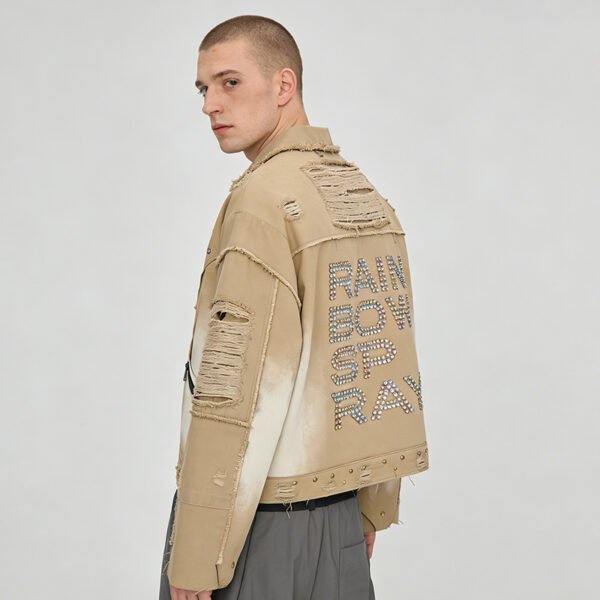


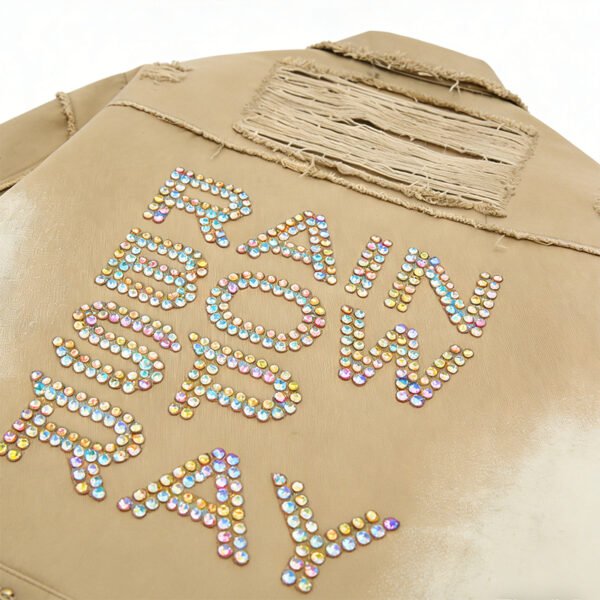

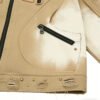


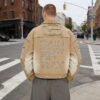


This jacket concept turns workwear structure into a visibly treated private-label statement. Its sand body, cream overspray, black zip pocket, metal rivets, and frayed hem create multiple alignment checkpoints, making side-seam spirality after laundering the central development decision for reliable repeat production.
Why Spirality Matters on a Treated Workwear Body
A side seam normally reads as a quiet vertical boundary, but this jacket places it beside curved pocket stitching, spray transitions, and a distressed lower edge. After laundering, even modest rotation can make those features appear uneven, weakening the intended workwear geometry.
The risk is visual rather than purely dimensional. When a jacket twists, the pocket opening can turn away from the body, the zipper line may look skewed, and the hem distress can drift from its approved position. The final sample therefore needs rotational review.
Reading the Supplied Jacket Evidence
The close-up shows sand-colored twill, a cream spray field, a black angled zip pocket, gold-toned rivets, and three different frayed openings along the hem. These details establish a design language built on controlled irregularity, not accidental imbalance or uncontrolled garment torque.
The visible seam lines remain deliberate around the pocket and lower panel, giving buyers useful reference points for approval. Development images should preserve those references after laundering so treatment variation remains intentional while the jacket body stays stable.
Balancing Distress With Seam Stability
Abrasion and fraying remove surface material at selected locations, while spray treatment changes perceived color density across adjoining panels. Together, they can hide or exaggerate construction movement, particularly where a rotating seam changes how light catches the treated twill surface.
A stable development route separates these decisions. First establish seam behavior on an untreated or lightly treated sample, then layer spray placement and hem distress while comparing the same side-seam, pocket, and hem landmarks at every approval stage.
VeeWen Development Checkpoint
VeeWen can translate this concept through a focused development sequence: confirm the jacket block, map the side-seam reference, define laundering conditions, and document pocket and hem landmarks before approving surface treatment. The workflow keeps the manufacturing axis connected to visible design evidence.
The buyer should receive a sample review centered on before-and-after photographs, measured seam rotation, pocket alignment, and hem balance. Any approved spray or distress variation should be recorded beside the seam-control decision, creating a practical reference for cutting, sewing, finishing, and inspection.
Trade-Offs Buyers Should Resolve
More pronounced distress creates stronger visual character but reduces the tolerance for seam movement and placement variation. A cleaner hem and lighter spray field simplify repeatability, yet they may deliver less of the worn workwear attitude shown in the supplied evidence.
The correct balance depends on the collection's tolerance for irregularity. Buyers should identify which details may vary naturally, such as spray density, and which must remain controlled, including side-seam direction, zipper placement, pocket shape, and overall hem level.
Approval Gate Before Bulk Cutting
The approval gate is a laundered, fully treated sample evaluated on a flat surface and worn body. Check whether each side seam remains visually vertical, whether the angled pocket sits symmetrically, and whether the distressed hem still supports the approved silhouette.
Record the accepted treatment map together with side-seam measurements and photographic landmarks. Bulk cutting should proceed only when the buyer accepts the trade-off between surface variation and geometric control, with MOQ: 100 pieces per style carried into the commercial brief.
Buyer Questions
Can the spray effect be customized?
Yes, the spray map can be developed as a placement reference, but density, color recipe, durability, and allowable variation require buyer approval.
What should the first sample prove?
The first treated sample should prove side-seam behavior after laundering, while confirming pocket alignment, hem balance, distress placement, and overall jacket proportions.
Is the frayed hem intended to be uniform?
The image shows varied distressed openings, so controlled variation may be appropriate; the buyer should define placement limits and acceptable edge irregularity.
What is the minimum order quantity?
The commercial minimum is MOQ: 100 pieces per style. Final development, material selection, and treatment approval should precede bulk production planning.
Approve the Laundering Control Brief
Send your target measurements, color references, treatment limits, and laundering expectations to VeeWen. We can structure the sample review around seam rotation, pocket alignment, hem balance, and the MOQ: 100 pieces per style requirement.



Reviews
There are no reviews yet.