

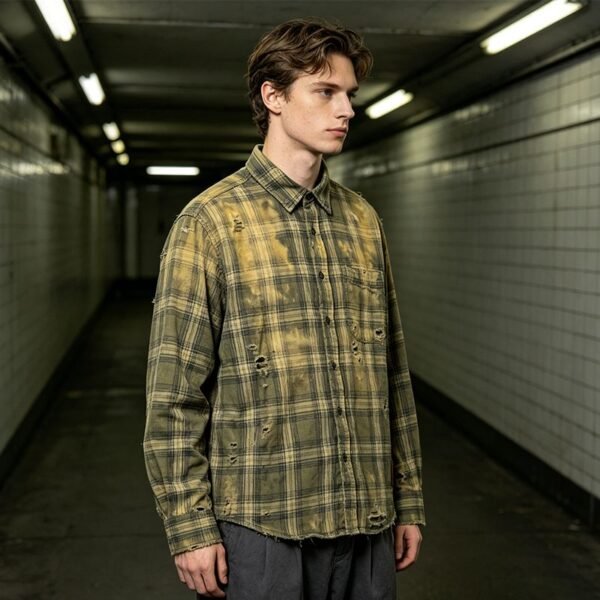


This custom distressed plaid overshirt turns a familiar workwear profile into a development exercise in fastening security. The visible abrasion pattern, frayed hem, and front closure require pull-resistance decisions that preserve character without allowing progressive failure during wear.
Why Distressing Changes Fastener Loads
A button or snap does not load only the closure tape; it pulls surrounding cloth through repeated dressing, movement, and laundering. When abrasion removes yarns nearby, the remaining structure carries more stress, making placement and reinforcement central to approval.
The supplied image shows openings across the front body and near the lower edge, while several dark closures run vertically down the placket. That combination suggests a need to separate visual distressing from primary fastening loads, especially around the chest and waist.
Placket and Reinforcement Decisions
VeeWen should first map each fastening position against the distressed artwork, then reserve intact cloth or concealed reinforcement behind the placket. The decision affects hand feel, visible authenticity, repairability, and whether the garment closes consistently after repeated handling.
If a softer appearance is required, reinforcement can remain localized rather than extending across the entire front. Buyers should approve the closure type, backing method, button or snap size, and acceptable pull threshold together, because each choice changes the stress path.
Evidence From the Overshirt Proportion
The long sleeves, roomy body, chest pocket, and dropped lower edge identify this piece as an overshirt rather than a close-fitting base layer. That proportion encourages layering and movement, increasing leverage on front fasteners when the wearer reaches or sits.
The visual evidence does not establish fiber percentage, fabric weight, or closure material. Those unknowns matter because thicker cloth may resist tearing while heavier hardware may increase local pull. Development should therefore preserve the silhouette while measuring the actual assembled components.
Distressing Without Sacrificing Closure Integrity
Distressing should be developed as a controlled placement system, not as unrestricted damage around every construction point. Keep tears, abrasions, and frayed effects outside the buttonhole, snap socket, and immediate reinforcement envelope unless the buyer deliberately wants a fragile vintage behavior.
A practical approval sample can show two nearby variants: one with distressing held away from the placket and another with tighter proximity. Comparing opening force, edge growth, and appearance after handling gives the buyer a clear commercial trade-off.
VeeWen Development Workflow Checkpoint
VeeWen can translate the supplied image into a fastening risk map during development: mark closure coordinates, distress boundaries, pocket intersections, and hem effects before pattern engineering. This turns the aesthetic reference into measurable construction instructions for the sample room.
At sample review, the buyer should inspect closure alignment, operate every button or snap, and examine backing from the reverse side. Record any movement, puckering, or yarn breakage before approving the graded pattern and production-ready distressing file.
Approval Criteria for Bulk Readiness
Bulk approval should depend on repeatable pull resistance at representative locations, including an intact placket position, a pocket-adjacent position, and the closest approved distressed area. The goal is not maximum stiffness; it is secure closure with the intended worn appearance.
The buyer should also confirm whether distressing is expected to remain visually stable after care. Once closure behavior, reinforcement visibility, distress boundaries, and measurement tolerances are accepted, the style can proceed under the stated minimum order.
Buyer Questions
Can this overshirt use snaps instead of buttons?
Yes, the closure can be developed either way, but the buyer must approve hardware appearance, backing construction, opening force, and pull resistance beside the distressing map.
Will distressing be identical on every garment?
That depends on the approved process. Buyers should define placement, size, and acceptable variation so the worn effect remains controlled without weakening closure zones.
What should the first sample prove?
The first sample should prove fit, closure alignment, reinforcement placement, distress boundaries, and handling behavior before the graded pattern and production artwork receive approval.
What is the minimum order quantity?
The commercial minimum is MOQ: 100 pieces per style. Final specifications, colorways, hardware, and approved construction details should be confirmed before production scheduling.
Approve the Fastening Risk Map
Send your target closure, distressing intensity, and size range to VeeWen for development review. We will align the fastening map, sample checkpoints, and MOQ: 100 pieces per style requirement.


Reviews
There are no reviews yet.