
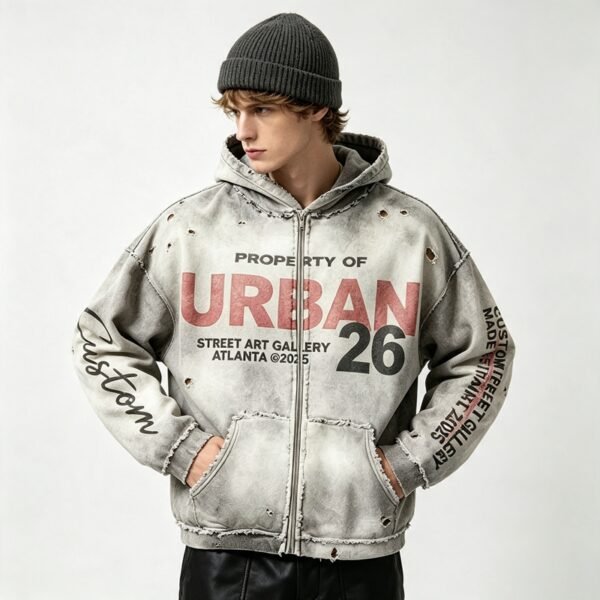
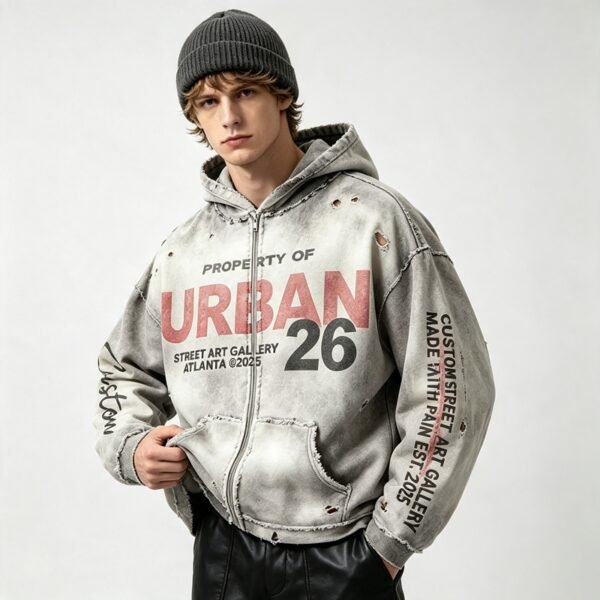

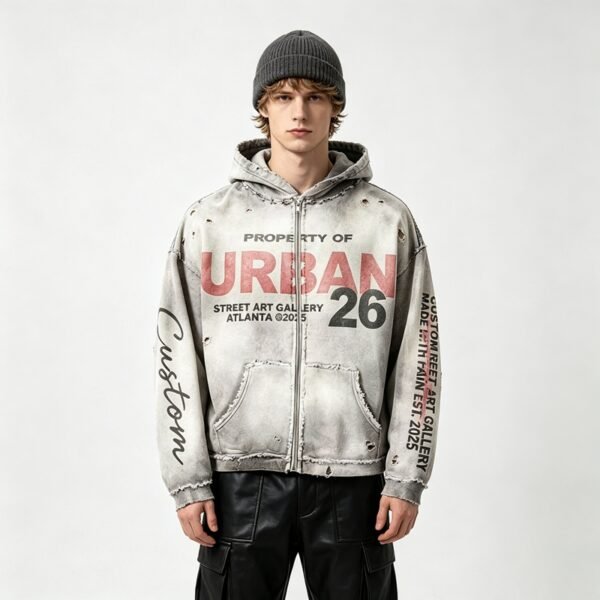
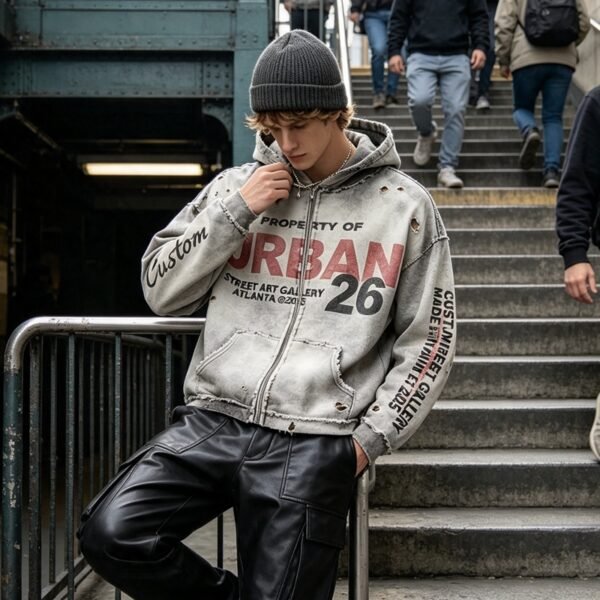


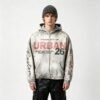



This hoodie is developed around a visible tension: the design needs saturated, readable graphics, while the washed fleece surface must retain its soft visual loft. VeeWen's development focus is controlled pressing, protective handling, and planned distress placement across a relaxed streetwear silhouette.
Why Pressing Method Controls the Graphic Result
DTG decoration depends on stable contact between garment and print platen. On a fleece hoodie, excessive compression can flatten the pile around the artwork, while insufficient contact can weaken coverage. The visible chest graphic therefore requires a pressure window matched to fabric loft.
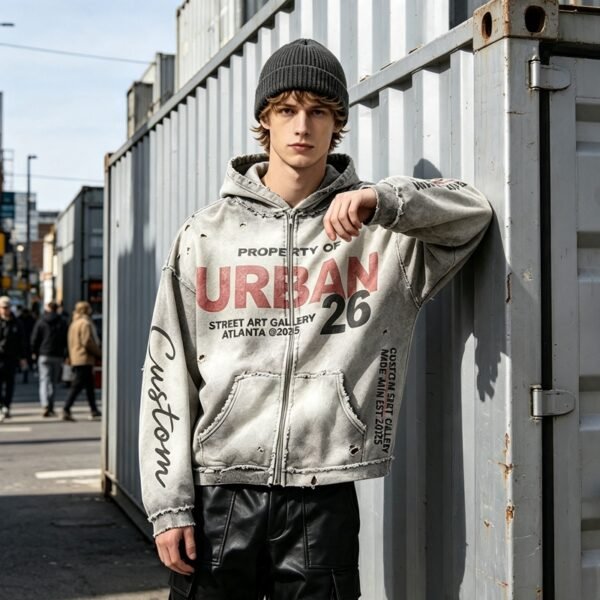
The front lettering uses broad color blocks, fine secondary text, and dark numerals, creating different coverage demands within one print. Sleeve graphics add alignment risk because curved arms shift under pressure. Development should separate body and sleeve settings before approval.
Protecting Pile Through Garment Preparation
The washed ground already carries tonal irregularity, so the production objective is not uniform smoothness. It is to keep the pile visually consistent around printed zones while preserving the intentionally aged appearance. Platen protection, lint control, and careful loading become part of the decoration specification.
A controlled support layer can reduce direct compression where appropriate, but its effect must be checked against print registration and curing requirements. The approval sample should compare printed and unprinted fleece under the same lighting, revealing whether pressure has created unwanted shiny or flattened areas.
Distress Placement Must Follow Construction
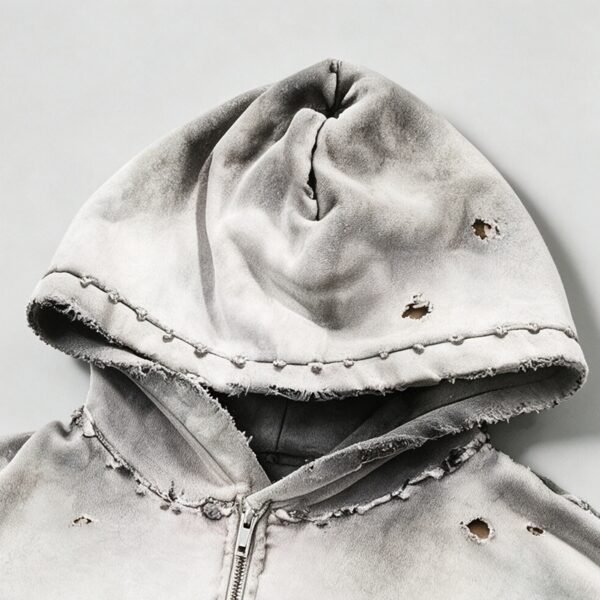
The image shows openings near the shoulder, chest, sleeves, cuffs, pocket, and lower body rather than one isolated distressed panel. That distribution changes seam stress and handling. Each opening should be mapped against stitch lines, pocket edges, closure components, and areas receiving repeated hand contact.
Raw-looking edges can be visually effective, yet uncontrolled cuts may spread during wash or weaken nearby seams. VeeWen's pattern review should convert the visual reference into a distress map with location, approximate scale, edge treatment, and acceptable variation for bulk garments.
Graphic Scale Across Body and Sleeves
The chest artwork is the primary recognition point, while the sleeve graphics create movement when the garment is worn. Their relationship should be checked on a full-size pattern, because a placement that looks balanced on a flat image can shift when the hood, shoulder, or sleeve rotates.
For development, artwork files should be separated by panel and marked from approved pattern notches. This allows pressing templates to respect seam allowances and sleeve curvature. It also makes later colorway changes easier without changing the established placement logic.
VeeWen Workflow for Pressure-Sensitive Decoration
VeeWen can translate this axis into a staged approval sequence: confirm the fleece source, map distress locations, prepare body and sleeve print files, then produce a decoration strike-off using the intended loading method. The checkpoint is graphic clarity alongside preserved pile appearance, not print brightness alone.
After the strike-off, the buyer should inspect the garment flat and worn, then review the treated areas after the agreed care simulation. Any changes to pressure, support, ink coverage, or distress scale should be recorded before the size-set sample proceeds.
Buyer Approval Checkpoint
The commercial decision is whether the washed texture, distressed openings, and printed message read as one controlled design. Buyers should approve the balance of tonal variation against graphic legibility, especially where muted inks meet the pale ground and where sleeve artwork approaches seams.
Before confirming bulk, request sign-off on the decorated front, both sleeves, cuff and pocket distress, and the care-label treatment. The final approval should identify acceptable variation ranges, because a distressed program cannot be judged by identical placement alone.
Buyer Questions
Can the distressed locations be changed for a private-label collection?
Yes, locations can be mapped to your artwork and pattern, but each change should be reviewed for seam proximity, stress concentration, and acceptable edge development.
Why does DTG pressure matter on this hoodie?
Pressure controls contact and compression during printing. Too much may flatten fleece visually, while too little may reduce coverage or registration, requiring strike-off testing.
Can the sleeve artwork use a separate pressing setup?
It should be evaluated separately because sleeve curvature and movement differ from the body. A dedicated loading method can improve alignment and reduce unintended pressure marks.
What must be approved before the 100-piece minimum?
Approve fabric reference, artwork scale, print appearance, distress map, pile protection method, measurements, labels, and acceptable variation before confirming MOQ: 100 pieces per style.
Approve the Distressed Graphic Development Route
Send your artwork, target fleece reference, color direction, and distress map to VeeWen for a focused strike-off review before confirming MOQ: 100 pieces per style.


Reviews
There are no reviews yet.