


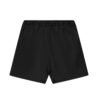


This short is developed around a practical tension: a softer surface improves first wear comfort, while relaxed proportions can lose definition after laundering. The visible elastic waistband, centered drawcord, clean side seams, and broad hems create measurable checkpoints for preserving shape without sacrificing ease.
Softness Must Be Separated From Structural Recovery
The main image presents a smooth, low-contrast off-white surface that supports a soft-touch direction. That finish may improve comfort, yet excessive brushing, softener, or wash action can reduce body. Development should therefore assess softness beside fabric rebound and seam stability.
A relaxed short depends on controlled ease rather than rigid structure. If the fabric softens unevenly, the leg opening may spread and the waistband may feel less secure. The target is a supple hand that still returns consistently after movement and laundering.
Waistband Engineering Controls Wearability
The gathered waistband visibly spans the garment, indicating elastic is central to fit rather than decorative. Elastic width, insertion tension, and casing allowance should be reviewed together because softness at the body cannot compensate for a waistband that rolls, twists, or stretches permanently.
The centered drawcord adds adjustment and gives the wearer a second control point. Its exit placement, reinforcement, and finished length should be standardized across sizes. A soft garment can remain commercially dependable when the waist system is tested as one coordinated assembly.
Hems Preserve the Relaxed Outline
The broad lower hems form a clean, slightly angled outline in the supplied image. Their appearance depends on balanced stitch tension and stable fabric behavior. A finish that feels pleasant but curls, ripples, or torque-shifts after washing would undermine the intended casual proportion.
Hem depth should be approved with the actual softened fabric, not a laboratory substitute. The development sample should examine side-to-side consistency, turnback behavior, and visual balance between leg opening and inseam. These checks protect simplicity, which leaves construction irregularities especially visible.
Color and Finish Need Joint Approval
The garment appears off-white rather than stark optical white, making shade control part of the product argument. Softening or washing can alter brightness and surface reflectance. Lab dips, hand-feel swatches, and finished-body references should be reviewed together before bulk color approval.
A pale shade also magnifies handling marks, seam impressions, and uneven finishing. VeeWen's development workflow should place shade, wash recipe, and pressing standard on the same approval sheet. This links the desired softness to the exact visual cleanliness required by the collection.
VeeWen Workflow Turns the Trade-Off Into Gates
VeeWen should begin by translating the relaxed image proportions into a measurement spec, then pair that spec with a hand-feel reference and recovery requirements. The first sample should record waistband extension, leg-opening measurement, and surface change after the agreed laundering method.
At the fit-review stage, buyers should compare multiple sizes rather than judging one sample alone. VeeWen can then adjust grading, elastic tension, seam allowance, or finishing intensity before confirming the production pattern. Each adjustment should preserve the same softness-to-shape balance across the size set.
Approve Against a Post-Wash Decision Standard
The key approval question is not whether the sample feels soft on arrival. It is whether the garment retains a credible waist, even hems, and balanced legs after realistic care. A controlled comparison makes comfort and shape retention visible as separate commercial decisions.
Buyers should sign off only when the approved sample meets the intended hand feel without excessive growth, shrinkage, or distortion. If softness wins at the expense of outline, revise the finish or construction before artwork, labeling, and production release proceed.
Buyer Questions
Is the fabric confirmed as 100% cotton?
The supplied source wording states 100% cotton, but VeeWen should verify composition, fabric weight, and applicable test documentation before final specification approval.
How should softness be evaluated?
Review hand feel beside waistband recovery, hem stability, dimensional change, and surface appearance after an agreed laundering protocol using the approved development fabric.
Can the drawcord construction be customized?
Yes, buyers can review cord material, diameter, tip finish, exit spacing, and length while preserving secure adjustment and consistent placement across graded sizes.
What is the commercial minimum?
The exact commercial minimum is MOQ: 100 pieces per style, subject to final confirmation of approved specifications, color requirements, labeling, and production scope.
Approve the Softness-to-Shape Benchmark
Send your target hand feel, size range, color reference, and care expectations to begin a sample review focused on recovery, hem stability, and the final relaxed silhouette.


Reviews
There are no reviews yet.