

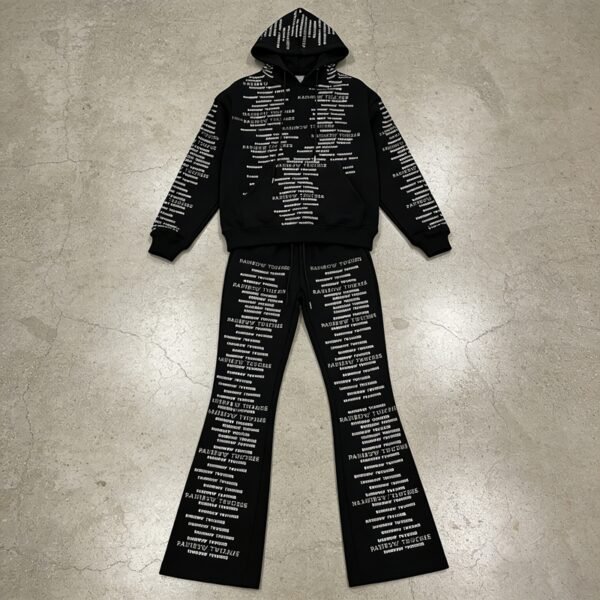











This coordinated hoodie and flare-pant set turns dense text embellishment into a controlled development problem: pressing can flatten or mark the raised surface. VeeWen can develop the set around protected application zones, calibrated heat, and staged inspection, preserving readable graphics while keeping the relaxed streetwear silhouette commercially consistent.
Why Pressing Controls Surface Definition
The supplied image presents repeated light text over a black hoodie and pant base, creating many decorated contact points. During fusing, pressing, folding, or packing, concentrated force can compress raised elements and reduce the crisp contrast buyers expect.
The production question is therefore not simply whether decoration adheres, but how the garment travels through each heat and pressure event. A controlled sequence should separate decorated faces, limit dwell time, and verify legibility after pressing and recovery.
Reading the Product Evidence
The source wording identifies embroidered rhinestone text, while the image shows a dense graphic treatment extending across the torso, sleeves, waistband area, and legs. This distribution makes the design visually distinctive but increases the number of zones requiring handling discipline.
The hoodie and flare pants are presented as one coordinated statement, not isolated separates. Matching placement logic, scale, and contrast across both pieces will determine whether the set looks intentional after assembly, washing evaluation, folding, and final presentation.
Decoration Zones and Handling Risk
Broad decorated panels create potential pressure conflicts at shoulder seams, cuffs, seat areas, knees, and folded leg sections. The flared lower silhouette also requires careful lay planning so graphics remain aligned without forcing embellished fabric into sharp compression points.
Development should map decoration boundaries against pattern pieces before approving production markers. Any areas that must remain clear for seams, labels, drawcords, or machine handling should be documented, because late placement changes can disturb both appearance and sewing efficiency.
Trade-Offs in the Protected Process
Lower pressure and shorter heat exposure can protect surface height, yet insufficient energy may weaken adhesion or create inconsistent attachment. Higher settings can improve bonding while increasing the chance of flattening, glossing, or imprinting the surrounding fabric.
The correct balance depends on the final decoration substrate, backing, fabric construction, and equipment settings, none of which are fully verified here. Buyers should compare appearance, attachment, flexibility, and post-process recovery on representative panels before selecting the production route.
VeeWen Development Checkpoint
VeeWen's workflow should begin by converting the supplied visual into a placement map covering the hoodie and flare pants separately. Pattern review can identify pressure-sensitive regions, while a decoration test establishes workable handling instructions before a complete sample is judged.
The approval checkpoint is a side-by-side review of the decorated sample before and after the planned pressing and packing sequence. Buyers should confirm text readability, surface hand, seam compatibility, and silhouette balance, then lock the approved process in the technical package.
Bulk Approval and Assortment Control
For the stated MOQ: 100 pieces per style, consistency matters across a meaningful production run. The set needs repeatable placement references, protected folding instructions, and an inspection focus on lifted, flattened, displaced, or visually uneven text elements.
Approve bulk only after the final sample demonstrates acceptable decoration definition on both garments and the handling method is documented. Also confirm composition, GSM, decoration materials, care requirements, and color tolerances, because these remain open technical inputs in the supplied evidence.
Buyer Questions
Is the fabric definitely heavyweight cotton?
Heavyweight cotton is stated in the supplied source wording, but exact fiber composition, GSM, blend ratio, and internal pile construction remain To Confirm during development.
Why does this set need a pressing protocol?
Raised or embellished text can flatten, gloss, shift, or imprint under heat and pressure, especially when decorated panels overlap during fusing, folding, packing, or inspection.
Can the text placement be changed?
Placement can be developed through artwork and pattern mapping, subject to seam clearance, machine handling, decoration limitations, approved sample evidence, and final technical confirmation.
What is the minimum order quantity?
The commercial minimum is MOQ: 100 pieces per style. Final quantities should follow the approved decoration method, garment specifications, color assortment, and production documentation.
Approve the Protected Decoration Test
Send the target artwork, size range, color requirements, and intended decoration details. VeeWen can prepare a mapped development review around pressing protection before bulk approval.

Reviews
There are no reviews yet.