


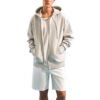
This custom full-zip hoodie is developed around print placement that remains intentional across a complete size range. The supplied image shows a clean grey base, centered zipper, divided kangaroo pocket, drawcord hood and ribbed openings, creating measurable landmarks for artwork approval.
Why the Print Map Matters
A graphic that looks centered on a medium can drift visually on larger or smaller bodies. The zipper provides a permanent vertical reference, while the pocket seam, hem and cuff lines create repeatable horizontal checkpoints for controlled placement.
The practical objective is not identical measurements on every size. It is consistent visual balance after grading, allowing artwork to scale, shift or crop deliberately without colliding with openings, seam allowances, drawcords or rib structures.
Reading the Supplied Garment
The supplied image shows an unprinted heather-grey full-zip hoodie with a centered front zipper and two-sided kangaroo pocket. Those details make the garment suitable for a placement study before any decoration method or artwork scale is approved.
The hood opening includes paired drawcord exits, and the sleeves finish with ribbed cuffs. These visible features establish additional exclusion zones, especially when artwork extends toward the upper chest, sleeve crown or lower front panel.
Artwork Scaling and Risk
Print dimensions should be evaluated against the body panel available after zipper separation and pocket construction. A fixed-width chest mark may feel undersized on larger grades, while proportional enlargement can approach the zipper or pocket opening too quickly.
Trade-offs should be made deliberately. A single print size simplifies production control, whereas graded artwork improves proportion but adds approval points. Oversized graphics can create stronger impact, yet require closer review around seams, openings and garment movement.
VeeWen Development Checkpoint
VeeWen can translate the approved base block into a print-placement worksheet that records artwork width, vertical drop, zipper clearance, pocket relationship and size-specific adjustments. This turns visual intent into measurable instructions for sampling and later production review.
The workflow checkpoint is a graded sample review, not merely a single-size approval. Buyers should inspect the smallest, midpoint and largest planned sizes, confirming that artwork remains balanced, printable and commercially legible before releasing the style.
Decoration and Construction Coordination
Decoration cannot be separated from garment construction on a zip hoodie. The zipper tape, pocket seams and ribbed boundaries may affect print access, registration and perceived alignment, so artwork files should be reviewed alongside the cut-and-sew pattern.
The final method remains To Confirm because the supplied evidence shows no decoration. Buyers should define print locations, artwork tolerances and acceptable seam proximity after the target fabric, color, hand feel and production decoration process are selected.
Approval Standard for the Range
A useful approval standard combines measurement and appearance. Record the artwork's distance from the zipper, pocket edge, shoulder reference and hem on each reviewed size, then assess whether the composition still reads as intended when worn.
Approve the style when the base fit, garment landmarks and graded artwork behavior agree. If any size looks crowded, underweighted or visually off-center, revise the map before confirming bulk specifications, labels, packaging and the MOQ: 100 pieces per style.
Buyer Questions
Is the hoodie composition verified as 100% cotton?
No. The source wording mentions cotton, but the supplied evidence does not verify composition. VeeWen should confirm fiber content, fabric weight and finishing requirements during development.
Can artwork be placed over the zipper?
That depends on the approved decoration process and artwork intent. The zipper creates a visual break, so buyers should review split, clearance or alternative placement options.
Which sizes should receive print-placement approval?
Review at least the smallest, midpoint and largest planned sizes, then confirm intervening grades through the approved placement worksheet and production tolerances before bulk authorization.
What is the commercial minimum for this style?
The exact commercial minimum is MOQ: 100 pieces per style. Final order acceptance remains subject to approved materials, construction, decoration specifications and production confirmation.
Approve the Graded Print Map
Send the target size range, artwork files and preferred decoration direction to begin a measurable placement review. VeeWen can then align the hoodie block, print map, sample checkpoints and MOQ: 100 pieces per style.



Reviews
There are no reviews yet.