
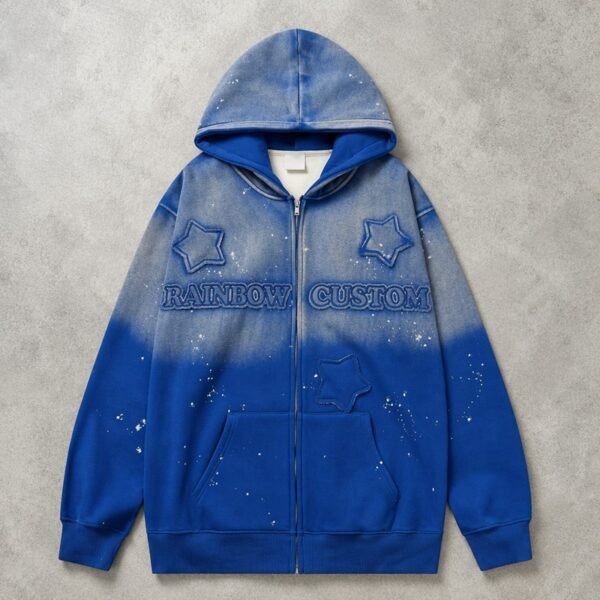
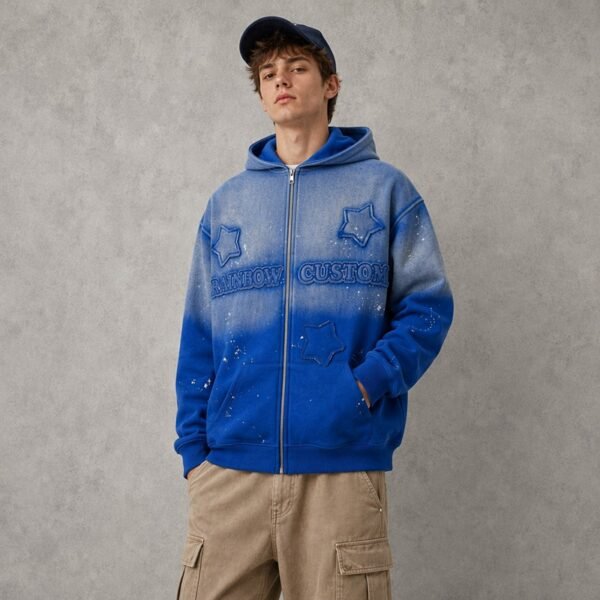



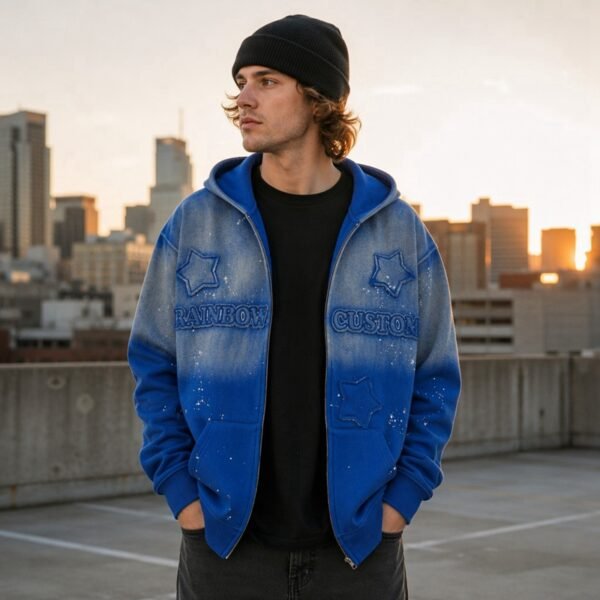








Developed around mobility through a decorated front-opening construction, this gradient washed zip hoodie places dimensional stars across a changing blue surface. The key decision is balancing armhole, sleeve, pocket, and zipper movement so the applique remains stable without losing the relaxed daily-wear proportion shown in the image.
Mobility Starts at the Armhole
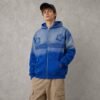
The image shows a front-opening hoodie with sleeves falling cleanly from the shoulder and a visible hood attached at the neckline. A relaxed appearance still needs controlled armhole depth and sleeve rotation, allowing the wearer to reach without pulling the zipper or distorting chest appliques.
VeeWen's development review should assess the armhole, bicep, elbow, and cuff as one movement system. If the buyer wants a fuller streetwear fit, added ease can improve mobility, but excessive volume may make the stars shift or cause the sleeve to collapse unevenly.
Front Decoration Must Clear the Zipper
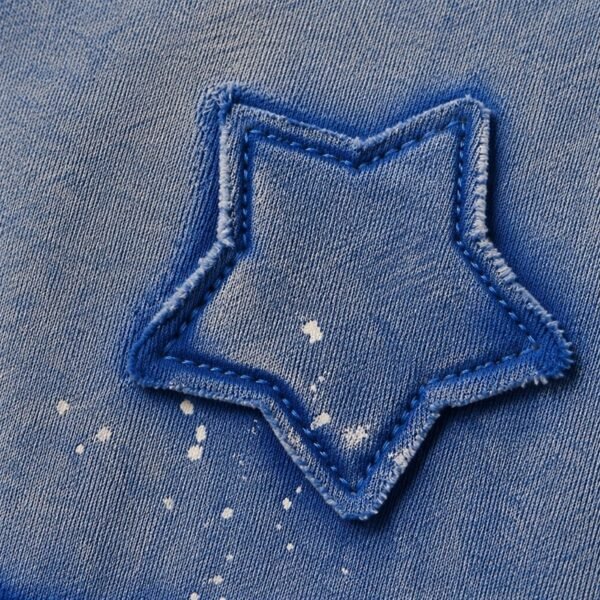
Several raised star shapes sit near the center front, alongside large tonal lettering and a vertical zipper. These elements compete for limited space, so the artwork must preserve a clean zipper path and avoid bulky intersections that can create pressure, drag, or uneven closure.
The buyer should approve minimum distances from the zipper teeth, seam allowances, pocket opening, and hem rib. Larger appliques create stronger impact, while smaller or flatter versions reduce interference risk and maintain a smoother front when the garment is opened or layered.
The Gradient Alters Perceived Balance
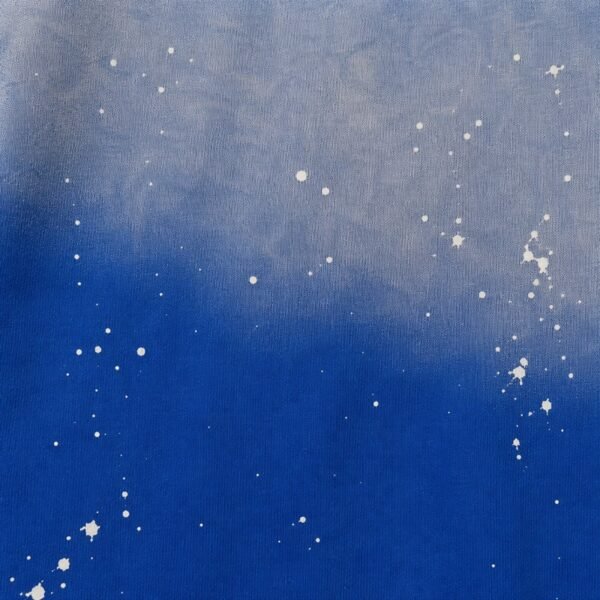
The supplied image moves from a pale blue upper field into a saturated blue lower body, with scattered light marks across the surface. This gradient makes the lower half visually heavier, so applique scale and placement must support balance rather than crowd the strongest color zone.
A development sample should be reviewed zipped and open, because the center front changes when the garment separates. VeeWen can map the wash transition against the pattern and adjust decoration placement so the stars remain legible without concentrating weight around one panel.
Pocket Junctions Need Ease and Stability
The kangaroo pocket occupies the lower front while the zipper divides the garment vertically. Hand entry, pocket loading, and body movement can pull against the surrounding decoration, particularly where the lower stars approach pocket edges or the gradient becomes darkest.
The pattern checkpoint should confirm pocket opening angle, bag depth, zipper clearance, and lower-front ease together. A gusset or carefully controlled seam allowance may improve access, but any mobility addition must be tested for visual disruption across the gradient and applique arrangement.
VeeWen Workflow: Test Movement in Sequence
For this design, VeeWen's product-development workflow should begin with a mobility sketch over the front pattern, marking armhole ease, sleeve articulation, zipper clearance, pocket access, and applique boundaries. This connects the manufacturing axis directly to the visual layout before decoration is committed.
The assembled sample should then receive the planned wash and decoration before movement evaluation. The buyer checks reaching, opening, pocket use, and seated comfort after finishing, because wash contraction or surface change can alter ease and tension at key junctions.
Buyer Approval Checkpoint
Approve the intended fit block, armhole allowance, sleeve shape, zipper path, pocket geometry, and star clearances on a fully assembled sample. Confirm the gradient placement and decoration scale in both closed and open positions before grading the style.
The decision is whether mobility should come from added ease, a shaped sleeve, or a localized gusset. Each solution changes silhouette and cost exposure differently, so the preferred mechanism should be documented before VeeWen prepares final production references.
Buyer Questions
Why is mobility the main development concern?
The design combines a front zipper, raised stars, sleeves, pockets, and a gradient wash. Movement allowances must prevent pulling, distortion, and decoration interference during normal wear.
Would a gusset be necessary for this hoodie?
Not automatically. First evaluate armhole depth, sleeve articulation, and pocket access. A gusset may help targeted mobility, but it should be approved only after reviewing silhouette and decoration effects.
How should the gradient be matched across panels?
Define the wash transition against the graded pattern, then inspect assembled samples zipped and open. Confirm acceptable shade movement because exact transitions may vary through finishing and panel orientation.
What is the minimum production quantity?
The commercial minimum is MOQ: 100 pieces per style. Confirm color, size, decoration, wash, packaging, and development requirements during the quotation and technical approval process.
Approve Mobility Before Decoration Lock
Share the target fit, gradient reference, applique dimensions, and zipper preferences with VeeWen. We will review movement, clearance, wash placement, and final decoration together at MOQ: 100 pieces per style.


Reviews
There are no reviews yet.