


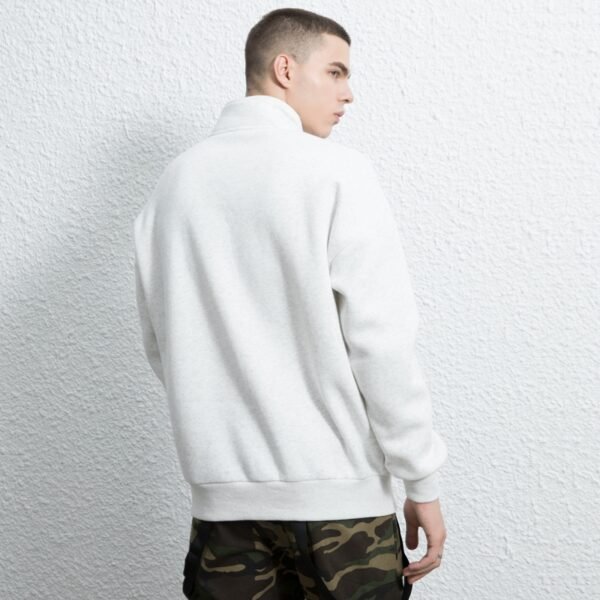


This half-zip hoodie is defined by how its centered chest print meets the stand collar, zipper, shoulder lines, cuffs, and hem. VeeWen can develop those relationships as one alignment system, helping buyers approve a front panel that remains composed across sizes and production variations.
The Front Panel Sets the Visual Grid
The supplied image presents a bright white hoodie with a dark chest graphic placed near the visual center. That placement is read against the collar opening, zipper line, shoulder slope, and lower hem, so the front panel needs a controlled alignment grid.
VeeWen can translate the graphic into a technical placement sheet that identifies center front, vertical drop, width, and seam clearances. Buyers should approve those landmarks together rather than evaluating the print as an isolated decoration on a flat sketch.
The Half-Zip Adds Alignment Landmarks
A half-zip closure introduces a strong centerline that continues upward into the stand collar. If the zipper tape, collar seam, or front panels shift, a centered print may appear offset even when its artwork dimensions remain unchanged.
During development, VeeWen can review zipper position, collar construction, front panel balance, and print placement in the same sample. This sequence exposes alignment conflicts early, especially where the graphic approaches the collar or where fabric folds around the opening.
Print Scale Must Respect Seam Movement
The dark lettering shown across the chest occupies enough width to interact with natural folds and front-panel tension. Oversized artwork may distort near the zipper or shoulder area, while undersized artwork can lose presence against the broad white body.
A development sample should test the artwork at actual scale on the intended panel shape, not only on a rectangular print file. Buyers can then confirm visual weight, clear space, and readability after the garment is worn and lightly flexed.
Collar Height Changes Perceived Balance
The stand collar frames the upper torso and makes the print's vertical position especially noticeable. A higher collar can make the graphic seem lower, while a lower collar may leave excessive space above it, changing the intended front proportion.
VeeWen's workflow should assess collar height, zipper endpoint, neckline seam, and graphic drop as a connected set. The buyer checkpoint is a front-view sample review that confirms the print remains balanced when the collar is standing naturally.
Seams Should Support Repeatable Placement
The image also shows ribbed cuffs and a defined lower hem, which provide useful visual anchors for the garment's overall front balance. Sleeve pitch, shoulder seams, and hem tension can influence how the centered artwork is perceived during inspection.
VeeWen can compare the print placement against pattern panels and construction landmarks before grading. This product-specific review helps maintain the same visual relationship across sizes, while allowing the buyer to define acceptable shifts caused by fit changes or fabric behavior.
Approve the Alignment Before Scale-Up
The central development question is whether the print, zipper, collar, and body panels read as one organized structure. A clean result depends on their combined registration, not simply on accurate printing or a visually appealing sample photograph.
Before production release, approve a front alignment diagram and corresponding sample from a straight-on view. Confirm centerline, print scale, collar relationship, zipper exposure, seam clearances, and size-grade adjustments, then lock those decisions into the style's technical record.
Buyer Questions
Can the chest graphic be replaced with our artwork?
Yes. VeeWen can review new artwork dimensions and placement while checking its relationship with the zipper, collar, shoulder seams, and front-panel proportions.
Why is the zipper important to print approval?
The zipper establishes a visible centerline. Any movement in closure or front panels can make an otherwise accurate print appear visually misaligned.
Should we approve one size or several sizes?
Approve the base size first, then review graded placement on representative sizes to confirm the graphic remains balanced against changing panel dimensions.
What is the minimum order for this style?
The commercial minimum is MOQ: 100 pieces per style, subject to final artwork, materials, construction details, and production approval.
Lock the Front Alignment
Share your artwork, collar preference, target colors, size range, and print dimensions with VeeWen for a seam-aware half-zip development review.



Reviews
There are no reviews yet.