











This jacket is a panel-engineering project disguised as a clean streetwear layer. Its light gray shell, neon yellow inserts, black closures, and hood geometry require a controlled patch map, stable seam sequence, and contained edges before production approval.
Panel Mapping Controls the Graphic Read
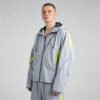
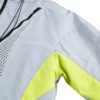
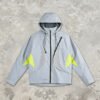
The supplied image presents contrast as a mapped system rather than scattered decoration. Neon yellow appears along the sleeve and side-body zones, while light gray dominates the shell. That relationship makes placement accuracy essential because even small shifts alter the jacket's balance.
VeeWen's development workflow should translate the visual reference into a numbered panel map, with notches, grain direction, and joining order recorded. The first approval should compare the assembled shell against the map before decoration or final edge finishing is accepted.
Stitch Containment Protects Panel Boundaries
Black lines visibly organize the front through the zipper, hood opening, and drawcord channels. These boundaries need controlled seam allowances so adjacent panels do not pull apart visually or create uneven ridges when the garment is zipped and worn.
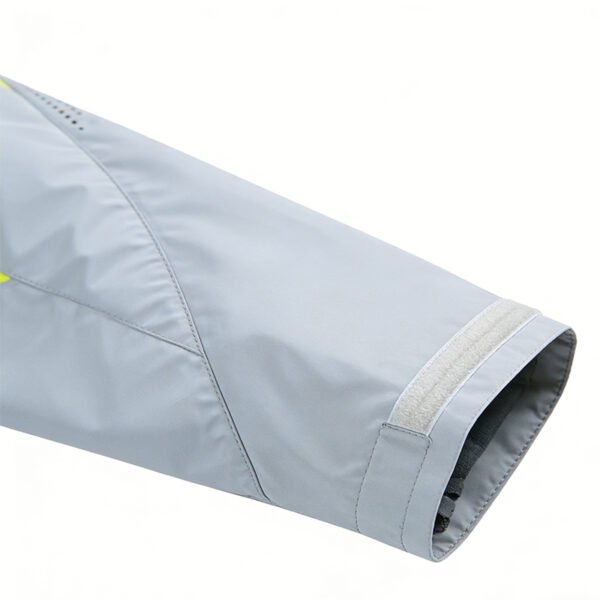
During development, VeeWen can isolate each containment point in the tech pack: zipper edges, pocket openings, sleeve inserts, cuff joins, and hem intersections. The buyer should approve stitch visibility, turn-under behavior, and seam bulk on a sewn construction sample.
Sleeve Movement Tests the Insert Strategy
The image shows contrast continuing through the sleeve region, where bending and arm movement can stress joined panels. A patch that looks centered on a flat table may rotate or ripple once the sleeve is shaped, especially near the elbow and underarm.
The workflow should therefore include a fitted shell review with the contrast pieces attached but before final finishing. Buyers should inspect the jacket on a moving form or wearer, checking insert tracking, sleeve balance, and whether containment lines remain intentional during ordinary movement.
Hood and Closure Intersections Need Sequencing
The hood is visually prominent, with black cords and a central front zipper meeting near the upper chest. Those components create several layers and pull directions, making construction order important for clean edges, balanced tension, and a stable opening.
VeeWen's sample review should lock the sequence for hood joining, cord-channel formation, zipper insertion, and facing or binding treatment. Approval should focus on whether the hood lies evenly when open and closed, with no visible distortion at the zipper head.
Decoration Must Respect the Patch Map
The source wording references screen printing, while the image emphasizes contrast panels and perforation-like surface details. Decoration should not be positioned independently from the patch layout, because artwork crossing joins can magnify registration changes or become visually interrupted.
For this product, VeeWen's workflow should separate artwork placement from panel approval, then reunite both in a pre-production visualization or sample. The buyer should confirm whether graphics stop at seams, cross them deliberately, or remain limited to stable single-panel zones.
Bulk Approval Depends on Contained Variation
Patchwork naturally introduces more points where tolerance can accumulate: panel dimensions, seam matching, zipper alignment, cuff width, and insert angle. The commercial risk is not one dramatic failure, but a gradual loss of symmetry across finished units.
The final development checkpoint should define acceptable visual variation through the approved sample, panel map, and measurement sheet. With MOQ: 100 pieces per style, buyers should confirm the complete construction package before releasing quantities, colors, or decoration into production.
Buyer Questions
Is the jacket waterproof?
Waterproofing appears in the source wording, but the image cannot verify performance. Confirm fabric construction, coating or membrane details, seam treatment, and any required test protocol before approval.
What material details are confirmed?
Nylon is identified by the source title, while composition percentage, fabric weight, lining, trims, and finish remain unverified until VeeWen receives or develops the technical specification.
How should patch placement be approved?
Approve a numbered panel map alongside a sewn sample. Check insert angles, zipper intersections, sleeve tracking, seam bulk, hood balance, and edge containment while the jacket is worn.
What is the minimum order quantity?
The commercial minimum is MOQ: 100 pieces per style. Final quantities, color assortment, decoration method, and production feasibility should follow the approved specification and quotation.
Approve the Panel Map First
Send the target measurements, artwork references, color standards, and material requirements to VeeWen. We will align the panel map, containment details, and sample checkpoint before MOQ: 100 pieces per style is scheduled.


Reviews
There are no reviews yet.