





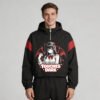

This kidswear jacket is best developed around boundary control. Its cropped body, gathered lower edge, and compact sleeve cuffs must preserve proportion after children pull, reach, sit, and layer. Rib recovery therefore becomes the approval metric connecting visual consistency with practical repeat wear.
Why Rib Recovery Controls the Design
A cropped jacket has little visual tolerance at its lower edge. If the hem rib relaxes, the body can hang longer and lose its intended proportion; if it over-contracts, it can bunch above the waistband. The recovery balance must be judged against the approved pattern.
The same principle applies to the sleeve cuffs. Children repeatedly push sleeves upward, pull them down, and grip the garment while dressing. A cuff that returns cleanly helps maintain sleeve volume and keeps the red bands positioned consistently across production sizes.
Reading the Supplied Visual Evidence
The main image shows a black hooded jacket laid flat, with a compact body ending in a visibly gathered rib hem. The lower edge is not a loose turned finish, so its tension materially shapes the jacket outline and the perceived cropped length.
Both cuffs appear ribbed and gathered, while the red upper-sleeve bands create horizontal alignment points. That combination makes recovery more than a comfort detail: uneven relaxation could shift sleeve proportion, distort color-block balance, and change how the back graphic sits.
Pattern and Rib Development
VeeWen should develop the shell length, rib height, and rib circumference as one connected pattern decision. The approved block needs allowance for the rib to contract without pulling the side seams inward or creating excessive fullness above the lower edge.
For kidswear grading, recovery should be reviewed across each size rather than assumed from one sample. Smaller cuffs may experience stronger proportional tension, while larger hems may relax differently. The development review should record measurements before wear and after controlled laundering.
Graphic Placement and Edge Stability
The centered back graphic sits above the hem, leaving a deliberate visual gap between artwork and lower edge. That spacing should remain stable when the rib contracts, because excessive draw-in can visually crowd the print and make the jacket appear shorter than approved.
The red sleeve bands also depend on stable cuff behavior. When cuffs return to their intended opening, sleeves should settle at the planned length and keep the bands readable. Artwork scale, print position, and hem recovery should be checked together on the fit sample.
VeeWen Development Checkpoint
VeeWen's workflow should translate this axis into a measurable sample gate: confirm rib specification, attach the cuff and hem to the approved shell, then record relaxed measurements and recovery after repeated extension. The purpose is to protect the designed boundary behavior, not merely approve appearance.
At the pre-production review, the buyer should inspect the sealed reference sample while wearing and stretching the jacket through ordinary child movement. Approval should cover cuff opening, hem return, cropped length, sleeve-band alignment, and graphic clearance before the size set proceeds.
Trade-Offs and Buyer Approval
Tighter rib recovery can improve silhouette retention but may increase pressure at the waist or wrists, especially when children layer garments underneath. Softer recovery can feel easier to wear but may allow the cropped body or sleeves to lose definition sooner.
The buyer should choose the acceptable balance using intended layering, age range, and care expectations. Approve the final rib construction only after reviewing comfort, recovery, visual proportion, and laundering observations against the signed measurement sheet.
Buyer Questions
What should be measured first during sampling?
Record cuff opening, hem opening, rib height, shell length, and relaxed body measurements before extension or laundering evaluations begin.
Why is the hem especially important here?
The cropped proportion ends at the rib, so relaxation or excessive contraction can immediately change the jacket's intended length and silhouette.
Should the graphic be approved separately?
Approve it alongside rib behavior, because hem contraction and shell movement can alter the spacing, scale perception, and alignment of the centered back artwork.
What quantity supports this development?
The commercial minimum is MOQ: 100 pieces per style, subject to final specifications, quotation, size breakdown, and production approval.
Approve the Rib Recovery Gate
Send the target size range, care expectations, and artwork files so VeeWen can align the jacket block, rib construction, graphic placement, and approval measurements.


Reviews
There are no reviews yet.