
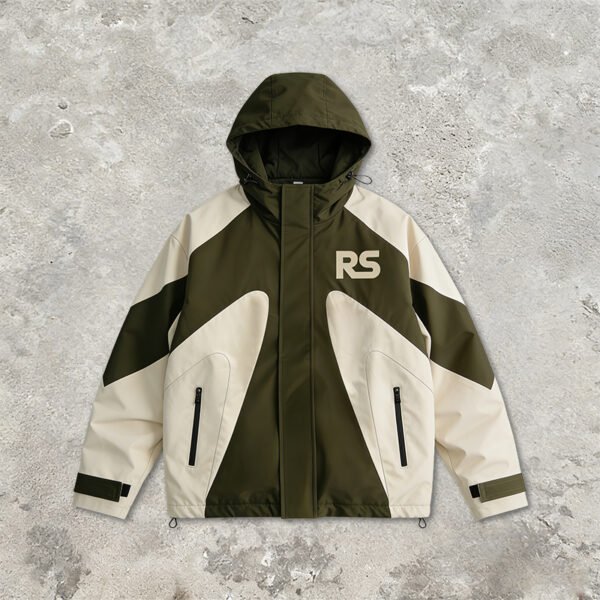
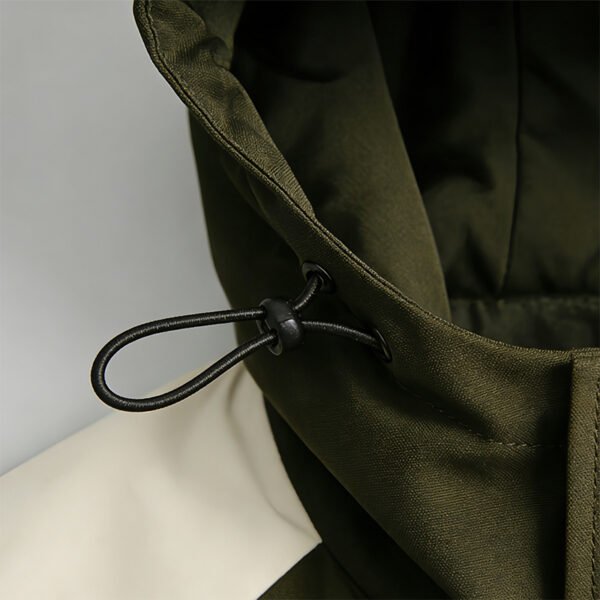


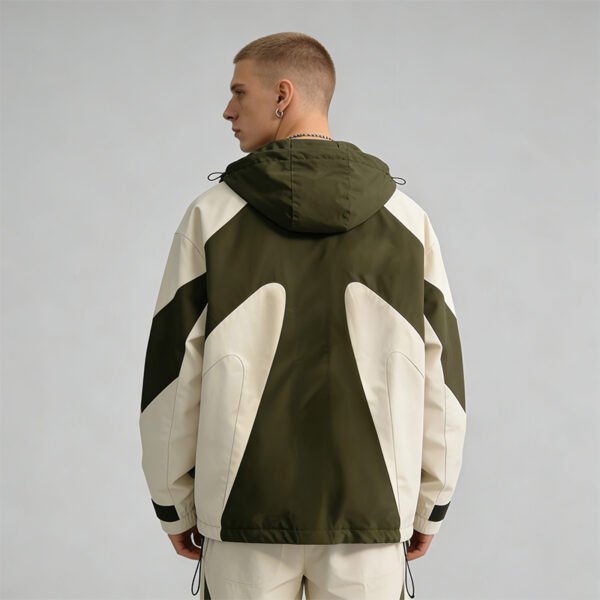


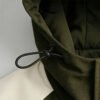
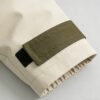





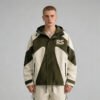

This men's windbreaker is best developed as a layered edge-management problem. The supplied image combines olive and cream panels, curved boundaries, zippered pockets, a hood, and adjustable openings, creating a technical silhouette whose success depends on flat transitions and controlled bulk.
Panel Edges Define The Jacket
The jacket's visual identity comes from broad cream and olive sections divided by sweeping boundaries. Those edges must remain smooth and accurately positioned because even small deviations can make the front look twisted, especially where sleeve panels continue toward the shoulder and upper chest.
Whether the panels are joined as cut pieces or applied over a base, the pattern must preserve consistent seam allowance and turn control. The buyer should approve the edge architecture before artwork, logos, or decorative printing are added.
Bulk Accumulates At Intersections
Layer bulk is not evenly distributed across this design. The center zipper, curved panel seams, pocket openings, hood attachment, and cuff construction all create nearby thickness, so the sewing sequence should prevent multiple allowances from stacking at one intersection.
A flatter result may require staggered seam joins, carefully managed notches, or selective allowance reduction, but each choice can affect durability and appearance. The development sample should expose those compromises rather than hiding them beneath pressing or styling.
Pocket Placement Needs Clearance
The two lower zip pockets sit inside contrasting cream panels, making their position important for both function and visual continuity. Pocket bags, zipper tapes, and seam allowances can pull the panel surface if they are placed too close to curved boundaries or the center closure.
VeeWen should map pocket openings against the panel pattern before cutting approval. The buyer should check hand entry, zipper operation, pocket-bag movement, and front balance while the jacket is worn, zipped, and layered over a midweight garment.
Hood And Closure Share Space
The raised hood and center-front zipper form a concentrated construction zone around the neck. If the hood seam or facing becomes too bulky, the zipper can sit away from the body and the collar line may resist folding, reducing comfort and weakening the clean technical profile.
The hood pattern should therefore be evaluated with the zipper, front facing, and any lining or insulation option represented. Confirming those layers together helps identify pressure points before the style reaches bulk cutting or final trim selection.
VeeWen Development Checkpoint
VeeWen's workflow should convert the image into a panel map, edge-control specification, seam-bulk risk chart, and construction sequence. That sequence is specific to this jacket because its color boundaries and hardware occupy the same zones where layered allowances can distort the shell.
The buyer's approval checkpoint is a construction sample with visible panel joins, working zippers, hood attachment, cuffs, and hem adjustment. Sign off only after reviewing edge smoothness, front symmetry, pocket clearance, and wear comfort under the intended layering condition.
Trade-Offs In Edge Control
Tighter edge tolerances improve graphic sharpness but may increase cutting complexity, matching time, and sensitivity to fabric movement. Simplifying curved boundaries can reduce manufacturing risk, yet it may weaken the directional energy that makes the color blocking distinctive.
The buyer must choose which visual boundaries are essential and where practical tolerance is acceptable. Approve the final method only after comparing appearance, hand mobility, seam flatness, and hardware operation on a representative development sample.
Buyer Questions
Is the jacket lined?
The image does not establish lining or insulation. Confirm the intended interior structure before sampling because lining thickness directly affects hood, zipper, pocket, cuff, and seam bulk.
Are the panels appliqued or cut-and-joined?
The visual evidence shows contrasting panel boundaries but cannot verify the method. VeeWen should compare cut-and-join and applique options against edge precision, bulk, durability, and target cost.
What nylon specification applies?
The source wording identifies nylon, but exact composition, weight, coating, backing, and water behavior require confirmation through the approved material submission and development documentation.
What should be approved first?
Approve the panel map and construction sample first. Review curved edge control, zipper alignment, pocket clearance, hood bulk, cuff adjustment, hem behavior, and movement before production authorization.
Review The Bulk-Control Sample
Share the panel artwork, target measurements, and interior-layer intent with VeeWen so edge tolerances and seam sequencing can be validated on a functional windbreaker sample.


Reviews
There are no reviews yet.