


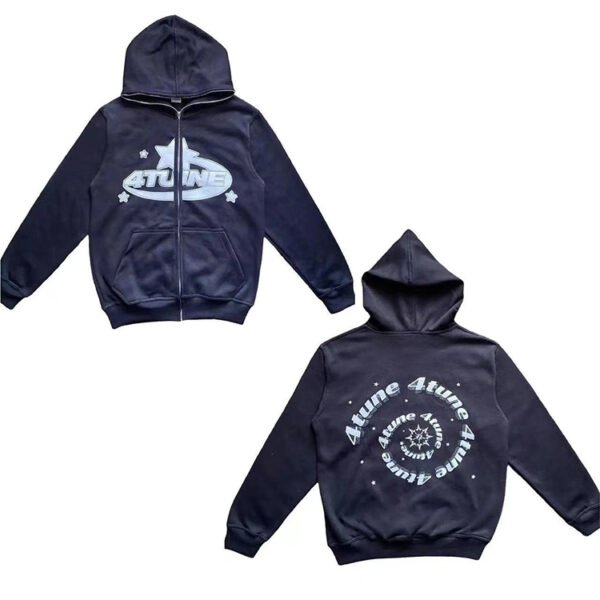


This full-zip hoodie is a development study in how a stable cream base supports concentrated front and back decoration. The split chest graphic, expansive circular back motif, hood, pockets, and rib finishes create practical checkpoints for controlling distortion before production approval.
Why Base Stability Controls Decorative Accuracy
A full-zip front is divided by the center zipper, so any unstable knit can shift artwork across opposing panels. The cream sample visibly places a dark chest emblem close to that division, making panel recovery and zipper installation part of decoration accuracy.
The back presents a larger circular arrangement on one continuous surface, creating a different stability demand from the front. If the body stretches or relaxes unevenly, circular spacing can appear oval, while dense stitching or raised decoration may intensify local pull.
Reading Density from the Supplied Sample
The front image shows multiple dark elements: a central wordmark-style graphic, surrounding stars, and a broad horizontal shape. That concentration suggests several adjacent decorated areas, where thread buildup, foam height, or print coverage should be mapped before selecting the final technique.
The rear image shows repeated lettering arranged around a central emblem, increasing directional changes and registration points. A development sample should inspect edge definition, inner openings, and spacing after laundering simulation, while confirming whether the intended result is embroidery, foam print, or another process.
Panel Placement and Mechanical Stress
The center zipper, pocket openings, hood seam, and shoulder joins divide the front into mechanically active zones. Decoration should remain clear of zipper teeth and pocket openings, with measured margins that prevent needle penetrations, adhesive interference, or surface buildup from weakening high-use construction points.
The back motif sits between shoulder and hem areas, where movement can stretch the fabric in several directions. Placement should therefore be graded against body width and back length, checking that the circular artwork remains visually centered when the hoodie is worn, zipped, and relaxed.
Trade-Offs in Dense Decoration
Higher decoration density can sharpen small details and create a more substantial surface, but it also increases local weight, production handling, and the possibility of puckering. A lighter treatment may improve drape and recovery, although it can reduce contrast or make fine lettering less legible.
Raised foam effects can provide visible dimension, while embroidery can define edges and tactile detail differently. The buyer should decide which visual cues matter most, then approve a controlled technique test that balances hand feel, wash appearance, panel stability, and workable placement tolerances.
VeeWen Development Workflow Checkpoint
VeeWen should convert the supplied front and back views into a decoration map with separate files for the split chest and continuous back motif. The technical review should record artwork dimensions, seam clearances, zipper relationship, stitch or print method, and acceptance points for surface distortion.
During sample review, the buyer should examine the zipped front and worn back simultaneously, because stability can look acceptable flat but change under tension. VeeWen's approval checkpoint is a signed sample specification covering base-fabric behavior, decoration density, placement, and the selected finish method.
Approval Criteria Before Bulk Cutting
Before authorizing bulk cutting, confirm the fabric composition, weight, rib specification, color standard, zipper details, and decoration process against the approved sample. These inputs determine whether the finished hoodie retains the intended proportion and whether repeat production can follow the same stability assumptions.
The final decision should focus on measurable appearance after handling: centered artwork, smooth zipper-side panels, clean circular spacing, and controlled edges without unacceptable rippling. If any point fails, revise density or placement before locking the pattern and production instructions for the MOQ of 100 pieces per style.
Buyer Questions
Is this hoodie definitely cotton?
The source wording references cotton, but the supplied evidence does not verify fiber percentage, blend, or weight. Request a fabric specification and approve a physical hand-feel sample before production.
Is the decoration embroidery or foam print?
The source wording mentions foam print, while the image only confirms dark graphic decoration. VeeWen should confirm the technique through artwork files, a technique swatch, and an approved sample.
What should the buyer inspect first?
Inspect zipper-side alignment, back-circle centering, edge definition, and fabric rippling. These checks directly test whether decoration density is compatible with the hoodie body's stability and recovery.
What is the minimum order quantity?
The commercial minimum is MOQ: 100 pieces per style. Final acceptance still depends on approved artwork, material specifications, measurements, decoration method, color standard, and production confirmation.
Approve the Stability and Decoration Sample
Send the artwork, target measurements, fabric requirements, and color standard to VeeWen for a controlled sample review before approving MOQ: 100 pieces per style.


Reviews
There are no reviews yet.