
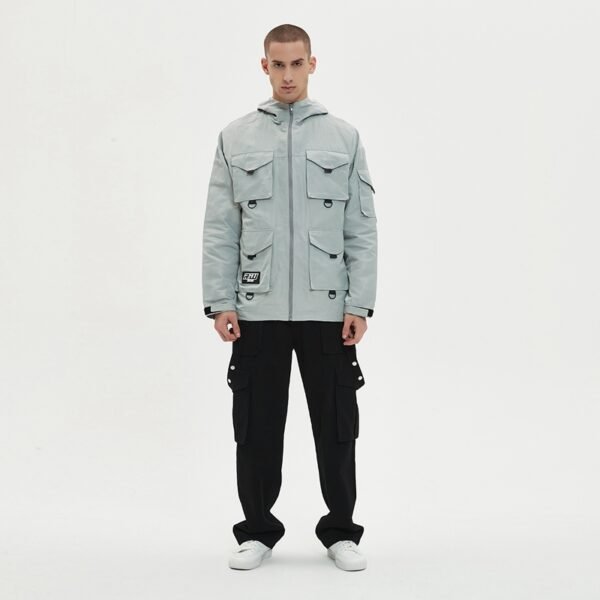
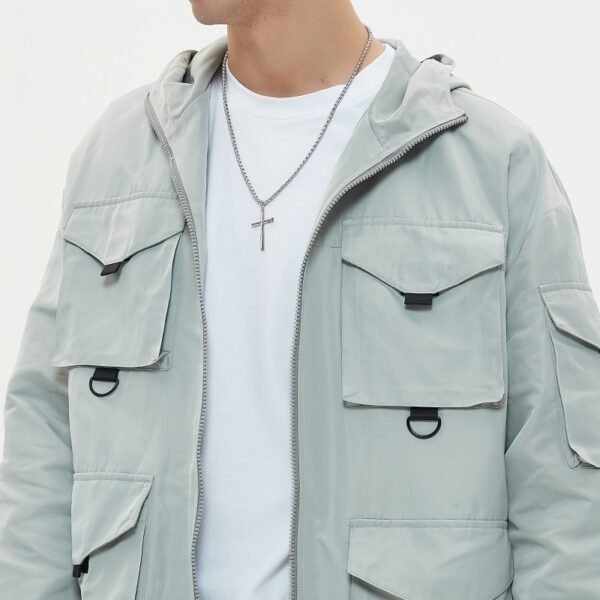
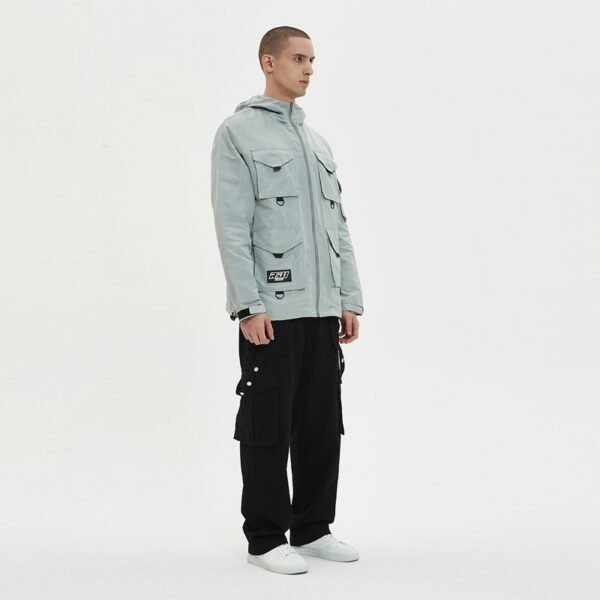
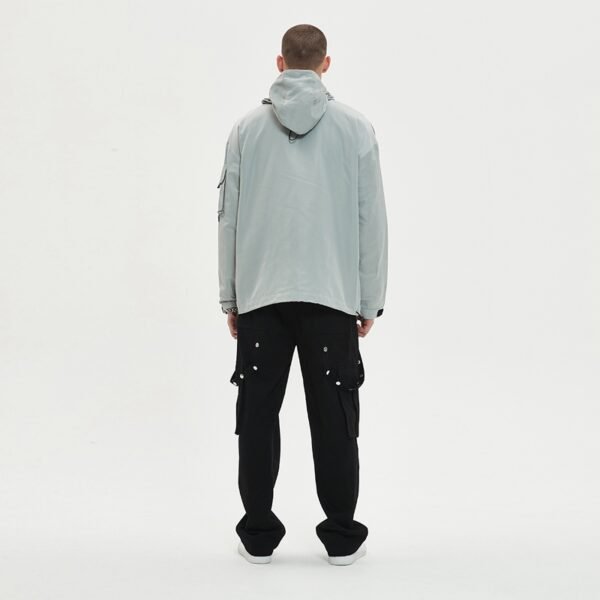









This custom men's utility jacket is developed around edge stability, because multiple pockets, a hood, zipper, and contrasting trim place repeated stress on shaped seams. VeeWen can translate the visible architecture into a controlled sample, with interlining decisions tested before production approval.
Why the Interlining Decision Matters
A utility jacket concentrates load around pocket mouths, flaps, zipper tapes, cuffs, and hood seams. Interlining changes how those areas resist stretching, bubbling, and edge collapse, so the correct choice must support the shell without making the garment unnecessarily rigid or heavy.
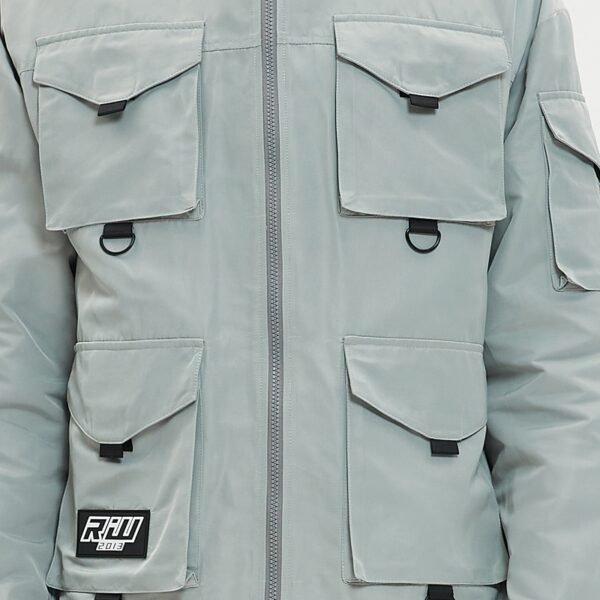
The supplied image shows a pale jacket carrying four substantial front pockets, a sleeve pocket, and a hood. That arrangement creates several adjacent stability zones, especially where pocket corners, zipper edges, and lower hem movement meet during repeated wear.
Reading the Pocket Architecture
The front layout is more than decoration: broad flap pockets create layered fabric panels, while visible lower loops or tabs introduce additional attachment points. Each layer can alter seam thickness and pressing behavior, making localized support more important than applying one uniform interlining throughout.
For development, pocket bags, flaps, and body panels should be evaluated together. A stable pocket opening can still look inconsistent if the surrounding body collapses, while excessive support may reduce comfort. The sample should reveal that balance before grading begins.
Edge Stability at the Zipper
The full center zipper forms the strongest vertical visual line on the garment. Its neighboring edges must remain parallel while the hood, pocket layers, and wearer movement introduce tension. Interlining selection therefore affects both appearance and the practical feel of the closure.
A development sample should check zipper wave, tape visibility, and edge recovery after opening and closing. The same review should examine whether the hood base pulls the neckline forward, because collar and zipper stability are mechanically connected rather than isolated details.
Cuffs, Hood, and Secondary Edges
The hood gives the jacket a dimensional upper frame, while the cuffs show dark contrasting construction at the sleeve ends. These elements need enough support to hold their intended outline, yet they must flex when the wearer raises the arms or adjusts the hood.
The image also shows a sleeve pocket and multiple flap corners competing for visual attention. VeeWen's sample review can separate structural support from decorative reinforcement, helping the buyer decide where firmer interlining belongs and where seam engineering should preserve softness.
VeeWen Development Checkpoint
VeeWen should convert the approved reference into a construction map identifying shell panels, pocket layers, zipper margins, hood components, cuffs, and patch placement. Interlining options can then be assigned by zone, allowing the team to review stability as a system.
The buyer's approval checkpoint is a side-by-side sample review under realistic handling. Confirm pocket-mouth recovery, zipper alignment, hood behavior, cuff flexibility, and patch integration before approving the final pattern, because these decisions determine whether the jacket feels considered or overbuilt.
Trade-Offs Before Bulk Approval
More supportive interlining can sharpen pocket flaps and protect edges, but it may increase stiffness, seam bulk, and pressing sensitivity. Lighter support may improve comfort, yet allow pocket corners or zipper edges to soften. The right outcome depends on the intended silhouette and handling expectations.
Before production, specify which visual edges must stay crisp and which areas may relax naturally. Confirm material composition, shell weight, interlining type, attachment method, and care requirements through the technical package rather than treating image appearance as complete construction proof.
Buyer Questions
What should be tested first on this jacket?
Test pocket-mouth recovery, zipper alignment, hood stability, and cuff flexibility together, because these zones share movement and can expose incompatible interlining choices.
Can the pocket layout be changed?
Yes, the pocket count, dimensions, flap shape, and placement can be developed within an approved pattern, while preserving the intended utility balance and edge-control requirements.
Is the shown patch material verified?
No. The image shows a patch-like detail, but its material, backing, dimensions, and attachment process require confirmation in the development specification.
What is the commercial minimum?
MOQ: 100 pieces per style. Final feasibility remains subject to approved materials, construction details, size range, packaging, and production documentation.
Approve the Stability Direction
Send your target measurements, shell reference, pocket priorities, and branding requirements to VeeWen. We will organize the interlining review around the jacket's most stressed edges before sample approval.


Reviews
There are no reviews yet.