


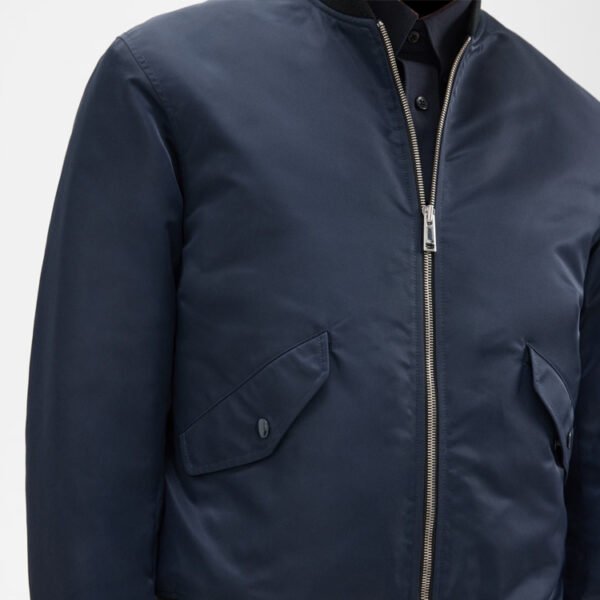




This custom men's bomber jacket is developed around one practical question: how much embroidery can the outer shell support before the clean silhouette loses balance? The navy body, ribbed edges, central zipper, and multiple pockets make stability and placement approval commercially important.
Why Base Stability Controls Embroidery Quality
A bomber shell can look smooth before decoration and still react unevenly under concentrated stitching. Dense thread inserts needle tension and localized weight, so the base fabric must resist shifting while remaining compatible with the jacket's curved body panels.
The supplied image shows a clean navy surface where ripples would be immediately visible. That makes stabilizer selection, hooping pressure, and embroidery direction part of the garment specification, not merely artwork preparation, especially across the chest and sleeve pocket.
Reading the Silhouette Before Artwork Placement
The compact bomber profile is defined by a ribbed collar, cuffs, and waistband that visually compress the garment. Embroidery placed too close to these transitions may compete with the rib structure or exaggerate distortion when the jacket is zipped and worn.
The central zipper and two angled front pockets create strong vertical and diagonal references. Artwork should be positioned against those landmarks, with measured clearances, so the finished decoration supports the silhouette instead of making the front appear visually crowded.
Managing Density Across Different Jacket Zones
Not every panel should receive identical stitch density. A broad chest area may tolerate a larger design, while the sleeve pocket zone has less usable width and greater interaction with zippers, pocket construction, and arm movement during wear.
A production-ready artwork pack should therefore separate chest, sleeve, and optional back treatments. Each location needs its own density limit, backing plan, and placement tolerance, allowing the decoration to remain legible without creating unnecessary stiffness or puckering.
Trade-Offs Between Impact and Wearability
Higher embroidery density can increase visual presence, but it also adds needle penetrations, thread weight, and a firmer hand. On a winter-style bomber, excessive stiffness may reduce comfort at the chest, shoulder, or sleeve where the wearer moves repeatedly.
A lighter design may preserve drape and reduce surface stress, yet it can lose impact against dark navy fabric. The approval decision should weigh brand artwork priorities against hand feel, seam proximity, care expectations, and the intended retail positioning of the jacket.
VeeWen Development Workflow for This Jacket
VeeWen's product-development work should begin by converting the visual reference into a shell specification, panel map, rib dimensions, zipper details, and embroidery placement chart. The first sample then tests fabric reaction and alignment together, rather than approving artwork in isolation.
After review, revisions should document stitch density, backing, thread colors, placement measurements, and acceptable surface tolerance. Before bulk cutting, the buyer should approve a decorated pre-production sample that represents the selected shell, construction, and final embroidery treatment.
Buyer Approval Checkpoint
The buyer should approve the jacket only when the decorated sample remains smooth after handling, zipper operation, pocket access, and normal body movement. Inspection should focus on chest flatness, sleeve-pocket interference, rib transitions, and symmetry against the center front.
The final technical pack should record artwork files, thread references, backing construction, placement measurements, shell composition, lining, insulation, and care instructions. Any unverified performance or composition claim should remain open until documented through the agreed development process.
Buyer Questions
What embroidery size is suitable for this bomber jacket?
Size depends on panel dimensions, stitch density, and clearances from zippers, pockets, and ribs. VeeWen should confirm the artwork through a decorated sample before production approval.
Can the sleeve pocket carry dense embroidery?
It may, but the narrow panel and zipper create higher distortion risk. A reduced-density treatment or alternate placement may protect function, comfort, and visual balance.
What fabric details must buyers confirm?
Confirm shell composition, weave, GSM, lining, insulation, color standard, shrinkage behavior, and surface stability before finalizing embroidery settings and construction specifications.
What is the minimum order quantity?
The commercial minimum is MOQ: 100 pieces per style. Final quantities, size breakdown, color options, and development terms should be confirmed in the quotation.
Approve the Embroidery Stability Test
Send the artwork, target measurements, and preferred shell references for a decorated sample review. VeeWen can then document placement, density, backing, and approval points before bulk production begins.


Reviews
There are no reviews yet.