


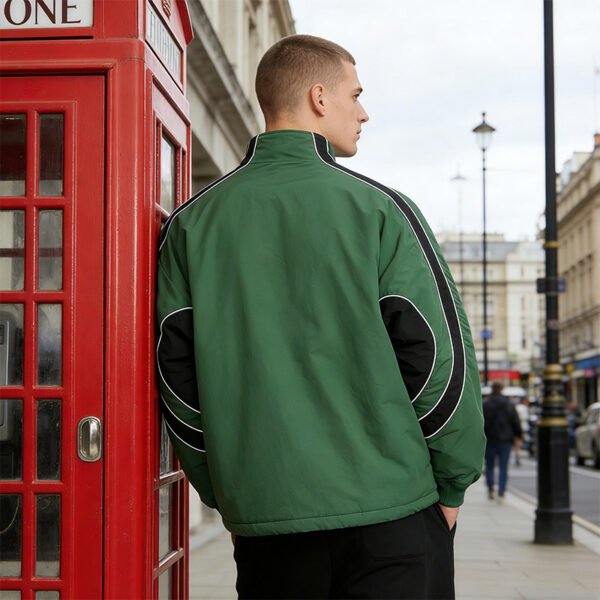

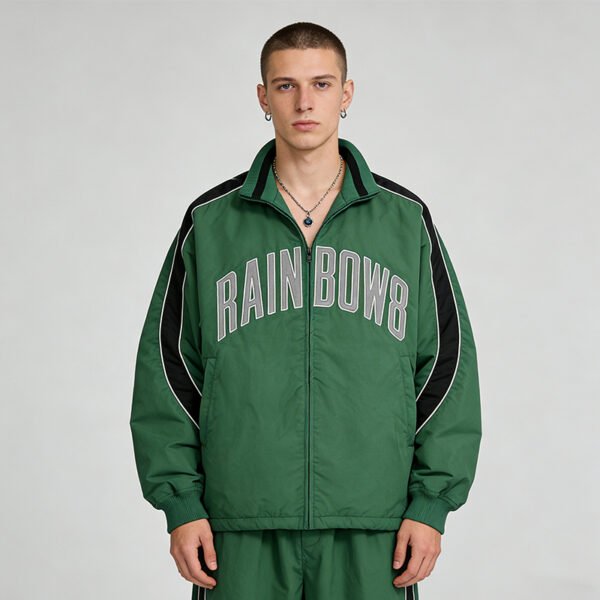
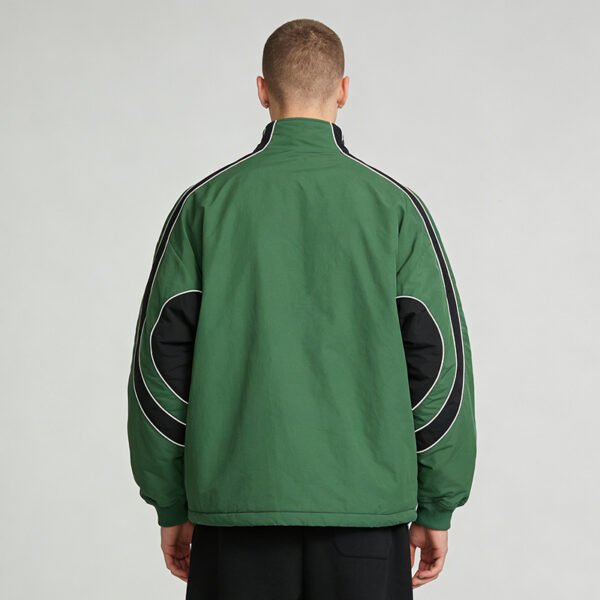

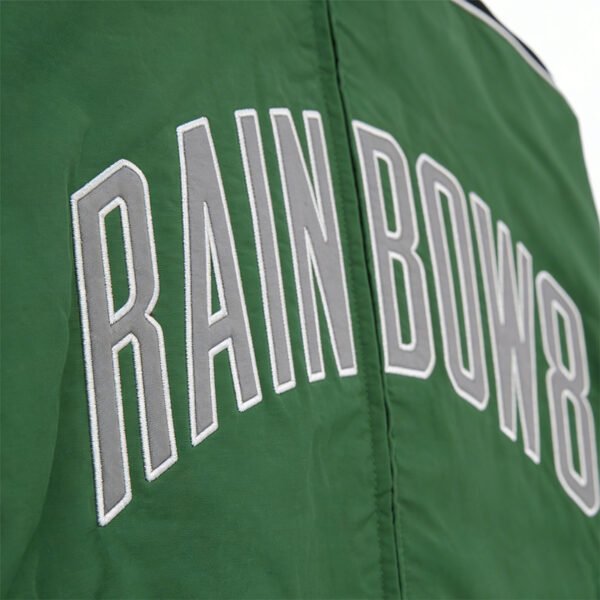








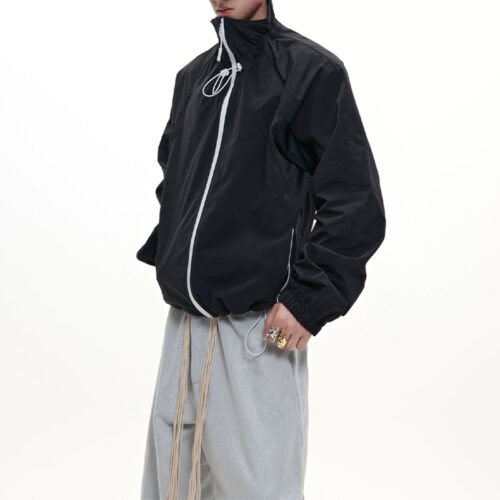
This jacket should be developed as an edge-management system, not simply a decorated outer layer. The visual combines a broad chest applique, curved contrast panels, piping, ribbed closures, and a front zipper, so durability depends on how each boundary is stabilized during wear and care.
Where Edge Failure Begins
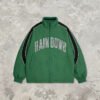
The chest applique occupies a broad, high-visibility area, making lifting, fraying, or puckering immediately apparent. Its perimeter should be treated as a controlled load path, with stitch density, adhesive choice, and seam allowance reviewed against the selected nylon surface.
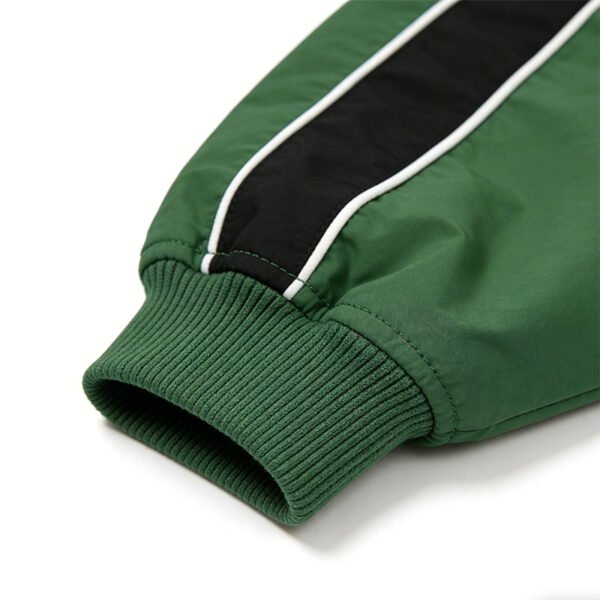
Curved sleeve inserts introduce longer edge runs than the chest graphic, while white piping adds another transition. Each junction can concentrate abrasion or tension, so the development sample should expose corners, curves, and zipper-adjacent areas before bulk approval.
Nylon Changes the Containment Plan
Nylon can be lightweight, slick, or coating-sensitive, and those variables affect needle penetration, adhesive bonding, pressing temperature, and stitch registration. The source identifies nylon but does not verify composition, weight, coating, or finishing, so material behavior remains a development checkpoint.
The practical target is a clean applique outline without excessive perforation, shine, distortion, or adhesive strike-through. VeeWen's sampling review should compare the chosen shell and reinforcement method under bending and surface handling, documenting which combination preserves both appearance and flexibility.
Patchwork and Panel Load
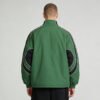
The black shoulder and sleeve sections visually frame the green body, but their joined edges must also carry movement from the arms. Panel geometry, seam direction, and reinforcement placement should prevent the contrast pieces from pulling against the center front or armhole.
A durable result may require balancing seam bulk against containment strength. Overbuilding every edge can restrict drape and raise visual thickness, while under-supporting long curves can invite distortion. Approval should therefore assess the jacket on a moving body, not only on a flat table.
Closures Need Edge Discipline
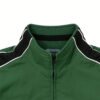
The center zipper divides the applique field and creates a narrow, repeatedly handled edge. Chest artwork placement should maintain a dependable clearance from the zipper tape, while the front facing must prevent rippling that could interrupt the graphic's visual alignment.
Ribbed cuffs and hem finish the jacket at active openings where stretching and recovery repeat frequently. Their attachment should be checked for exposed raw edges, seam torque, and uneven gathering, especially where heavier applique or panel seams change the surrounding fabric tension.
VeeWen Development Checkpoint
VeeWen can translate the containment argument into a focused development sequence: confirm shell behavior, map every applique and patch boundary, then prototype reinforcement only where movement or abrasion demands it. This keeps the sample technically intentional rather than adding generalized support everywhere.
The buyer review should record edge appearance after handling, zipper operation, sleeve mobility, cuff recovery, and laundering simulation when available. Any hood requirement must also be resolved against the supplied visual evidence, because the visible sample presents a high collar rather than a confirmed hood.
Approval Criteria for Production
Production approval should depend on consistent applique registration, secure patch perimeters, smooth piping curves, and stable panel joins across the full size range. Grading can change edge tension, so the largest and smallest sizes deserve direct inspection before releasing the size set.
The commercial decision is whether the containment method protects the graphic and patchwork identity without making the jacket rigid or over-engineered. Confirm shell specifications, hood configuration, care testing, and the agreed MOQ: 100 pieces per style before purchase order approval.
Buyer Questions
Is the jacket confirmed waterproof and windproof?
No. Those claims appear in the source wording, but supplied evidence does not include test results, coating details, seam sealing, or performance documentation for verification.
What should the first sample test?
Review applique lift, patch perimeter security, piping curves, zipper clearance, cuff recovery, sleeve mobility, and shell response after handling before approving the construction route.
Is a hood visible in the supplied image?
No. The image shows a raised collar, while the source title references a hooded jacket; hood shape, attachment, and inclusion require explicit confirmation during development.
What is the minimum commercial quantity?
The exact commercial minimum is MOQ: 100 pieces per style. Final ordering should follow approved materials, measurements, construction details, color standards, and packaging requirements.
Approve the Edge-Control Sample
Send the target shell reference, applique artwork, patch layout, size range, hood decision, and care expectations to begin a focused VeeWen development review at MOQ: 100 pieces per style.


Reviews
There are no reviews yet.