
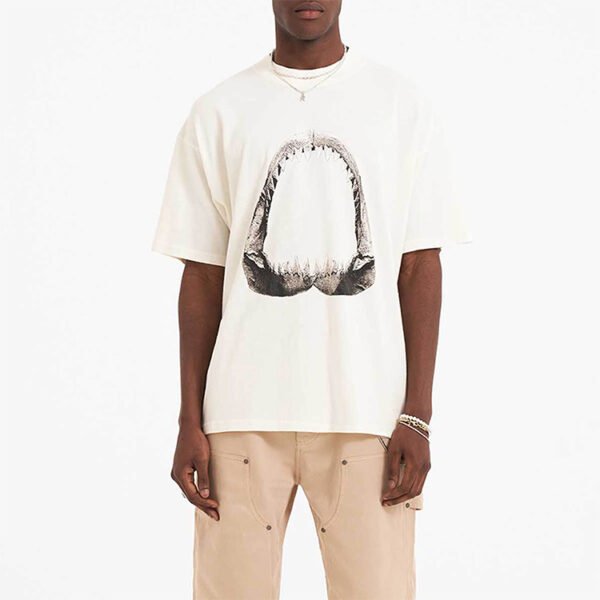
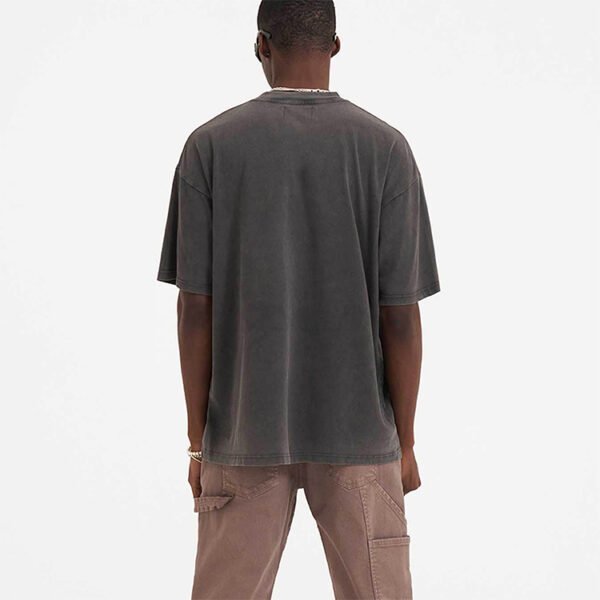

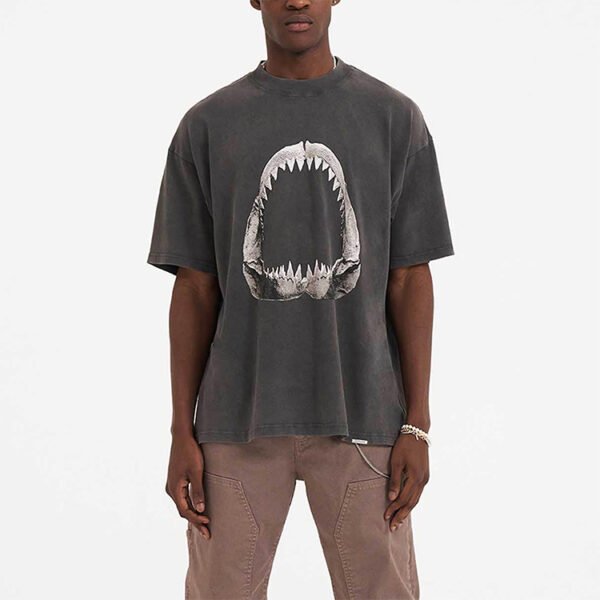

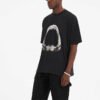
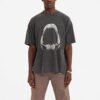
This men's graphic T-shirt is best developed as a placement-control project. The off-white body exposes every registration shift, while the large tonal shark-mouth illustration must stay centered through panel cutting, seam joining, grading, and final approval across the intended size range.
Reading the Graphic as Geometry
The shark-mouth illustration dominates the front and behaves like a geometric anchor, not a small emblem. Its upper arch, teeth, and lower curves create reference points that can expose even modest shifts relative to the neckline or side seams.
VeeWen's first development action should map those reference points onto the front pattern and artwork file. The buyer should approve a measured centerline, vertical offset, and safe distance from seams before the sample is treated as production-ready.
Controlling Panel Registration
Although the supplied image emphasizes the front, a production-ready graphic system must anticipate how artwork relates to shoulders, sleeves, side panels, and any continuation required by the approved design. Each cut component can alter alignment after sewing and pressing.
The workflow should therefore use notches, placement marks, and a panel-specific artwork map where applicable. Buyers should decide whether the design requires true continuity across joins or a deliberately self-contained front, documenting that choice clearly.
Protecting Tonal Contrast
The pale off-white ground makes the gray-black graphic easy to read, but it also makes halos, edge softness, and registration drift conspicuous. Fine teeth and textured tonal areas need enough definition without creating an overly harsh or uncomfortable surface.
During strike-off review, VeeWen should compare the graphic at viewing distance and close range, examining tooth spacing, mouth contours, and tonal transitions. Approval should balance visual sharpness with the selected fabric's hand-feel and intended wear experience.
Accounting for Relaxed Ease
The model reference indicates a relaxed, straight silhouette, so the front artwork must be positioned for movement rather than a tightly fitted torso. Excessive width or length can change the perceived center and make the mouth look visually low or stretched.
VeeWen's product-development workflow should overlay the artwork on graded front patterns and assess it on the sewn body. The buyer checkpoint is confirming proportional scale, neckline relationship, and side-seam clearance at both sample and extended sizes.
Sequencing Cut, Sew, and Print
Registration problems often begin before decoration, when marker direction, fabric relaxation, cutting tolerance, or seam allowance changes the panel relationship. A central graphic therefore requires coordination between artwork preparation and the garment's physical construction sequence.
The development record should state whether panels are printed before assembly, after assembly, or through a hybrid route approved for the design. Buyers should authorize the sequence only after reviewing alignment risk, access, handling, and final appearance.
Finalizing the Registration Gate
A strong approval sample should make the shark-mouth graphic feel intentional from the first glance, with the arch centered and the teeth reading evenly against the off-white body. Any approved irregularity should be designed, repeatable, and visible in the specification.
Before bulk release, VeeWen should consolidate panel artwork, pattern measurements, size-grade rules, print references, and seam tolerances. The buyer's final decision is approval of the assembled garment, not merely acceptance of a flat artwork proof.
Buyer Questions
Why does an off-white body increase registration risk?
Dark graphic edges and fine teeth contrast sharply with off-white fabric, making small shifts, halos, tonal bleed, or seam-related distortion easier to notice.
Does the image prove an all-over print construction?
No. It visibly proves a large front graphic; any panel continuation or all-over treatment must be defined and approved through artwork maps and samples.
How should the graphic be graded?
Grade the artwork with the front pattern, preserving neckline distance, side-seam clearance, tooth scale, and visual centering rather than mechanically enlarging one file.
What is the essential bulk approval?
Approve an assembled, graded sample with documented panel marks, print references, seam tolerances, and the selected fabric response before authorizing production quantities.
Approve Registration Before Scaling the Style
Share the artwork, pattern targets, size range, and desired panel treatment with VeeWen. We will structure development around measurable registration, assembled-sample review, and a documented bulk approval gate.


Reviews
There are no reviews yet.