
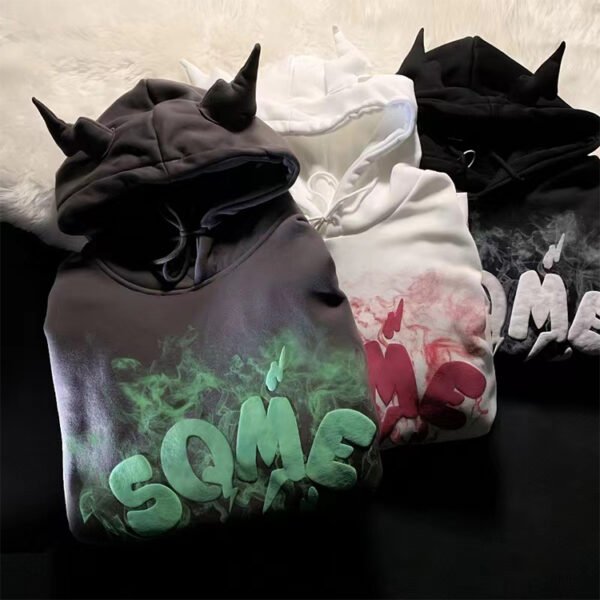
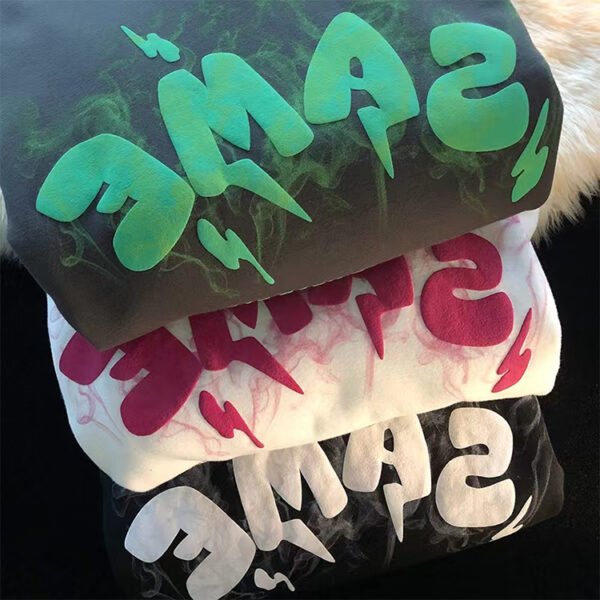
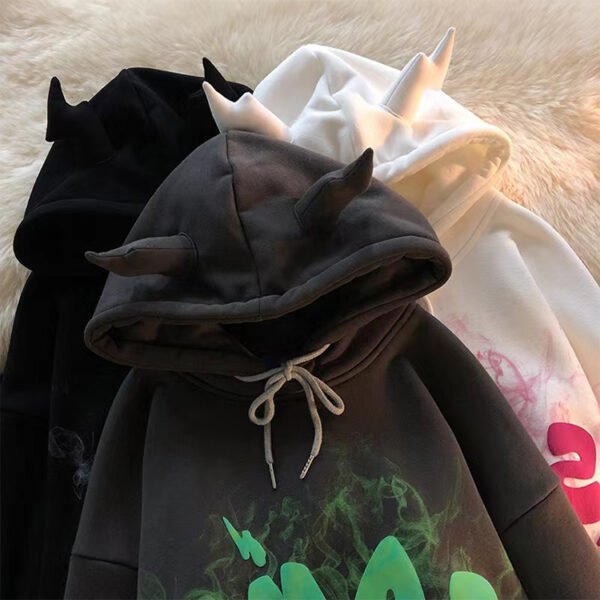
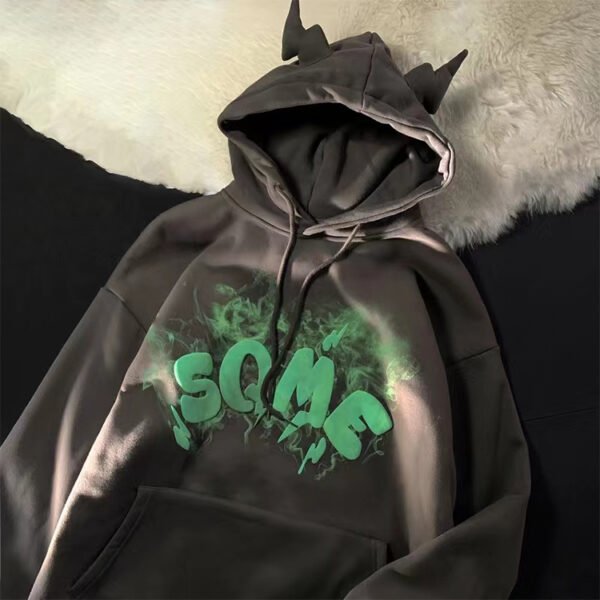
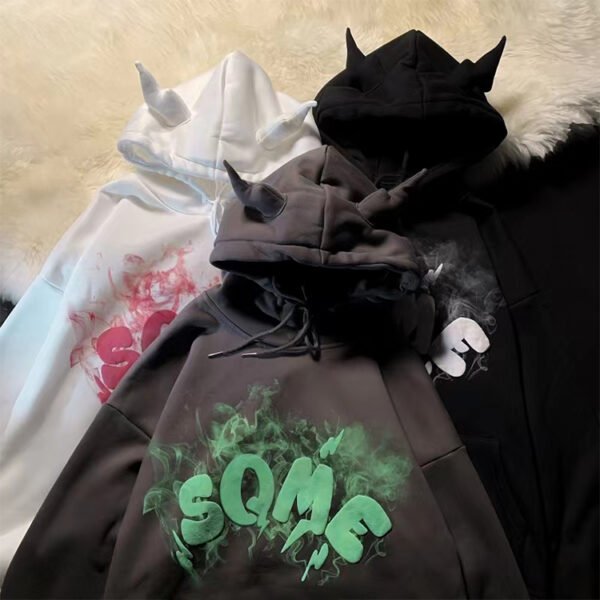



This pullover hoodie is developed around a practical relationship between fleece stability and dense dimensional decoration. The supplied image shows broad raised lettering, contrasting body colors, and a sculpted hood, so approval must balance graphic impact against panel distortion, seam stress, and everyday comfort.
The Graphic Requires a Controlled Foundation.
The image places oversized raised lettering across the lower front, concentrating visual and physical load over one broad panel. If the fleece relaxes unevenly, the graphic can pull the body out of plane, change hem behavior, or create unwanted rippling around adjacent seams.
The development sample should therefore examine panel recovery after decoration application, handling, and laundering. VeeWen can map the graphic footprint against the front pattern, then review whether stabilizer selection, backing, or stitch distribution preserves the intended surface without making the garment unnecessarily rigid.
Decoration Density Should Follow the Artwork Geometry.
The visible lettering is not a small chest mark; it stretches across multiple front zones with several rounded forms and apparent dimensional layers. That scale changes registration risk, especially where letters approach the hem, pocket area, or curved body sections during handling.
A buyer should approve artwork at production dimensions, including edge clearances and color separations, before committing to final decoration settings. The meaningful checkpoint is a decorated front panel attached to the actual fleece, because paper artwork cannot reveal distortion or stiffness.
The Hood Adds a Separate Stability Challenge.
The supplied image shows pointed hood projections that create a sculptural silhouette beyond a conventional pullover hood. Their shape depends on seam accuracy, internal support, and controlled turning, while excess bulk could make the hood uncomfortable or cause the points to collapse during wear.
VeeWen's development workflow should isolate the hood as its own construction test, checking projection symmetry, opening comfort, drawcord routing, and recovery after manipulation. Approval should record the accepted shape in profile and front views, preventing the body graphic from distracting from hood inconsistencies.
Contrast Changes the Perceived Precision.
Black and white bodies are visible in the supplied image, and the decoration changes character against each ground. Dark fleece can emphasize light or saturated raised elements, while white fleece exposes shadow, edge buildup, and any uneven registration more readily during inspection.
The sample review should use at least the intended lightest and darkest body colors before bulk approval. VeeWen can compare thread, print, or applique appearance under consistent lighting, then confirm whether the chosen decoration process maintains readable edges without compromising the base fabric.
Comfort Must Survive Structural Decoration.
A tactile front treatment may create a premium handfeel visually, but concentrated density can add weight, stiffness, or abrasion at the wearer's torso. The hood projections introduce another contact and balance consideration, particularly when the garment is layered or worn while moving.
Buyer approval should include an inside-out handling review, not only a front-facing appearance check. The development team can assess backing exposure, seam ridges, neckline balance, and hood weight together, then adjust construction where visual drama begins to reduce practical comfort.
The Buyer Approval Gate Is a Combined Test.
This style should advance only when the decorated body, hood sculpture, and color contrast pass as one coordinated system. Approving artwork alone leaves unresolved questions about fleece reaction, while approving fabric alone cannot validate the raised graphic's scale or registration.
For VeeWen's product-development workflow, the final checkpoint is a signed preproduction sample with measured graphic placement, accepted hood profile, confirmed material details, and documented color references. MOQ: 100 pieces per style should be planned after that specification is locked.
Buyer Questions
Is the raised front decoration confirmed as embroidery?
No. The source wording references 3D puff-style decoration, while the image shows dimensional lettering; the exact embroidery, print, applique, or hybrid method remains To Confirm.
Can the hood projection be modified during development?
Yes, the hood geometry can be reviewed as a development variable, subject to pattern feasibility, comfort evaluation, reinforcement decisions, and approval of the revised sample.
What should be approved before ordering?
Approve the decorated fleece panel, hood profile, color references, material composition, internal finishing, size grading, and placement measurements before production authorization.
What is the commercial minimum for this style?
The exact commercial minimum is MOQ: 100 pieces per style, applied after the technical specification and preproduction sample receive buyer approval.
Approve the Stability and Decoration Test.
Send the intended artwork, color references, and target size range so VeeWen can prepare a focused development review before MOQ: 100 pieces per style.


Reviews
There are no reviews yet.