

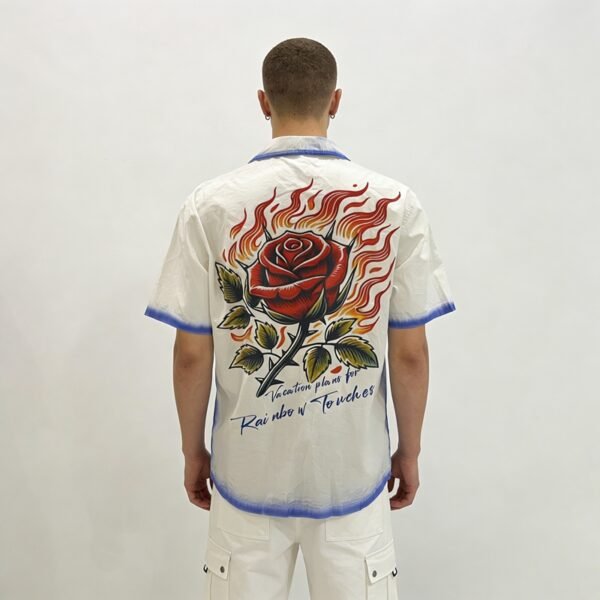


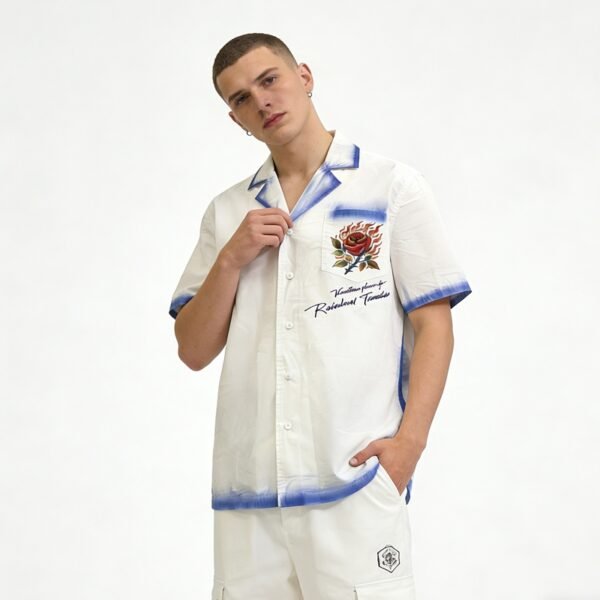




Developed around channel reinforcement, this short-sleeve shirt combines a pale base, blue edge spray effect, open camp collar, and rose chest artwork. The development priority is controlling drawcord or eyelet details so openings remain anchored, cleanly finished, and consistent across repeated production.
Reinforcement Around Drawcord And Eyelet Openings
Drawcords and eyelets introduce localized pulling forces that can distort lightweight shirt panels. A reinforced channel distributes that tension along a controlled path, while stabilized eyelet zones reduce stretching, puckering, and uneven cord movement during wear.
This image does not show a visible drawcord or eyelet, so the axis should guide a development option rather than an assumed finished feature. VeeWen can first map the proposed channel onto the collar, hem, or side seam before sample approval.
Blue Edge Spray Requires Controlled Panel Boundaries
The blue effect is visibly concentrated at the collar edges, sleeve hems, side edges, and lower hem. Those locations create a strong visual boundary, making channel width, seam allowance, and reinforcement placement important to prevent construction lines from interrupting the intended spray rhythm.
A controlled process should separate structural stabilization from the color treatment wherever possible. Otherwise, channel stitching or eyelet backing may alter absorption and create halos. The buyer should approve a physical sample showing reinforcement after the planned finishing sequence.
Camp-Collar Geometry And Opening Stability
The open collar forms a broad V-shaped opening above a center button placket. Because the collar points and front edge carry visual attention, any channel, cord exit, or eyelet must be positioned symmetrically and kept clear of the rose artwork and pocket edge.
The visible shirt has short sleeves, a straight body, and a single chest pocket, creating a relatively clean canvas for controlled openings. Reinforcement should follow the pattern's load paths without adding bulky ridges that compete with the relaxed resort-inspired silhouette.
Artwork Placement Must Survive Structural Decisions
The chest area combines a rose motif with script-style decoration beneath it, creating a vertically organized focal point. This placement leaves the lower body quiet, so construction deviations near the pocket or front placket could become more noticeable than on an all-over graphic.
VeeWen's workflow should lock the pocket pattern, artwork placement, and reinforcement map in one development review. Confirming these relationships together helps prevent a later eyelet or channel adjustment from shifting the decoration or narrowing the usable chest area.
Trade-Offs Between Reinforcement And Hand Feel
Additional channel layers, eyelet patches, or dense stitching can improve opening stability, but they may increase rigidity and show-through on a light-colored shirt. The correct balance depends on cord size, opening location, fabric behavior, and the desired softness at the body.
The blue edge treatment also raises a visual trade-off: stronger saturation can sharpen boundaries, while softer saturation preserves an irregular sprayed character. Buyers should decide whether structural reinforcement should disappear into the finish or remain an intentional technical detail.
Approval Checkpoint For Production Readiness
Before production, approve the exact opening package: drawcord presence, eyelet diameter, channel width, reinforcement material, and exit position. These details are not visibly confirmed in the supplied image, so they require a separate technical decision rather than silent interpretation.
Request a development sample that preserves the off-white ground, blue edge placement, rose chest decoration, and collar proportions. The final checkpoint is consistency across repeated panels, with special attention to channel alignment, eyelet anchoring, and artwork clearance.
Buyer Questions
Does the supplied image confirm drawcords or eyelets?
No. The image shows a collar, button front, pocket, and sprayed edges, while drawcord and eyelet construction must be specified and sampled separately.
What should buyers approve first for this style?
Approve the opening location, reinforcement map, spray boundaries, collar proportions, and artwork clearance together, because each decision affects visual balance and seam behavior.
Can the rose decoration be changed?
Yes. Artwork can be revised during development, but the buyer should confirm the selected decoration method, scale, placement, and interaction with pocket and placket construction.
What is the minimum order quantity?
The commercial minimum is MOQ: 100 pieces per style. Final quantities, colors, artwork versions, and construction details should be confirmed in the quotation.
Approve The Reinforcement Map
Send the intended opening details, artwork files, target measurements, and color references for review. VeeWen can then align the channel construction, spray boundaries, and chest placement before sample approval.



Reviews
There are no reviews yet.