


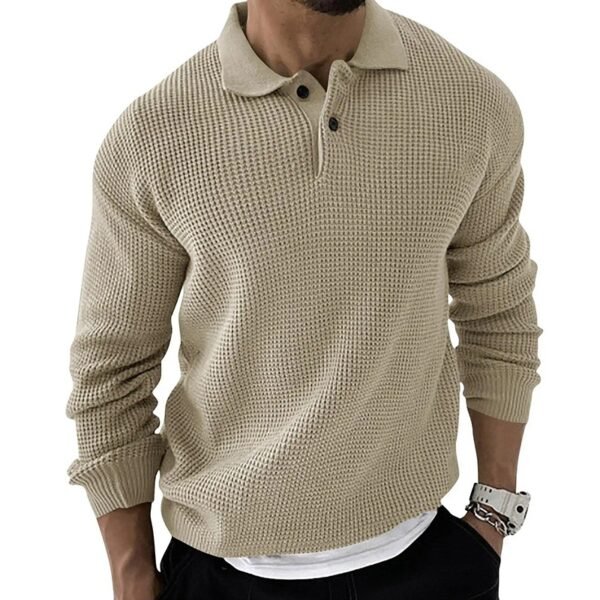


This custom men's lapel knit sweater is developed around a practical production question: how can a textured surface, structured collar, and visible underlayer support applique without creating unwanted thickness or waviness? The answer requires coordinated edge engineering before bulk approval.
Treat the Lapel as an Applique Control Zone.
The collar and short placket form the garment's most stable visual anchor. Their defined edges can help frame an applique, but the knit remains flexible, so placement must avoid interfering with button spacing, collar roll, or the transition into the textured body.
Because the image shows a pronounced collar rather than a plain crew neckline, the upper panel carries more visual structure and seam attention. Development should map the decoration away from fold lines, preserve comfortable neck movement, and keep the lapel silhouette readable after finishing.
Control Applique Edges on a Textured Knit.
The visible knit texture creates surface relief beneath any future applique, increasing the risk of uneven contact, edge lift, or a distorted outline. A development sample should therefore examine backing, attachment method, edge width, and local stabilization specifically on this textured construction.
Edge control is not only a decoration decision. A heavy or rigid applique may flatten the surrounding knit and create a visible step, while an undersupported edge may follow the texture inconsistently. The approval target is a clean perimeter that respects the sweater's tactile surface.
Manage Bulk Where Layers Meet.
The main image intentionally exposes a white garment beneath the sweater hem, making the product's layering profile part of its appearance. The sweater should retain enough ease to cover the underlayer cleanly without bunching at the waistband or pulling across the lower torso.
Bulk also accumulates at cuffs, collar, placket, applique backing, and any internal reinforcement. These areas should be reviewed together because reducing thickness in one location can shift pressure into another. The final balance should preserve warmth and shape without making the garment feel cumbersome.
Preserve a Slim Visual Profile.
The source wording identifies a slim sweater, and the image supports a streamlined appearance through close-set sleeves, a relatively neat torso, and controlled ribbed openings. That profile makes placement accuracy more important because distortion is immediately visible across the front panel.
A slim silhouette must still accommodate movement and the intended underlayer. Pattern review should compare chest ease, sleeve mobility, hem recovery, and applique clearance before size grading. If decoration increases stiffness, the buyer should decide whether to adjust placement, scale, or body ease.
Use Color to Clarify Surface and Decoration.
The primary image presents a dark olive green sweater, while the side references show beige, charcoal, brown, black, and another green direction. These observations establish a neutral color family, but they do not verify a final palette, dye standard, or shade tolerance.
Darker grounds can make a contrasting applique perimeter highly legible, yet tonal decoration may depend more heavily on edge definition and texture control. Development should evaluate the proposed artwork against the actual knit color, especially where the raised surface could soften small details or reduce contrast.
Build the Checkpoint into VeeWen Development.
VeeWen's workflow for this style should begin with a technical brief that records collar dimensions, placket spacing, applique boundaries, backing assumptions, and the intended white underlayer exposure. Those details connect the visual concept directly to pattern and decoration decisions.
The approval sample should be reviewed for edge flatness, collar behavior, layer clearance, cuff recovery, and overall profile in the same fitting session. Once the buyer confirms those interactions, VeeWen can carry the approved construction direction into the MOQ: 100 pieces per style production plan.
Buyer Questions
Is an applique already included on this sweater?
No applique is visibly present in the supplied image. The page treats applique edge control as the assigned development axis, so artwork, placement, attachment, and backing remain To Confirm.
What material is this men's sweater made from?
The image verifies a knit construction and textured surface, but it does not verify fiber composition or percentages. VeeWen should confirm the proposed yarn and material specification during development.
Can the white underlayer be part of the finished styling?
The image visibly shows a white layer beneath the hem, but its status is unverified. The buyer should confirm whether it is styling reference, a separate garment, or required allowance.
What is the minimum order quantity for development?
The commercial minimum is MOQ: 100 pieces per style. Final quantities, color allocation, decoration requirements, and production details should be confirmed after technical and sample approvals.
Approve the applique and layering brief.
Send the target artwork, color direction, collar preferences, and intended underlayer profile so VeeWen can align edge stability, bulk control, sampling checkpoints, and MOQ: 100 pieces per style planning.


Reviews
There are no reviews yet.