
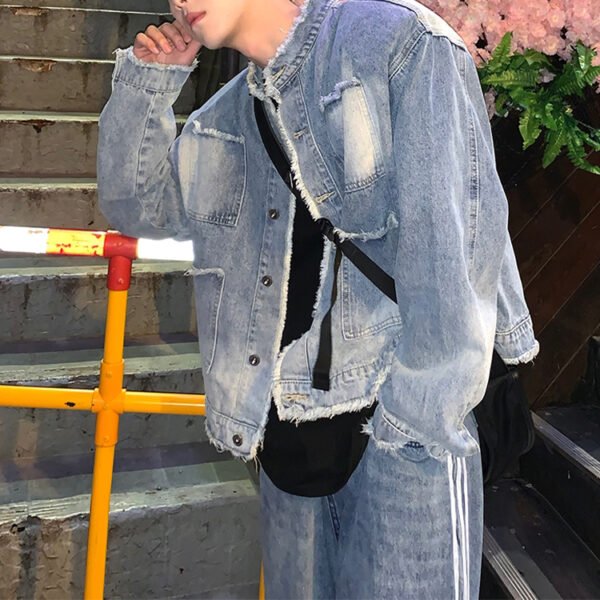
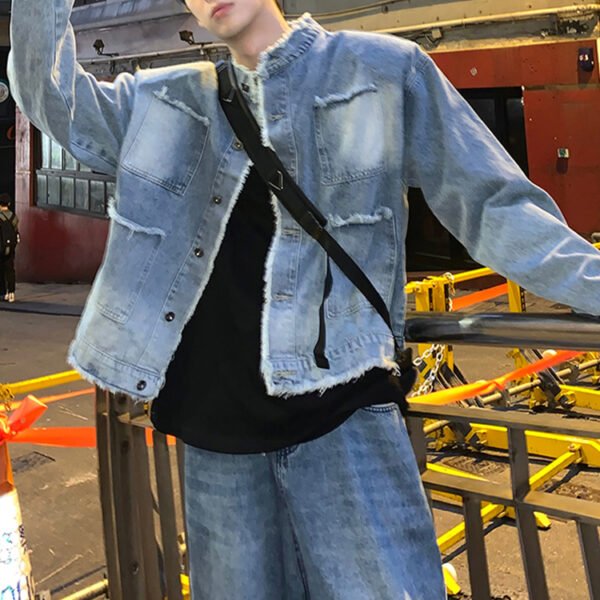


This custom men's denim jacket is developed around controlled fabric relaxation before cutting. That sequence matters because the visual identity depends on distressed edges, balanced pockets, a standing collar, and a stable button front that must remain aligned after washing.
Why Relaxation Comes Before the Pattern
Denim can change during handling, washing, and finishing. Relaxing the selected fabric before pattern cutting allows the development team to observe its settled state, reducing avoidable movement in body length, sleeve length, pocket openings, and collar placement.
This garment makes that control especially important because the image combines a cropped-looking body, broad sleeves, and a firm standing collar. If panels shift differently, the jacket can lose its intended balance even when the original pattern was accurate.
Reading the Wash as a Construction Requirement
The supplied image shows pale blue denim with irregular fading, lighter center areas, and darker seams. Those contrasts are not merely decorative; they expose panel orientation, seam positions, and any dimensional difference created after cutting or garment washing.
A buyer should therefore approve the wash direction alongside measurements. The target is a repeatable vintage appearance that preserves pocket symmetry and button spacing, while accepting that natural wash variation may remain between production pieces.
Pocket Placement Needs Settled Dimensions
Several front patch pockets create a visual grid across the torso. Their openings, corners, and top edges must be checked against the relaxed fabric state, because even modest growth can make the pockets appear uneven or change their usable opening.
The lower pocket area also sits near visibly frayed edges in the reference. During development, VeeWen can review pocket templates, reinforcement points, and edge allowance together, ensuring the distressed finish does not undermine the intended utility or alignment.
Standing Collar and Button-Line Control
The collar rises close to the neck and frames a straight center front. That relationship depends on stable collar length, balanced neckline shaping, and consistent front-panel dimensions after the denim has completed its relaxation and wash preparation.
The dark button row provides a clear approval reference through the center. VeeWen's sample review should measure button pitch, overlap, collar stand, and hem relationship together, so the visual line remains intentional rather than drifting through grading.
How VeeWen Develops This Specific Jacket
VeeWen's workflow for this style should begin with fabric relaxation records, followed by a measured pre-wash pattern and a controlled sample review. The team can then compare body, sleeve, collar, pocket, and edge behavior against the supplied visual direction.
Approval should focus on dimensional change by panel, not only overall appearance. Once the relaxed-state measurements and wash result are accepted, the graded pattern can be checked for consistent pocket relationships before the style moves toward production planning.
Buyer Approval Checkpoint
The key decision is whether the chosen denim reaches a stable working dimension before cutting while still delivering the requested vintage character. Buyers should review a sample after the relevant wash process, measuring all major points against agreed tolerances.
Approve the style only when collar height, button spacing, pocket placement, sleeve balance, and frayed-edge proportions remain coherent. If any area shifts noticeably, revise relaxation, pattern allowances, or finishing controls before placing the order.
Buyer Questions
Why relax the denim before cutting?
Pre-relaxation reveals how the fabric settles before panels are cut, helping the team control later measurement changes across sleeves, pockets, collar, and body length.
Is the shown wash recipe confirmed?
No. The image establishes a light vintage-wash direction, while the exact abrasion, laundering sequence, shade tolerance, and repeatability require buyer approval during sample development.
Can the pocket layout be adjusted?
Yes. Pocket dimensions, spacing, reinforcement, and placement can be reviewed as pattern decisions, provided the revised layout supports the intended proportions and production construction.
What must be approved first?
Approve the relaxed fabric behavior and washed sample measurements first, then confirm grading, pocket alignment, collar proportions, button spacing, and edge-finishing tolerances for production.
Approve the Relaxed-Denim Development Brief
Send your target measurements, wash references, and label requirements to begin a focused review of fabric relaxation, pattern stability, pocket alignment, and sample approval for this jacket.


Reviews
There are no reviews yet.