


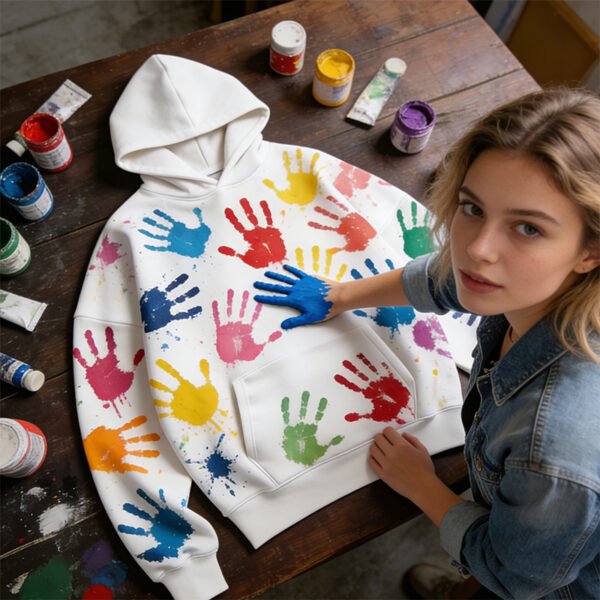


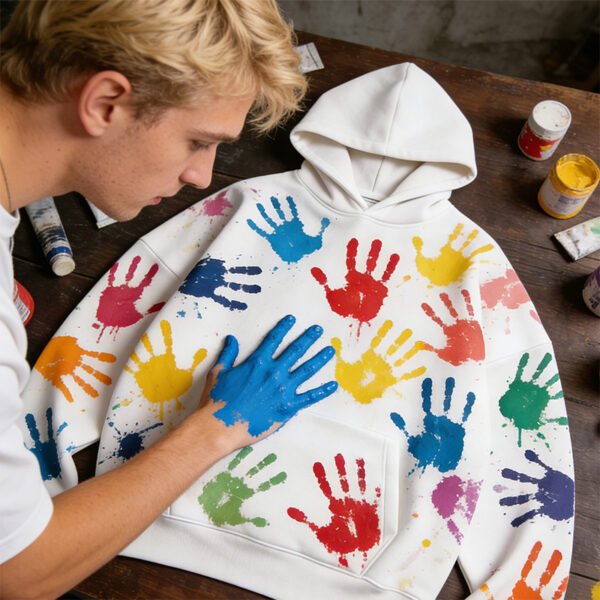

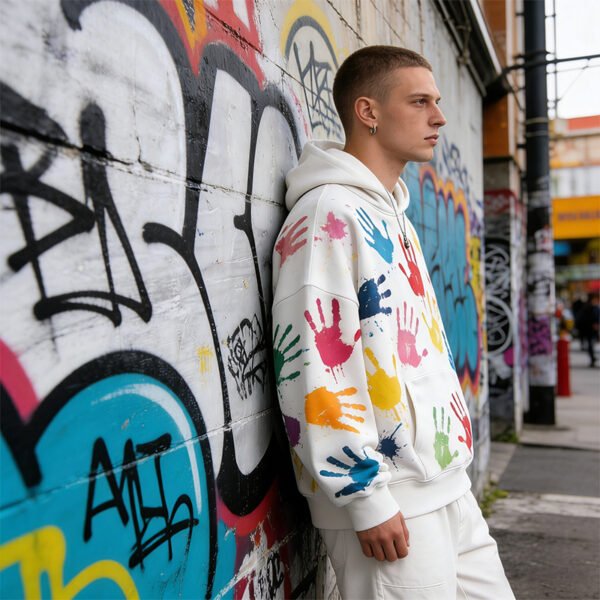







This pullover hoodie turns a white base into a mapped field of multicolor hand impressions. The development challenge is directional marker control: each print must retain recognizable fingers while keeping coverage, bleed, and material consumption commercially manageable across repeated production panels for approval.
Directional Artwork Requires a Marker Map
The visible artwork is not a single centered emblem; hand silhouettes travel across front, sleeves, pocket area, and lower panels. Each orientation changes finger spacing, edge exposure, and the amount of open white ground remaining around the mark.
For development, convert the visual field into a placement map before grading or cutting. Define permitted rotations, minimum distances from seams, and protected rib zones, then identify whether each hand is printed as an isolated unit or part of a controlled repeat.
Coverage Changes Material Consumption
Large hand shapes use more color than small partial impressions, while overlapping marks increase local material demand without necessarily improving recognition. The supplied image visibly mixes dense saturated hands with lighter, smaller gestures across the same white garment.
A commercial marker plan should therefore separate high-coverage colors from accent colors and establish an artwork allowance per panel. This supports more predictable replenishment and reduces the risk that late production batches become visually heavier or materially wasteful.
White Ground Makes Bleed More Visible
Against the white base, every soft edge, stray mark, or color migration becomes immediately noticeable. The image shows strong contrast between saturated pigments and clean surrounding fabric, so directional placement must protect the open ground that gives each hand definition.
Request strike-offs on the intended base fabric and inspect finger tips, palm interiors, and areas near pocket seams. Approval should cover edge sharpness, color separation, curing or setting method, and the appearance after an agreed care simulation.
Panel Boundaries Affect Recognition
The kangaroo pocket creates a separate front surface, and the sleeves introduce curved, moving zones. A hand that crosses a seam or disappears into a pocket opening can lose its intended silhouette, even when the artwork file itself remains accurate.
Build the artwork against production patterns rather than a flat front template. Mark pocket placement, hood overlap, armhole shaping, cuffs, and hem turnback, then review a sewn sample to confirm the hands remain legible after assembly and movement.
VeeWen Workflow Checkpoint: Artwork to Sewn Sample
At VeeWen, this axis should enter development during artwork engineering, before bulk material planning. The team can translate the supplied visual direction into panel files, placement tolerances, color separations, and a sample review focused specifically on coverage and marker usage.
The buyer checkpoint is a signed visual standard covering orientation families, clean zones, acceptable variation, and color density. Only after that standard survives panel review and a sewn sample should the style move toward the exact commercial minimum of MOQ: 100 pieces per style.
Approval Should Balance Expression and Control
The appeal comes from irregularity, but irregularity still needs boundaries when multiple garment panels and colors are produced repeatedly. Too much control can flatten the hand-made character; too little control can create uneven density, bleed, or escalating material consumption.
Approve the style when the sample preserves varied hand direction while meeting defined clean-zone and color-density limits. The final decision should document acceptable artistic variation, rejected defects, and the replenishment assumptions used for the 100-piece style minimum.
Buyer Questions
Can the handprint directions be changed for a collection?
Yes, direction families can be re-engineered, but each rotation should be checked against seams, pocket boundaries, clean zones, and the approved material-consumption allowance.
What should the first sample prove?
The first sample should prove hand recognition, color separation, edge control, pocket alignment, rib protection, and consistent artwork density on the intended base fabric.
Does the artwork need one fixed repeat?
Not necessarily. Controlled variation can preserve the expressive look, provided approved orientation limits, placement tolerances, and color-density rules remain documented for production.
What is the commercial minimum for this style?
The exact commercial minimum is MOQ: 100 pieces per style, subject to final artwork approval, material confirmation, and the agreed production specification.
Approve the Handprint Control Standard
Send the artwork direction, target color references, and preferred base fabric for a panel-mapped review. VeeWen can then align coverage limits, sample checkpoints, and MOQ: 100 pieces per style.



Reviews
There are no reviews yet.