

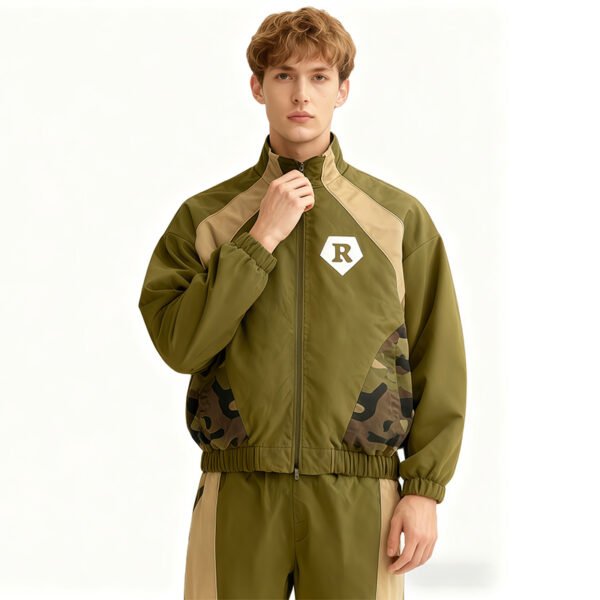
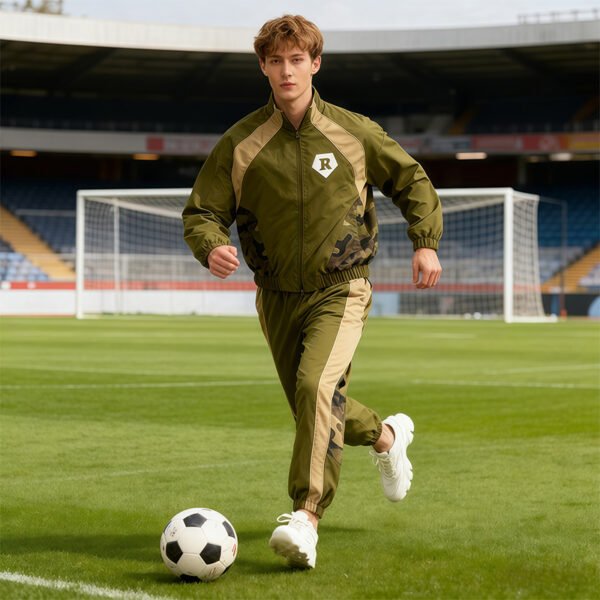

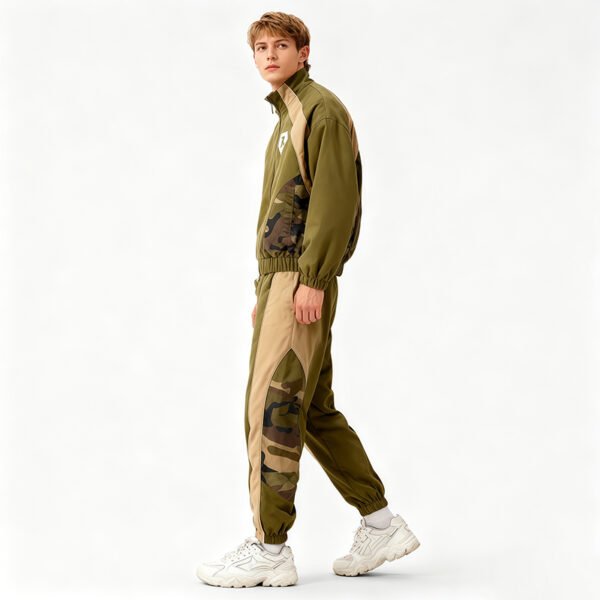


This coordinated tracksuit uses an olive base, camouflage interruptions, and gathered openings to create a technical streetwear set. Its development argument centers on pull resistance: closure points and nearby panel seams must withstand handling without separating, shifting, or breaking the visual continuity between jacket and trousers.
Where Pull Forces Concentrate
The image shows a centered zipper, gathered jacket hem, elastic-looking cuffs, and panel transitions near the sleeves and sides. If snaps or buttons are added, those points will experience concentrated outward force during dressing, layering, and movement across the coordinated set.
Reinforcement should be designed around the actual opening construction rather than added uniformly. Wider support can improve pull resistance, but it may stiffen the garment or show through lightweight panels, so placement, backing, and stitch density require sample-level approval.
Patchwork Creates Stress Boundaries
Camouflage inserts break the olive field along sleeve and side areas, creating seam boundaries with different visual directions and potentially different mechanical behavior. Each boundary must remain flat and accurately matched, because puckering can redirect force toward the nearest closure or gathered edge.
The development sample should identify panel grain, seam allowance, and matching rules for both jacket and trousers. More complex matching raises cutting and sewing control requirements, while simplified placement may improve repeatability but reduce the intended patchwork definition.
Closure Choice Must Match the Brief
The supplied main image clearly shows a front zipper, not snaps or buttons. The assigned manufacturing axis still requires a closure decision: retain the zipper alone, or introduce additional hardware at selected points where pull resistance becomes commercially important.
VeeWen should confirm hardware type, size, placement, and backing before the pattern is frozen. Snaps offer quick opening but can pull through unsupported fabric; buttons depend on secure stitching and a stable opening, while a zipper changes the stress path along its full length.
Gathered Openings Need Balanced Support
The cuff and waistband areas appear gathered, which helps create a compact sporty silhouette but concentrates recovery and handling forces. If closure hardware sits nearby, the transition between gathered fabric and smooth paneling can become a weak or visibly distorted zone.
Approval should compare opening circumference, gathering distribution, and hardware clearance on the jacket and trousers. Excessive gathering may increase local pull, while insufficient gathering can flatten the silhouette; the correct ratio should be established through the complete set sample.
VeeWen Product-Development Checkpoint
VeeWen's relevant workflow checkpoint is a coordinated set review: confirm the closure brief, map reinforcement zones, lock camouflage panel boundaries, and evaluate jacket and trouser openings together. Reviewing only the jacket could hide proportion or stress inconsistencies that become obvious when both pieces are worn.
The buyer should approve a sample with closure hardware installed exactly as intended, including backing and attachment method. Record any acceptable pull behavior, panel displacement, and visible puckering before grading, because those decisions define the production standard for every colorway.
Trade-Offs and Buyer Approval
Heavier reinforcement can reduce pull-out risk but may add stiffness, bulk, or a visible shadow beneath smooth fabric. More camouflage panels increase visual depth but create additional seam boundaries. A simpler closure may improve reliability, yet alter the intended sporty function and styling.
Before production, approve the complete hardware and panel package: closure type, reinforcement, attachment method, seam allowances, gathering ratio, and matching tolerances. The decision checkpoint is whether the set remains comfortable and visually coherent after repeated opening, movement, and normal handling.
Buyer Questions
Does the pictured tracksuit use snaps or buttons?
The supplied main image visibly shows a central zipper. Whether snaps or buttons supplement that closure remains a buyer decision requiring confirmation during development.
Why does patchwork affect closure pull resistance?
Panel seams create stress boundaries near openings. If reinforcement or seam alignment is inadequate, outward force can cause puckering, shifting, or hardware separation.
Can the jacket and trousers use different closure details?
They can, if the approved specification separates functional requirements by garment. The complete set sample should still review proportion, color balance, and coordinated hardware.
What is the minimum order quantity?
The required commercial minimum is MOQ: 100 pieces per style. Final quantities remain subject to approved specifications, colorways, and production planning.
Approve the Reinforced Set Sample
Share your panel map, closure brief, measurement chart, and hardware preference with VeeWen. Review pull resistance and coordinated fit on the complete set before authorizing MOQ: 100 pieces per style.



Reviews
There are no reviews yet.