


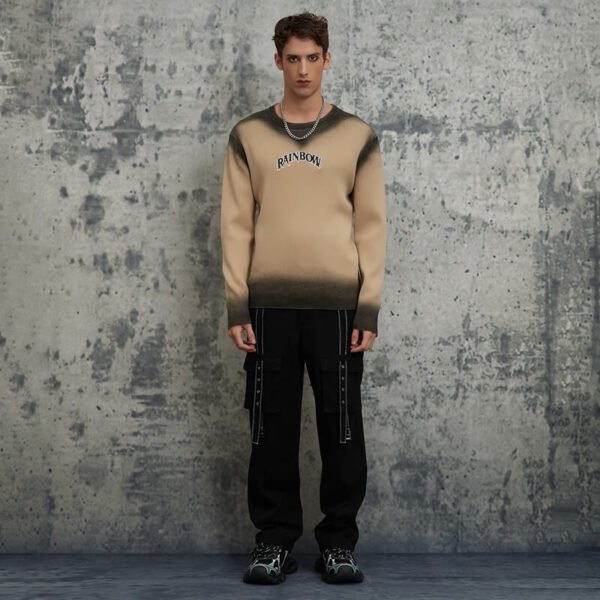


Develop this slim-fit sweater around post-process measurement recovery: its dense rib texture, dark-to-light body shading, and centered embroidered lettering make finished dimensions and motif placement inseparable from the approval decision for a repeatable streetwear program across sizes and production lots before bulk release.
Why Measurement Recovery Controls This Design
A rib-knit sweater does not hold every dimension identically through washing, steaming, drying, pressing, and handling. Loop relaxation can change body width, length, sleeve length, and opening circumference, so this silhouette must be measured after the intended finishing route.
The supplied image emphasizes a close body fit and long sleeves, leaving limited tolerance for drift. A small change at the hem or cuffs can change perceived proportion, while uneven recovery may shift the embroidered chest graphic away from its approved position.
Reading the Supplied Visual Evidence
The image shows fine vertical rib lines running consistently across the torso and sleeves, with a darker visual band around the neckline, lower hem, and cuffs. These details indicate that surface appearance depends on both knit definition and controlled finishing treatment.
The chest lettering sits centrally above the midline, while the body appears narrow through the torso and fuller toward the sleeves. Development should therefore record graphic coordinates and key width points together, rather than approving artwork independently from garment measurements.
Construction Variables to Confirm
Before sampling, confirm yarn composition, rib gauge, stitch density, and finishing sequence because each variable can influence relaxation and dimensional change. The supplied evidence supports rib texture visually, but it does not verify fiber percentages, GSM, or recovery performance.
The ombre appearance also needs a defined production method, whether knitted coloration, garment treatment, or another approved process. Any method should be reviewed for shade continuity at seams, edge zones, and embroidered areas without assuming an unverified technical process.
Embroidery and Dimensional Control
Letter embroidery adds localized weight and stiffness to a flexible rib surface. If the base fabric relaxes after decoration or finishing, the motif can appear wider, narrower, higher, or lower than its pre-finish placement, especially on a close-fitting chest panel.
The approval sample should document artwork size, stitch density, backing approach, and placement from stable reference points. Review the lettering after the complete finishing route, then compare it with the measurement chart and visual standard before authorizing graded production.
VeeWen Development Workflow Application
VeeWen should translate this axis into a recovery-led sample path: establish the intended finishing route, record pre-process measurements, complete decoration and finishing, then measure the relaxed garment against the approved technical points and artwork coordinates.
The useful decision is not simply whether the first sample looks correct. The buyer and VeeWen development team should identify where recovery changes the fit or graphic relationship, revise the pattern or process, and approve a post-finish tolerance before grading.
Approval Checkpoint for Bulk Release
Approve this style when the finished sample preserves the intended slim torso, sleeve length, rib opening behavior, shade placement, and centered embroidery after the agreed finishing sequence. Record each result by size so later production review has usable comparison points.
If recovery remains inconsistent, choose the corrective route deliberately: adjust pattern dimensions, stabilize the finishing process, revise the rib specification, or modify placement tolerances. The trade-off is additional development control in exchange for a more dependable visual and dimensional result.
Buyer Questions
What should be measured after finishing?
Measure body length, half-chest, shoulder, sleeve length, cuff opening, hem opening, and embroidery coordinates after the complete approved finishing sequence.
Does the image verify fiber composition or GSM?
No. The image supports visual construction observations only; fiber composition, yarn details, GSM, and performance characteristics require source documentation or confirmation.
Why review embroidery after dimensional recovery?
Rib relaxation can alter the fabric field supporting lettering, changing apparent scale or placement. Final review confirms the motif remains aligned with the approved garment proportions.
What is the commercial minimum for this style?
The commercial minimum is MOQ: 100 pieces per style. Final ordering remains subject to approved specifications, color requirements, sizing, and production planning.
Approve the Recovery Checkpoint
Send the target measurement chart, finishing expectations, embroidery artwork, and shade reference to begin a recovery-led sample review with VeeWen for this sweater style.


Reviews
There are no reviews yet.