
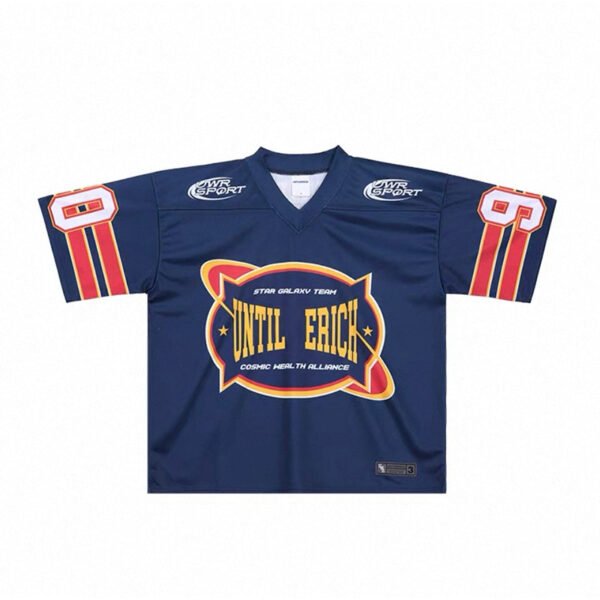


This oversize football jersey is a development study in controlling thickness where athletic graphics, neckline construction, sleeve attachments, and labels converge. The supplied image shows several decorated zones that must remain visually crisp without making key seams bulky, stiff, or difficult to sew consistently.
Why Intersections Control the Outcome
The visual identity depends on several layers arriving at the same zones. Sleeve numbers extend toward shoulder joins, while shoulder patches sit close to those joins. If thickness is not planned, needle penetration, seam flattening, and edge alignment can vary across production.
The V-neck adds a separate concentration point because binding, front body panels, and graphic placement share limited space. A successful sample should show a smooth neckline, stable shoulder line, and no visible distortion where decoration approaches structural seams.
Decoration Stack and Handling
The image presents large sleeve numerals, small shoulder emblems, and a dominant chest graphic. These elements should be separated in the technical file by decoration type, placement boundary, edge tolerance, and sequence, allowing the sewing line to avoid unnecessary layer accumulation.
Trade-offs are practical. Thicker applications may create stronger visual relief but increase stiffness and bulk; flatter methods may improve sewability while changing perceived depth. VeeWen should confirm the intended hand, edge definition, and decoration process against the approved artwork sample.
Sleeve Construction and Number Placement
The broad sleeves provide high visibility for the contrasting numerals, but their placement near the shoulder can influence sleeve-setting accuracy. The pattern should reserve a clear seam allowance and establish a measured distance from the armhole, sleeve hem, and side edge.
Because the number graphics span a wide surface, distortion can become obvious when the sleeve hangs or moves. Development review should inspect both flat and worn positions, checking that stripes remain balanced and that the decoration does not pull the sleeve seam out of alignment.
Chest Graphic Clearance
The large chest emblem occupies the central front and approaches the lower visual area without reaching the hem. Its scale makes small placement errors noticeable, especially if the front panel shifts during printing, pressing, or sewing. A controlled center line is therefore essential.
The buyer should decide whether the chest graphic is printed, transferred, embroidered, or assembled from applications after reviewing a physical strike-off. Each route changes bulk, flexibility, color appearance, and registration risk, so the chosen method must be documented before size-set approval.
VeeWen Development Checkpoint
VeeWen can translate this jersey into a focused development sequence: first lock the relaxed block and seam allowances, then map every decoration boundary against collar, shoulder, sleeve, chest, and hem construction. This keeps bulk decisions connected to pattern engineering rather than handled afterward.
The approval sample should be reviewed at the actual decoration stack, not a simplified substitute. VeeWen's team can use that sample to confirm sewing order, pressing access, edge tolerances, and inspection points before the buyer releases the style for bulk quotation and production planning.
Approval Standard for Bulk Readiness
Bulk readiness should be judged at the intersections most likely to expose inconsistency: V-neck points, shoulder joins, sleeve-number edges, chest artwork boundaries, and the lower hem label. The garment should lie flat, retain its intended oversize balance, and avoid visibly raised seam congestion.
Before approval, the buyer should confirm final artwork, decoration route, material composition, measurements, seam allowance treatment, and acceptable appearance tolerance. The commercial checkpoint is not simply whether the jersey looks attractive; it is whether the complete construction remains repeatable.
Buyer Questions
What is the primary development risk for this jersey?
The primary risk is accumulated thickness where sleeve graphics, shoulder details, collar construction, chest decoration, and labels approach structural seams during sewing.
Is the polyester composition fully verified?
Polyester appears in the supplied source wording, but the exact fiber percentage, fabric weight, knit construction, and finishing details require written confirmation before approval.
What should the first sample prove?
The first sample should prove neckline smoothness, shoulder alignment, decoration registration, sleeve balance, seam thickness, and the intended oversize proportion using the final decoration stack.
What is the minimum order quantity?
The required commercial minimum is MOQ: 100 pieces per style, with final specifications, approvals, and production conditions confirmed during the development process.
Approve the Decoration and Seam Map
Send the target measurements, artwork files, color references, and decoration preferences so VeeWen can prepare a sample focused on seam-bulk control and intersection approval.


Reviews
There are no reviews yet.