


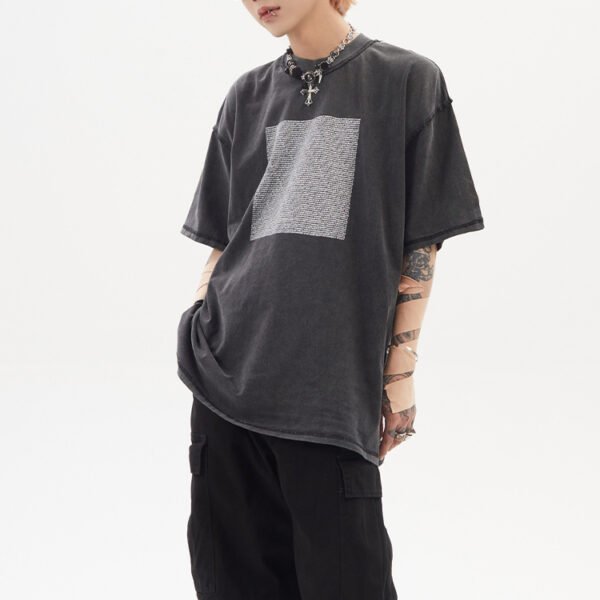


This oversized black crew neck T-shirt turns a simple rectangular chest treatment into a demanding alignment exercise. VeeWen develops the style around stable cutting references, controlled sewing sequence, and post-finish measurement, helping buyers approve a graphic-led silhouette whose visual balance depends on disciplined placement.
Why the Rectangle Controls the Entire Front.
The front design is visually quiet but geometrically unforgiving. A large, nearly rectangular gray field sits on an otherwise open black body, so uneven edges, rotation, or lateral drift become more noticeable than they would within a dense, irregular allover composition.
The oversized silhouette increases that exposure because the broad torso creates strong negative space around the design. Placement must therefore be evaluated against the garment centerline, neckline, shoulder drop, and finished hem rather than referenced only to an isolated cut panel.
Establishing Reliable Cutting References.
VeeWen would translate the approved artwork dimensions into panel-specific registration points before assembly. The front panel grain, fold alignment, and cut perimeter must remain stable because skew introduced during spreading or cutting can make a correctly positioned application appear rotated after sewing.
The buyer should define whether the gray field is a print, applied panel, transfer, or another technique during development. Each method introduces different edge behavior, shrink response, and handling requirements, so the technical package must identify the process before tolerances become meaningful.
Managing Distortion During Assembly.
Dropped shoulders and a wide body can shift freely while operators handle the garment, especially when the front carries additional surface work. A controlled sewing sequence should prevent neckline attachment, shoulder joining, or side-seam feeding from pulling the center reference away from its approved position.
Stabilization must suit the selected fabric and decoration method without creating a rigid patch around the rectangle. The objective is not merely straight edges on the table; the approved result must remain visually square when the completed shirt hangs naturally on body.
Accounting for the Washed Appearance.
The visible black surface has a faded, washed character, including lighter tonal definition near seams and edges. If that appearance is created through garment finishing, dimensional movement may occur after the rectangle has been positioned, making post-finish inspection essential for final approval.
A pre-finish placement target and a finished-garment target should be treated as connected controls. Sampling can reveal whether the body twists, the rectangle changes proportion, or contrast shifts after processing, allowing pattern, artwork, or finishing parameters to be adjusted deliberately.
Balancing Geometry With Oversized Drape.
The long torso, dropped shoulder line, and wide sleeves create a relaxed vertical fall. The rectangle should reinforce that proportion rather than visually crowding the collar or floating too close to the hem, making worn-position review more useful than flat measurements alone.
Trade-offs arise when buyers enlarge the artwork, deepen the wash, or increase garment ease. A larger block magnifies edge irregularity, stronger finishing may alter contrast and dimensions, while additional width changes perceived centering even when measured placement remains technically equal.
VeeWen Development and Approval Workflow.
VeeWen can begin with the buyer's target measurements, artwork file, color direction, and intended application method. Pattern and decoration references are coordinated so the sample tests the actual relationship among neckline, shoulder drop, rectangle boundaries, and finished body length.
Approval should use a measurement sheet plus clear front-view photographs on a hanger or fit model. Before bulk authorization, the buyer should sign off rectangle width and height, center offset, top position, edge character, washed color, and acceptable post-finish skew.
Buyer Questions
How should the rectangular chest field be measured?
Measure its finished width, height, distance from the high-point shoulder or neckline reference, and offset from the garment centerline. Record the method consistently for both flat and post-finish inspection.
Can the faded black finish affect placement accuracy?
Yes. Garment finishing may change dimensions, twist the body, or alter perceived contrast. Development should compare pre-finish references with finished measurements before the buyer approves production tolerances.
What decoration method is included in this reference?
The image confirms a contrasting rectangular surface treatment but not its production method. Printing, transfer, applique, or another technique remains To Confirm according to artwork and hand-feel requirements.
What is the minimum order quantity?
MOQ: 100 pieces per style. Colorways, size ratios, decoration details, labels, packing, and material commitments should be consolidated into the approved order specification before manufacturing begins.
Approve the Geometry Before Production.
Send VeeWen your artwork dimensions, target fit, fabric reference, finish direction, and labeling requirements. We will structure development around the rectangle's finished position, visible edge quality, and the buyer-approved oversized silhouette. MOQ: 100 pieces per style.


Reviews
There are no reviews yet.