
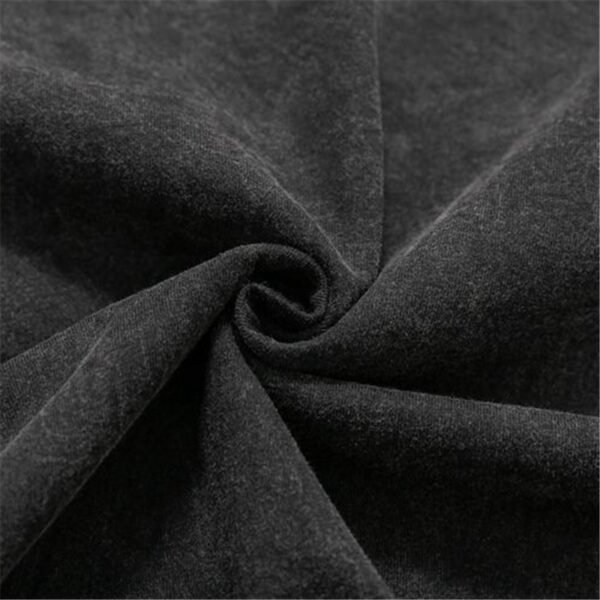
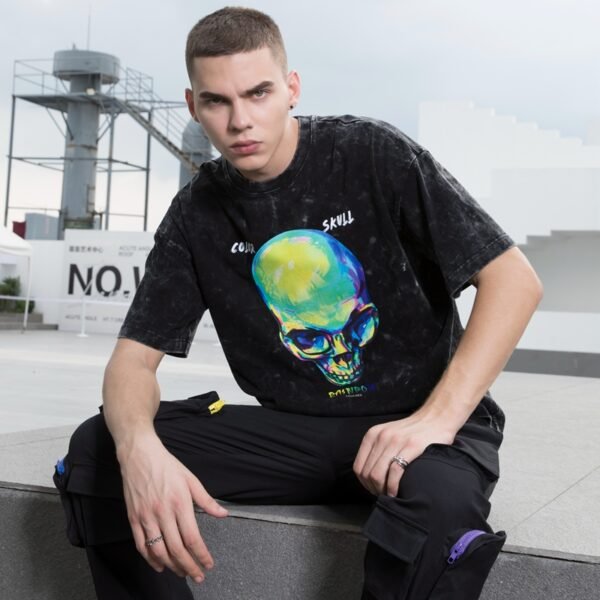







This custom oversized cotton T-shirt should be developed as a surface-led product: fabric weight establishes presence, while heat-transfer artwork supplies the recognizable finish. The supplied image shows a dense dark textile with strong folding depth, making handfeel, print placement, and recovery central approval points for buyers.
Why Garment Treatment Leads the Argument
The supplied fabric image presents no visible plated hardware; instead, its dark, compact surface and central twist make texture, drape, and finish the dominant visual signals. That shifts development attention toward treatment choices surrounding artwork, washing, and final handfeel.
Heat-transfer artwork can create a clean graphic focal point without introducing metal components that interrupt the shirt's soft surface. Buyers should therefore judge whether the decoration remains visually integrated with the substantial fabric, especially across oversized panels and relaxed sleeve proportions.
Fabric Weight and Surface Behavior
The source wording identifies 230 GSM cotton, while the image shows folds holding defined ridges around the gathered center. Together, those references support a development hypothesis of noticeable body, but the final hand, shrinkage, and recovery remain approval items.
A heavier T-shirt can support a structured oversized outline, yet excess stiffness may reduce comfort or distort artwork across movement zones. VeeWen should confirm fabric swatches, pattern balance, and post-treatment appearance before locking the production construction for the intended market.
Artwork Placement as a Construction Decision
On an oversized body, artwork placement must account for wider fronts, longer hems, dropped shoulders, and sleeve volume. A graphic positioned correctly on a standard block can appear too low, too narrow, or visually detached after proportion changes.
VeeWen's development workflow can map artwork boundaries directly against the approved pattern and sample measurements, then review transfer positioning on the actual garment. This connects decoration approval to pattern engineering, reducing the risk that a technically crisp graphic loses balance in the finished silhouette.
Surface Treatment Trade-Offs
Treatment can add depth, softness, or controlled variation, but every intervention may alter color consistency, print contrast, and perceived fabric weight. The charcoal-black image already carries tonal variation through folding, so additional treatment should be selected for purpose rather than novelty.
Buyers should compare untreated, washed, and decorated sample panels under consistent lighting. The checkpoint is whether the chosen treatment strengthens the intended surface story while preserving readable artwork, stable dimensions, and a commercially repeatable appearance across the order.
VeeWen Development Workflow
For VeeWen, this axis becomes a staged approval sequence: first confirm cotton quality and weight, then test the oversized block, then place artwork against the graded pattern. Each stage should preserve the relationship between fabric body and visual treatment.
The next approval should review a decorated sample after the proposed finishing process, focusing on handfeel, print edge behavior, tonal consistency, and proportion. That sample gives the buyer a concrete basis for authorizing bulk specifications under MOQ: 100 pieces per style.
Buyer Approval Checkpoint
Before production approval, buyers should sign off on the exact fabric reference, measured oversized dimensions, artwork file, transfer location, and intended treatment. These decisions define the product more materially than any optional hardware detail for this particular concept.
The final decision is whether the garment still reads as substantial, comfortable, and visually coherent after decoration and finishing. If the surface treatment competes with the graphic or weakens the silhouette, revise the sample before confirming the production standard.
Buyer Questions
Is the 100% cotton and 230 GSM specification confirmed?
Those details appear in the supplied source wording, but VeeWen should confirm the final fabric composition, measured GSM, tolerance, and approved swatch before production.
Why is hardware plating less important for this T-shirt?
The supplied image shows no visible hardware, while the fabric surface and heat-transfer decoration carry the visual identity. Hardware remains optional, not central.
What should the first sample prove?
The first sample should prove oversized proportions, fabric body, artwork scale, transfer integration, surface treatment, and dimensional behavior after the proposed finishing process.
What is the commercial minimum?
The exact commercial minimum is MOQ: 100 pieces per style. Final quantities, color allocation, packaging, and production details should be confirmed through the quotation process.
Approve the Surface-Led T-Shirt Direction
Send the artwork, target measurements, preferred fabric hand, and treatment direction to VeeWen for a focused development review and sample approval under MOQ: 100 pieces per style.



Reviews
There are no reviews yet.