

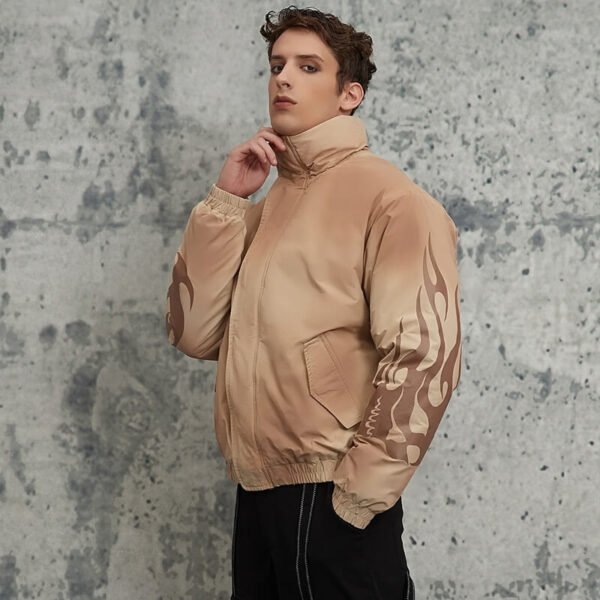
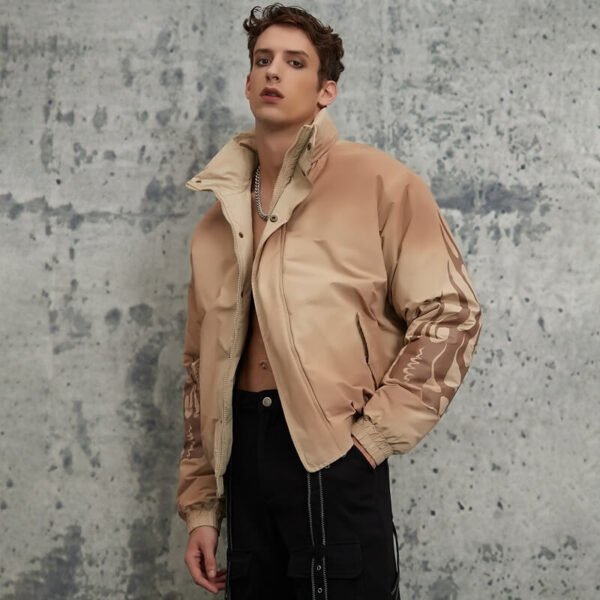








This puffer is developed around raw-edge containment and durability, using its oversized volume, gathered openings, and sleeve artwork as a focused engineering problem for streetwear production. The approval question is whether exposed transitions remain clean while the jacket flexes, compresses, and repeatedly contacts bags or outer layers.
Containment Starts At The Openings
The image concentrates attention at the hem and cuffs, where elastic gathers pull shell panels inward. Those transitions should receive a defined seam allowance, secure edge finish, and controlled stitch density so raw layers cannot migrate during wear, packing, or repeated size grading.
The collar adds another containment checkpoint because its upright shape holds multiple layers close to the neck. VeeWen development should map shell, interlining, lining, zipper tape, and collar edge relationships before approval, ensuring the closure remains smooth without trapping bulk inside the top seam.
Quilting Must Support The Oversized Volume
A generous body can look relaxed while still demanding disciplined internal support. Quilting layout should distribute insulation and shell movement across the broad front and back panels, preventing loose fill from pressing unevenly against contained edges or creating distortion around the central zipper.
The visible jacket presents relatively uninterrupted torso surfaces, which makes panel alignment especially important. During development, VeeWen can use the approved measurement chart to test quilting scale, seam placement, and grading behavior so larger sizes preserve the intended proportion without excessive edge strain.
Printed Sleeves Create Abrasion Zones
The sleeve graphics sit on areas that naturally fold, brush against surfaces, and contact adjacent garments. Their placement therefore changes the durability brief: the print method, curing process, and base fabric interaction must be assessed alongside seam containment rather than treated as decorative finishing.
The supplied image shows artwork extending across both forearms while cuffs gather below it. A development sample should examine the lower print boundary, fold lines, and cuff entry for cracking, lift, or visual crowding, then adjust artwork scale or clearance where movement creates concentrated stress.
The Front Closure Needs Clean Layer Control
The central zipper and covered front area form the jacket's most visible vertical line. Containment depends on consistent tape positioning, stable topstitching, and a clean overlap that prevents shell or lining edges from catching during operation, especially where the puffer's loft pushes layers outward.
VeeWen's product-development workflow should lock the zipper specification, placket width, collar height, and stitch sequence in one construction review. That checkpoint connects the durability argument to practical assembly decisions, allowing the team to identify bulky intersections before grading or bulk production approval.
Elastic Recovery Determines Long-Term Shape
Gathered cuffs and hem create the compact finish visible in the image, but elastic recovery controls whether that finish remains intentional. The specification should identify elastic width, insertion method, tension target, and replacement allowance, with raw-edge containment preventing the elastic channel from opening under repeated pull.
Trade-offs should be made consciously. Stronger gathering can improve wind-blocking appearance and edge control, yet excessive tension may restrict movement or distort printed sleeves. The buyer should approve a balanced tension after reviewing the jacket on-body and flat, across the full size range.
Approval Requires A Containment Review
The final review should focus on physical transitions rather than general appearance alone. Inspect collar ends, cuff interiors, hem channels, zipper placket edges, quilting intersections, and printed sleeve folds for exposed layers, puckering, skipped stitches, or inconsistent compression after handling.
The buyer's approval checkpoint is a documented sample review covering construction, print behavior, opening recovery, and graded proportions. Once those observations are resolved, VeeWen can carry the approved technical package into the requested MOQ: 100 pieces per style production route.
Buyer Questions
Is the jacket made from wool fabric?
Woolen fabric appears in the source wording, but fiber percentages, blend details, insulation, lining, and final shell construction remain To Confirm during development.
Can the sleeve artwork be changed?
Yes, artwork placement, scale, color, and technique can be developed against the sleeve fold zones, subject to sample review and approved production specifications.
What should the first sample test?
Check raw-edge containment, zipper alignment, elastic recovery, quilting distribution, sleeve-print durability, collar comfort, and proportion across the intended size range.
What is the minimum order?
The commercial minimum is MOQ: 100 pieces per style, after the buyer approves the construction, materials, artwork, measurements, and color direction.
Approve The Durability Sample
Send the target measurements, artwork, and material preferences for a containment-focused sample review covering openings, print zones, zipper layers, and graded proportions.


Reviews
There are no reviews yet.