


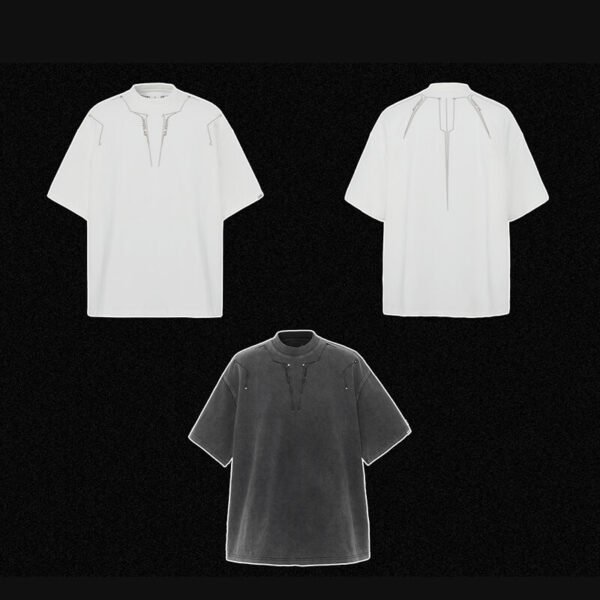
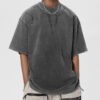



This custom washed rivet T-shirt is built around raw-edge containment and durability. Its heavyweight 260GSM cotton reference, washed charcoal appearance, oversized body, and visible hardware-led detailing create a development challenge: preserve controlled distress while preventing edge growth, distortion, or attachment failure.
Raw Edges Need a Defined Failure Boundary
Raw-edge detailing creates visual irregularity by exposing or distressing the cut edge, but the effect becomes unreliable when yarns continue opening. The development target is a deliberate boundary: enough looseness to show character, with construction controlling how far the edge can progress.
The supplied image shows distressed linear details near the upper front, while the source wording identifies a washed rivet tee. Buyers should approve edge width, placement, and allowable change after laundering, because these details may expand differently across seams, openings, and reinforced zones.
Rivets Concentrate Stress at Small Points
Rivets can anchor a visual detail and distribute local movement through a small hardware point, yet they also create concentrated stress around the fabric. Hole size, backing, setting pressure, and distance from the edge must be coordinated to avoid tearing or unwanted puckering.
The image visibly presents multiple attachment points around the upper garment area. VeeWen should test the selected rivet finish on the approved cotton before production release, checking whether the hardware remains secure and whether the surrounding fabric still lies cleanly after washing.
Heavyweight Cotton Changes Edge Behavior
The supplied source wording explicitly references 260GSM heavyweight cotton. A heavier knit may support the oversized body and give distressed details more visual substance, but it can also resist soft curling, increase seam bulk, and make raw-edge transitions appear abrupt.
That trade-off should be resolved through sample construction rather than assumed from GSM alone. Compare edge treatments, reinforcement widths, and seam finishes on the specified fabric, then evaluate comfort and appearance after the intended wash process has been confirmed.
Wash Development Must Protect the Design Intent
The washed charcoal appearance in the supplied main image suggests that color variation and surface character are central to the product direction. Washing can alter shrinkage, edge exposure, seam torque, and rivet surroundings, so raw-edge approval before washing is incomplete.
The buyer should review the garment both before and after the designated wash route. Record acceptable shade range, distress development, dimensional change, and hardware condition, then use those observations to establish a practical approval standard for later production lots.
Oversized Proportion Adds Construction Load
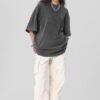
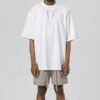
The supplied image shows a broad body, dropped shoulder impression, and extended short sleeves. Those proportions increase the visual area around each detail and can magnify small distortions; a shifted rivet or widening edge may become immediately noticeable against the large uninterrupted panel.
Pattern and construction reviews should therefore assess balance at the same time as durability. Confirm body width, sleeve length, hem behavior, and detail placement in relation to one another, ensuring the oversized shape supports the distressed concept instead of exposing inaccuracies.
VeeWen Workflow: Contain, Wash, Then Release
VeeWen should document the raw-edge map, reinforcement method, rivet locations, fabric reference, and wash route in one development brief. The fit sample establishes proportion; the treated sample then confirms whether edge progression and hardware behavior remain within the buyer's approved boundaries.
The release checkpoint is a laundered, fully inspected sample with signed detail tolerances and measurements. Buyers should approve the exact distressed appearance, attachment security, and dimensional result before proceeding under MOQ: 100 pieces per style for bulk production.
Buyer Questions
What makes raw-edge containment important on this garment?
Containment keeps intentional distress within an approved boundary, reducing uncontrolled fraying, shape distortion, and inconsistent appearance after washing or repeated wear.
Are the 260GSM and cotton references verified?
Yes. The supplied source wording explicitly states 260GSM heavyweight cotton, while fiber percentages, finish standards, and final material testing remain To Confirm.
What should be checked on the rivet sample?
Check hole size, backing, setting security, surrounding puckering, edge distance, and post-wash condition before approving the hardware specification for production.
What is the minimum order quantity?
The commercial minimum is MOQ: 100 pieces per style, with approved wash, material, measurements, hardware, and construction details required before bulk release.
Approve the Contained-Distress Standard
Share your target wash route, hardware preference, and acceptable edge change so VeeWen can validate containment, durability, oversized proportions, and the final laundered appearance.


Reviews
There are no reviews yet.