



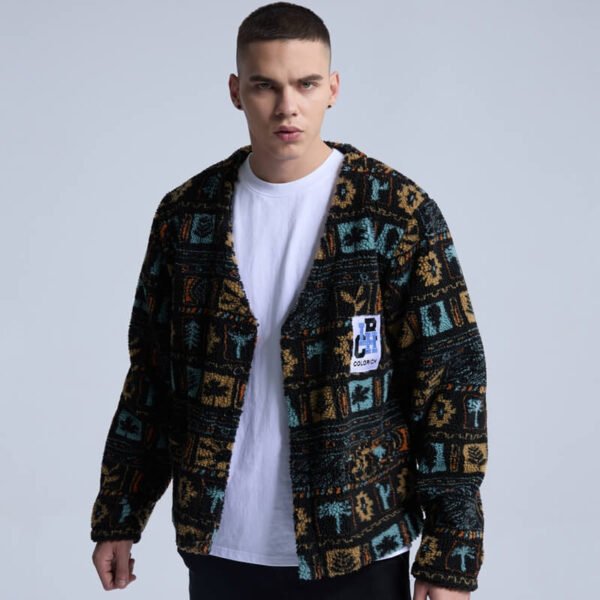





This custom printed fleece jacket is developed around pocket position and load reinforcement. Its dense geometric surface, compact outerwear shape, and visible chest application leave little room for misplaced utility details, making access, stress points, and print continuity central approval decisions.
Pocket Position Shapes Daily Function
The supplied image shows a compact jacket with a dense patterned front and a small applied chest detail. Because the visible surface is already busy, any added pocket must be positioned for access without making the torso appear crowded or unbalanced.
Pocket coordinates should be evaluated against chest width, side seams, hem level, sleeve movement, and the wearer's natural hand path. A few centimeters can change whether the pocket feels useful, decorative, restrictive, or visually disconnected from the jacket's proportions.
Load Paths Begin at the Opening
A pocket carries force through its opening, corners, bag attachment, and surrounding shell fabric. On fleece, those forces may distort the surface or pull the print when users repeatedly insert hands, phones, keys, or other everyday items.
Development should therefore define opening length, entry angle, pocket-bag depth, and attachment route before choosing reinforcement. The correct solution may combine bartacks, internal tape, binding, layered fleece, or another construction detail, but the final method remains To Confirm.
Print Continuity Is a Construction Constraint
The jacket's geometric print is made of repeated blocks and contrasting motifs, so pocket placement can interrupt the visual rhythm even when the pocket is technically centered. Misregistration at the opening or flap can make the garment look accidental rather than intentionally engineered.
VeeWen should review the print layout together with pocket patterns, seam allowances, and applied chest details. Where continuity matters, the technical package can identify matching points and acceptable visual breaks before panels are cut and assembled.
Reinforce Without Making the Front Heavy
Reinforcement adds stability, but excessive layers can create stiffness, visible ridges, or an uneven hand across a soft fleece body. The supplied image suggests a relatively clean front, so utility should remain integrated rather than turning the pocket area into a bulky block.
The buyer should compare reinforcement options for appearance, flexibility, and handling comfort. Internal solutions may protect the stress area while preserving the printed face, although the final construction must be selected through sample review and material confirmation.
Workflow Checkpoint: Test Access and Stress
VeeWen's development workflow should begin with a pocket map over the printed front, followed by a construction sheet identifying openings, bags, corners, attachment seams, and reinforcement zones. The first sample should make pocket access and print disruption easy to inspect.
A representative wear and load review can check whether openings remain accessible with the jacket closed, whether contents pull the shell, and whether repeated handling affects print alignment. Findings should become measured revisions rather than informal comments about general quality.
Buyer Approval: Confirm Utility and Balance
Before production approval, the buyer should decide whether the pockets serve a clear carrying purpose while preserving the jacket's compact silhouette and patterned front. The chest application, sleeve movement, and hem relationship should be reviewed at the same checkpoint.
Approve when pocket access feels natural, reinforcement remains visually controlled, and the print maintains an intentional rhythm around openings and seams. The final specification should record the approved coordinates, stress treatments, and any acceptable visual tolerance for motif interruption.
Buyer Questions
Can pockets be added without disrupting the printed pattern?
Yes, pocket patterns and print layouts can be coordinated, but matching points, seam allowances, and acceptable motif breaks should be approved before cutting.
What areas usually need reinforcement on jacket pockets?
Openings, upper corners, lower corners, bag attachments, and nearby shell seams commonly require review, with the final treatment determined by material behavior and intended load.
Is the fleece weight specified in the source evidence?
No. The source wording identifies fleece, but exact fiber content, weight, backing, stretch, and performance characteristics require material confirmation during development.
What is the minimum order quantity?
The commercial minimum is MOQ: 100 pieces per style, subject to approved artwork, fabric, pocket construction, measurements, and the final production specification.
Approve Pocket Engineering Before Production
Share the print artwork, target pocket use, and preferred fleece reference with VeeWen for a development review covering placement, reinforcement, access, motif continuity, and sample approval.



Reviews
There are no reviews yet.