
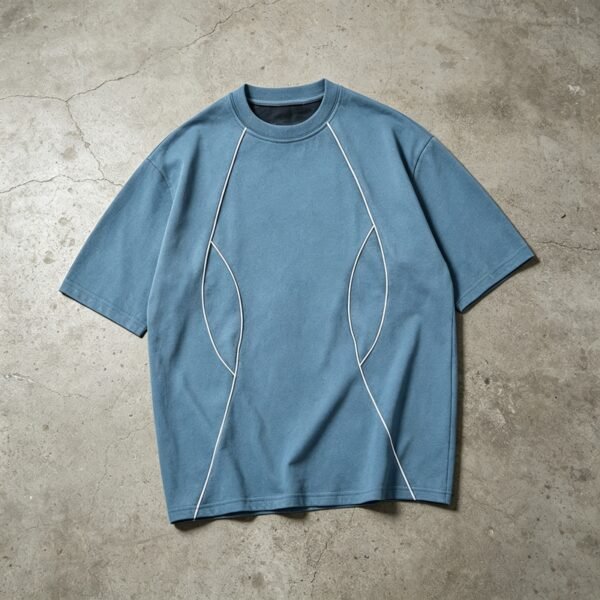






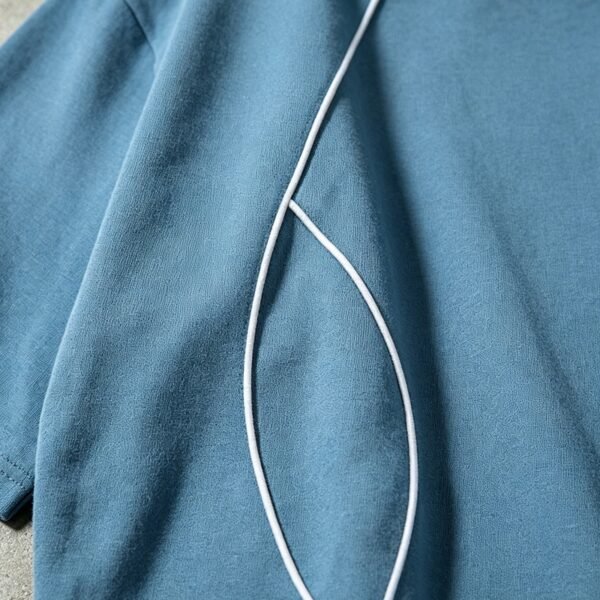









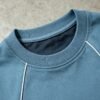
This custom oversized T-shirt turns a simple front into a controlled surface study: pale piping traces the blue body with deliberate continuity, while the unprinted image exposes proportion, seam placement, and fabric behavior. For development, the key decision is how future graphics meet that already-defined linear structure.
Piping Establishes the Graphic Boundary
The image shows pale piping traveling from the upper shoulder region, curving beside the chest, and continuing toward the lower hem. That route creates a visible boundary system, so artwork should be positioned with measured clearance rather than treated as an isolated central print.
Because the body is dusty blue and the trim is light, even a modest registration shift would be noticeable where artwork approaches the piping. VeeWen's development review should therefore map graphic safe zones against the actual sewn route before approving screens or transfers.
Ink Film Must Support the Garment Surface
The reference image does not show a printed graphic, which is useful because it leaves the base surface unobstructed for evaluating future ink behavior. A heavy film could interrupt the relaxed drape, while an overly thin deposit may lose definition across the broad front.
The approval sample should compare artwork coverage, edge sharpness, and perceived hand feel after normal folding and movement. The objective is not maximum surface build; it is a controlled film that remains readable without making the piping and print feel visually disconnected.
Oversized Proportion Changes Placement Risk
The relaxed body presents a generous front field, but its width also increases the distance between artwork and the curved piping. A graphic that looks centered on a flat table may appear displaced when the garment hangs naturally, especially across the lower torso.
Development should assess the print while the T-shirt is laid flat and worn on a fit model or form. Buyers should confirm optical centering relative to the piping, neckline, and hem, rather than relying only on a rectangular measurement grid.
Neck and Hem Keep the Composition Quiet
The ribbed crew neck and straight lower hem provide stable horizontal anchors around the curved trim. Their restrained treatment helps the piping carry the visual identity, leaving room for a small chest mark or controlled front graphic without creating competing focal points.
A practical trade-off is that minimal framing exposes every imbalance. VeeWen can use the approved neckline, hem, and piping measurements as fixed reference points, then adjust artwork size only when the complete front composition remains calm and proportionate.
VeeWen Workflow Converts Evidence into Approval
VeeWen should begin by recording the supplied image's piping path, blue color reference, neckline proportion, and broad front area as development checkpoints. The next review can test artwork scale and edge treatment against those checkpoints without changing the garment's underlying visual logic.
At the sample stage, buyers should inspect the sewn piping before judging print quality, then review both together under consistent lighting. Approval should cover route continuity, graphic clearance, ink-film hand feel, and optical balance, with unresolved variables marked To Confirm.
Trade-Offs and Final Production Gate
A sharper, higher-build ink film may deliver stronger contrast, but it can feel more noticeable and compete with the piping's tactile line. A softer deposit may integrate better with the knit, though fine edges and small details may require stricter artwork control.
The final checkpoint is a combined garment approval: confirm piping contrast, artwork registration, edge clarity, surface hand feel, and fit appearance after handling. Once these decisions are signed off, the style can proceed under the agreed technical specification and MOQ.
Buyer Questions
Can this style include a front graphic?
Yes, the broad front offers placement potential, but artwork must be cleared against the curved piping route so contrast, registration, and optical centering remain controlled.
What should buyers assess in the first sample?
Review piping continuity, artwork clearance, edge definition, ink-film hand feel, and worn appearance together. Flat inspection alone may conceal proportion shifts across the oversized body.
Is the cotton composition confirmed?
No. Cotton appears in the source wording, but exact fiber composition, weight, and finishing details require confirmation during material development and specification approval.
What is the commercial minimum?
The exact commercial minimum is MOQ: 100 pieces per style. Final quantities remain subject to approved materials, construction details, artwork, and production documentation.
Approve the Surface Logic
Send your artwork direction and target hand feel for a focused review of piping clearance, graphic edges, color contrast, and sample checkpoints before committing the style to production.


Reviews
There are no reviews yet.