


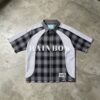
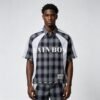



This panelled button-down is developed as an alignment exercise: a plaid ground, striped inserts, curved seam lines, and raw edges must cooperate so the shirt looks intentionally engineered rather than accidentally mismatched.
Alignment Begins With the Pattern Map
Plaid is directional and repetitive, so the pattern must establish matching points before cutting begins. A panel that looks acceptable in isolation can fail once it meets the front, sleeve, or side seam, especially when the design introduces curved boundaries.
The supplied image shows the plaid body interrupted by pale curved inserts, making those transitions highly visible. VeeWen should map dominant horizontal and vertical lines across the body, then identify which visual breaks are intentional and which require matching.
Curved Inserts Increase Cutting Sensitivity
Curved panels change the apparent angle of surrounding checks and stripes, even when the fabric is cut accurately. The pattern therefore needs clear notches, grain instructions, and matching references at both ends of every insert before marker planning begins.
The light side panels in the image sweep inward toward the lower torso, while the sleeve areas carry separate striped sections. This creates multiple alignment relationships that should be reviewed on paper and in toile form before final fabric cutting.
Front Closure Is a High-Visibility Checkpoint
The center button line divides the plaid body and becomes an immediate test of repeat continuity. If left and right fronts are cut without a matching plan, the closure can look skewed even when the buttons and placket are sewn correctly.
A development sample should inspect collar points, placket edges, button spacing, and chest artwork together. The image presents a centered front treatment, so the production file should protect that visual axis while allowing the chosen repeat to remain technically workable.
Raw Edges Need Controlled Irregularity
Raw edges can support a deliberately unfinished direction, but uncontrolled fraying changes measurements and may obscure the intended panel geometry. The edge treatment must define where irregularity is welcome, where seam allowances remain protected, and how the garment behaves after handling.
Source wording references raw edges, and the image visibly shows frayed lower and sleeve edges. VeeWen should approve the edge appearance from a physical sample, documenting trimming tolerance and the point at which natural fraying becomes a quality concern.
VeeWen Workflow Protects the Visual Seams
VeeWen can convert this shirt into a panel alignment workflow by creating a seam map before sampling. The map should identify plaid matching points, stripe grain, curved insert endpoints, front-center references, and raw-edge boundaries as separate approval items.
Once the first sample is reviewed, corrections should be traced back to pattern pieces and marker placement rather than handled only at sewing. This keeps the approved alignment repeatable across sizes, while shrinkage and fabric behavior remain open until material confirmation.
Approve Continuity Before Surface Extras
The buyer's approval checkpoint is a full-garment alignment review, not merely a print or label review. Inspect the front repeat, shoulder transitions, sleeve stripes, curved inserts, collar, and hem together under consistent lighting before releasing production specifications.
Screen print and woven labeling can be finalized after the panel relationships are stable. If surface details are approved first, later pattern corrections may move artwork or labels. The commercial decision should prioritize repeat continuity, edge control, and the MOQ: 100 pieces per style.
Buyer Questions
Is 100% cotton confirmed?
The supplied source wording states 100% cotton, but weave weight, shrinkage behavior, and finishing details still require material documentation and approval.
Why is plaid matching central to development?
Plaid repeats make seam errors visible, while curved contrast panels alter visual direction; mapping and checking those relationships protects the intended engineered appearance.
Can raw edges remain intentionally frayed?
Yes, provided the approved sample defines acceptable irregularity, protected seam areas, trimming tolerance, and behavior after handling or laundering review.
What is the minimum order?
The commercial minimum is MOQ: 100 pieces per style, with final quantities, colors, and specifications confirmed through the approved development record.
Approve the Panel Alignment Map
Share your repeat priorities, artwork, size range, and edge preference so VeeWen can review the pattern, sample the seam relationships, and confirm production checkpoints.


Reviews
There are no reviews yet.