
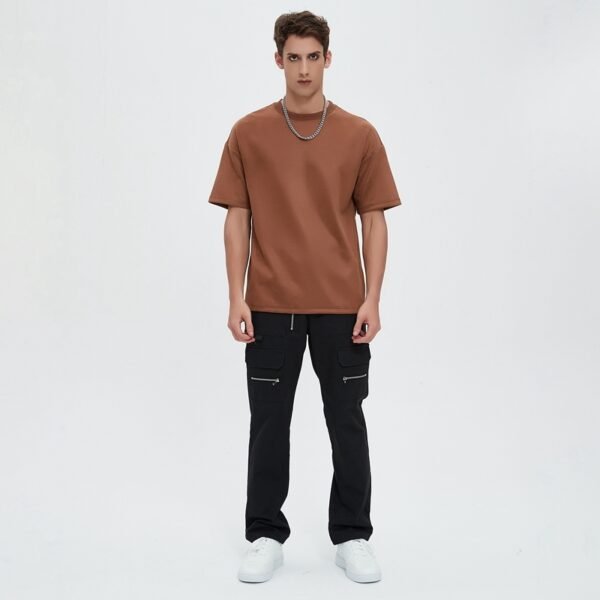
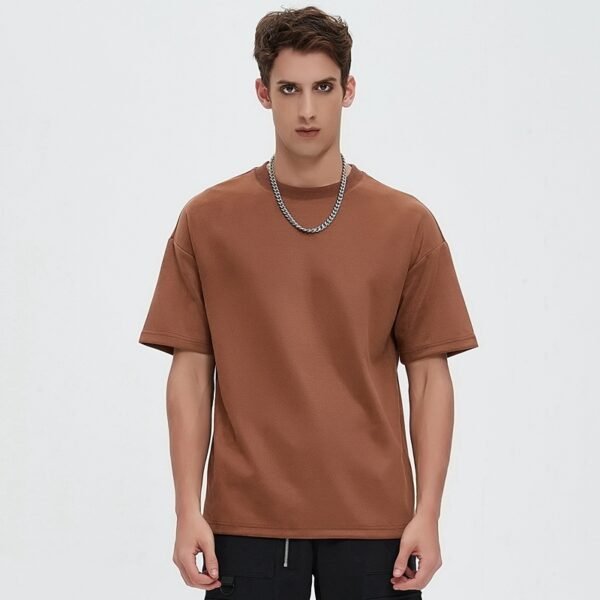
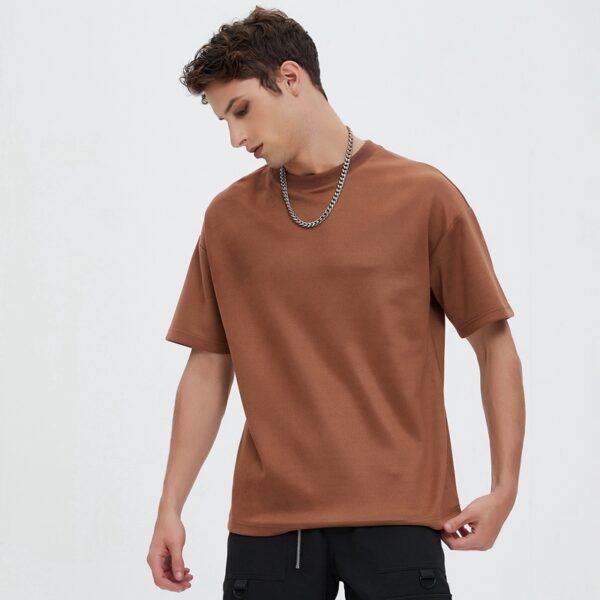

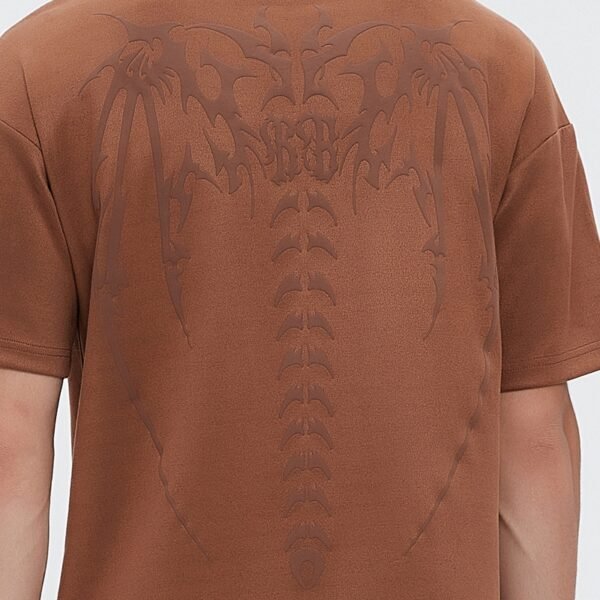
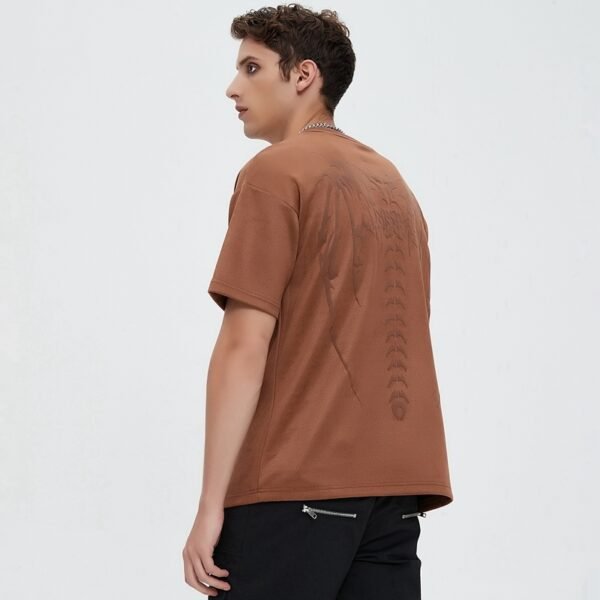
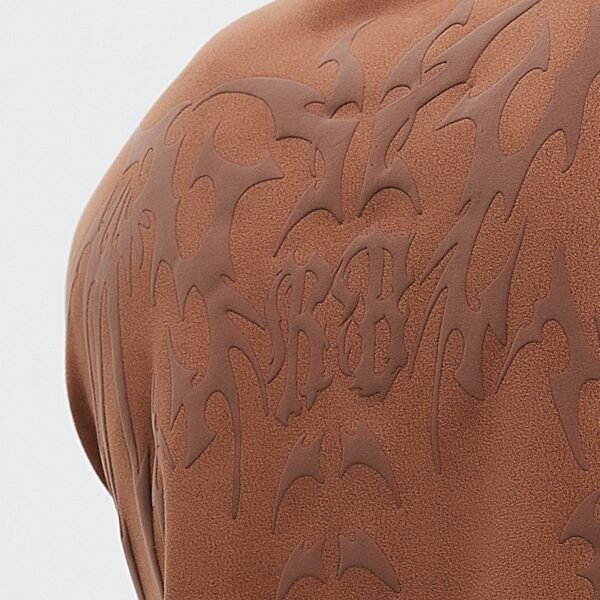
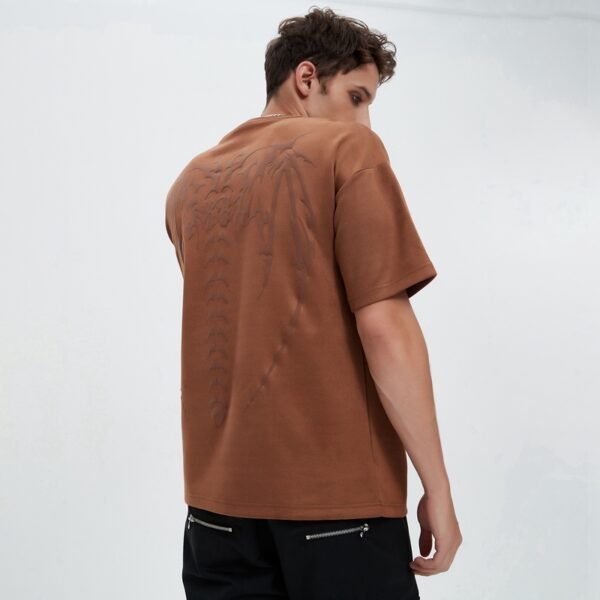
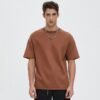
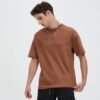
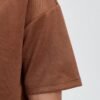
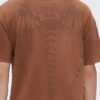
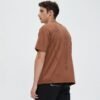


This oversized tee is organized around registration: every panel boundary must meet cleanly before a raised graphic is applied. The supplied image shows a broad, uninterrupted front in warm brown, while the source wording adds puff print, soft suede fabric, and a dark graphic direction.
Why Seam Accuracy Comes First
Color-blocking is controlled at the pattern and sewing stages, not corrected by print placement afterward. A small panel shift changes the apparent centerline, shoulder balance, and relationship between the graphic and neckline, which becomes more visible on an oversized front with generous surface area.
The supplied image presents a clean brown front without visible panel boundaries, so the development sample must make the intended color divisions explicit. That sample should show joined panels, measured seam positions, and the artwork together before any raised print is approved.
Reading the Tee Evidence
The main image shows a warm-brown crew-neck tee with short sleeves, broad shoulders, and a straight, roomy body. These proportions create a large graphic field, but they also magnify small distortions around the chest, armholes, and side seams when the garment hangs naturally.
The source wording identifies a dark graphic, puff print, soft suede fabric, and breathable crew neck. Those references guide development, while the image confirms the silhouette and visible body color; composition, surface weight, and exact graphic appearance remain technical checkpoints.
Pattern Registration Across Panels
Before cutting, VeeWen should establish notches and reference lines that carry from front panels through shoulder joins and side seams. Matching these points makes the color-block structure repeatable and gives the print team a reliable coordinate system for artwork placement.
Oversized garments can relax differently across wide panels, especially when a soft surface changes during handling. A paper pattern, cut-panel review, and sewn-body inspection should therefore precede printing, allowing seam alignment to be corrected while access remains straightforward.
Puff Print and Seam Interaction
Raised print changes both the visual weight and tactile height of the graphic. If it crosses a seam or lands too close to a panel join, uneven support can create an inconsistent edge or make the artwork appear displaced when the body is worn.
The artwork should be positioned after the assembled body has been measured, not only from flat pattern dimensions. VeeWen can compare the approved chest coordinates against neckline, shoulder, and side-seam references so the decoration remains balanced across the finished silhouette.
Trade-Offs in Color-Block Construction
Sharper color-block transitions demand closer cutting and sewing control, while simpler panel layouts reduce alignment risk but may limit the intended visual structure. More seams can also alter drape, hand feel, and the amount of uninterrupted area available for a raised graphic.
The buyer should decide which boundaries are commercially essential and which can be simplified. A clear hierarchy helps protect the signature panel relationship without adding construction that offers little visual value or introduces avoidable distortion near the print zone.
VeeWen Development Checkpoint
VeeWen's workflow should translate the reference into a measured tech pack covering panel map, seam tolerances, artwork coordinates, print height, neckline construction, sleeve proportions, and fabric confirmation. The team can then review a sewn, unprinted body before evaluating the finished decoration.
The approval checkpoint is a fully assembled sample with confirmed panel colors and puff print. Check seam continuity, chest centering, graphic clearance, neckline balance, body measurements, surface appearance, and wash-care direction before authorizing MOQ: 100 pieces per style.
Buyer Questions
Does the image confirm the dark graphic placement?
No. The supplied image shows a clean brown front, while the source wording references a dark graphic; artwork placement and final appearance require an approved development sample.
Can color-block panels be added to this silhouette?
Yes, paneling can be developed through revised patterns, but seam positions, color boundaries, artwork clearance, and resulting drape should be reviewed together before approval.
What fabric details are currently verified?
Only the source reference to soft suede fabric is available; fiber content, GSM, knit structure, finishing, and breathability claims remain To Confirm.
What is VeeWen's minimum order?
VeeWen's exact commercial minimum is MOQ: 100 pieces per style, subject to approved specifications, construction details, decoration method, and production documentation.
Approve the Registered Tee Sample
Share your panel map, graphic artwork, color targets, size range, and fabric expectations with VeeWen, then approve the assembled printed sample before confirming MOQ: 100 pieces per style.



Reviews
There are no reviews yet.