


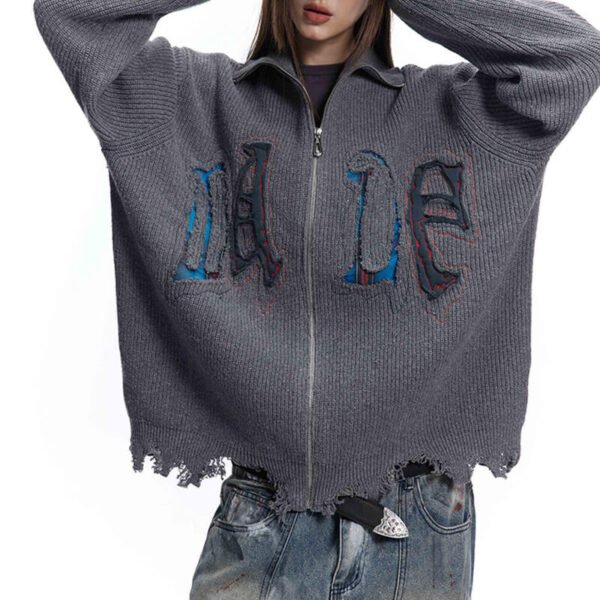


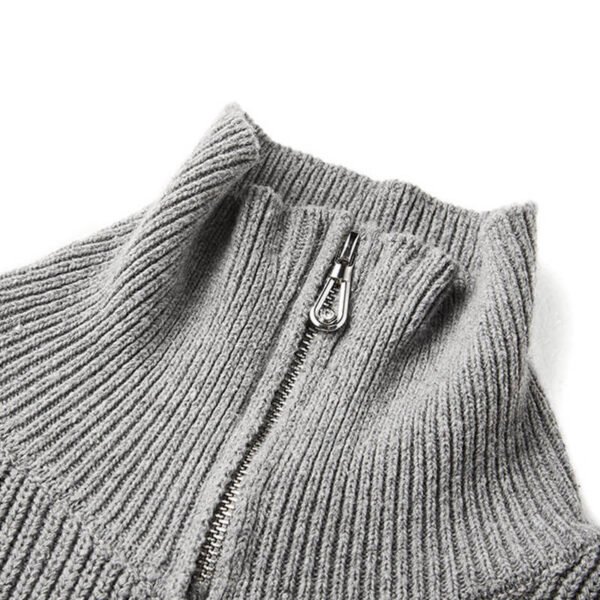





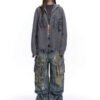


This zip-up sweater is built around a functional proportion question: how large can the puller become before it competes with the embroidered front? The supplied image shows a prominent zipper, hooded neckline, black knit body, and graphic embroidery requiring coordinated clearance.
The Puller Sets The Front Scale
The supplied image places a visible metal puller at the center of a dark zip opening, making it a strong proportion cue. Its length, width, and attachment point influence how the neckline, hood, and embroidered graphics are read together.
VeeWen should establish puller dimensions alongside the front pattern rather than selecting hardware after embroidery. The buyer should approve a proportion sheet showing puller size, zipper tape width, neckline depth, and graphic clearance before sampling begins.
Clearance Protects Embroidery
Front embroidery appears on both sides of the zipper and includes tall, contrasting letter-like forms. Because the artwork approaches the center opening, even small placement shifts could cause the puller, slider, or zipper tape to interrupt the intended graphic balance.
During development, the embroidery file and zipper installation should share one centerline reference. Review the closed and open garment positions, since a graphic that clears the zipper when flat may become crowded when the sweater is worn or partially unzipped.
Hood And Neckline Need Room
The hood rises directly from the upper zipper area, while the visible opening creates a narrow operational zone around the puller. Excessive hardware scale could catch against the hood edge, distort the neckline, or make the first pull difficult to engage.
VeeWen's sample review should test the puller with the hood folded, raised, and worn open. Confirm whether the puller remains easy to grasp without dragging the neckline, then record the approved clearance as a construction requirement rather than a styling preference.
Slider Travel Must Stay Clean
A full-length zipper has to travel through several changing zones, including the neckline, chest, waist, and ribbed lower edge. The image indicates a continuous center closure, so slider movement and bottom insertion must remain practical across the complete front length.
The development checkpoint is a repeated open-close test on the assembled sample, followed by visual inspection of nearby knit panels. Buyers should check that the puller does not snag embroidery, catch loose yarns, or twist the zipper path during normal operation.
Rib Finishing Changes The Exit
The lower edge appears intentionally irregular above a ribbed-looking hem zone, adding contrast to the structured zipper line. This juxtaposition makes the lower zipper exit important: bulky or poorly placed hardware could disturb the hem shape and weaken the intended layered finish.
VeeWen should confirm zipper length, bottom-stop position, rib attachment, and lower edge treatment as one assembly. Approve the sample only when the puller reaches its endpoint cleanly and the hem retains its planned character after repeated operation.
Approval Connects To Production
For this sweater, VeeWen's workflow should carry the approved centerline from artwork placement into pattern engineering, zipper selection, puller specification, knit assembly, and sample testing. The purpose is continuity: every department works from the same clearance relationships visible on the front.
Before ordering, confirm yarn composition, gauge, fabric weight, zipper finish, puller dimensions, embroidery density, and wash behavior as To Confirm items. MOQ: 100 pieces per style applies once the technical and commercial approvals are aligned.
Buyer Questions
Can the puller be made smaller or larger?
Yes, puller size can be adjusted, but each option should be tested against zipper travel, hood clearance, embroidery spacing, and the finished front proportion.
Is the sweater composition verified as cotton?
No. Cotton fabrics are mentioned in the source wording, while exact composition, yarn specification, gauge, and fabric weight require confirmation.
What is the minimum order quantity?
MOQ: 100 pieces per style. Colorways, size ratios, hardware choices, and final development costs should be confirmed in the order brief.
Which sample details need priority approval?
Prioritize puller dimensions, zipper operation, centerline placement, hood clearance, embroidery spacing, lower zipper exit, and ribbed hem behavior.
Approve The Puller Proportion
Share your artwork, preferred zipper direction, measurement chart, and hardware reference with VeeWen. Review the fully assembled sample for clearance and operation before approving bulk production.



Reviews
There are no reviews yet.