





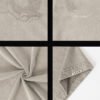
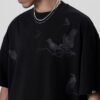
This T-shirt development centers on a quiet but technically demanding contrast: dense tonal raven artwork must remain visible while heavyweight jersey supports a deliberately oversized streetwear shape. The approval target is a balanced decoration package, stable body, and repeatable measurements across the size range.
Decoration Density Must Follow the Artwork Map
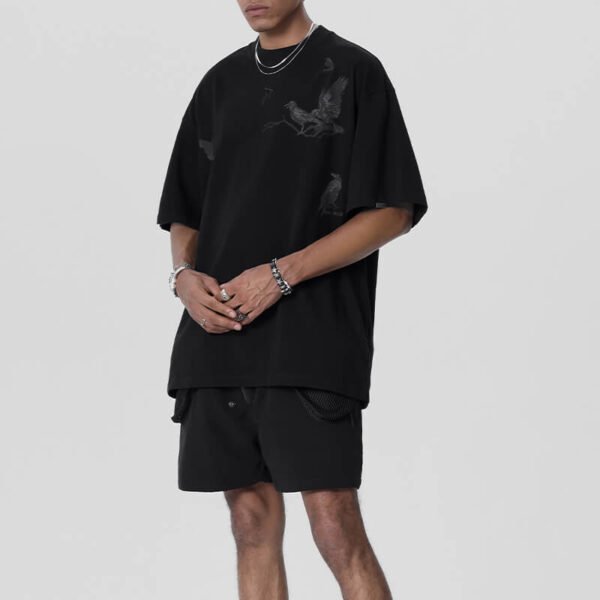
The image presents dark motifs against a black body, so visibility depends on edge definition rather than bright contrast. A dense raven graphic can lose separation when stitch coverage, underlay, or print deposit is excessive, making the artwork appear flat and weakening the intended tonal effect.
VeeWen should first lock the artwork map by motif, location, and scale, then sample the most crowded chest and sleeve areas. The review should record thread or ink behavior, edge clarity, puckering, and visual weight before the design is graded across sizes.
Heavyweight Jersey Needs Controlled Stability
The stated 250GSM heavyweight reference suggests a substantial base suited to oversized proportions, but fabric weight alone does not guarantee dimensional stability. Relaxation, cutting direction, seam tension, and decoration loading can alter body width, sleeve hang, and hem alignment after processing.
For this style, the base-fabric checkpoint should compare unworked panels with decorated panels and measure the same landmarks after laundering or the agreed finishing sequence. This isolates whether the artwork process or the jersey itself drives movement in the silhouette.
Oversized Proportions Magnify Small Errors
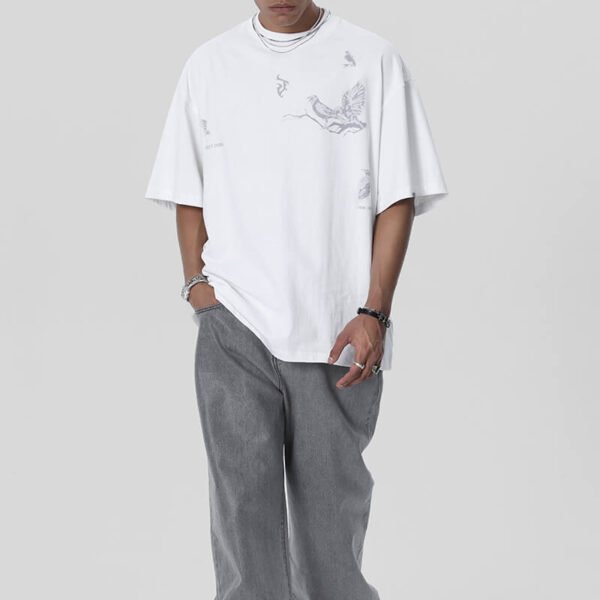
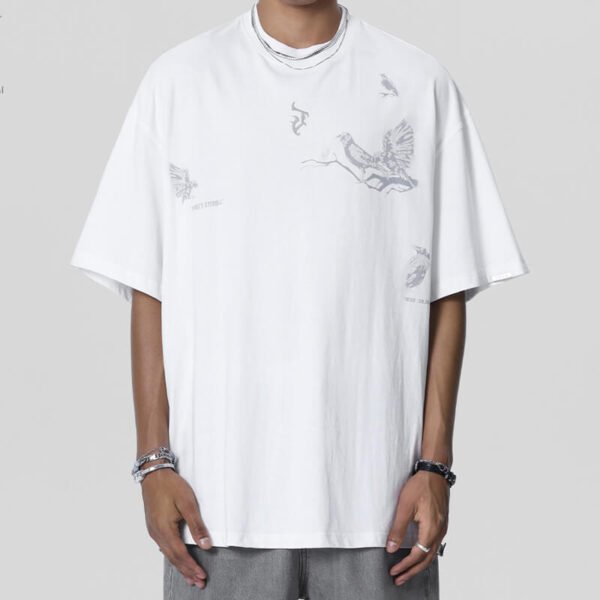
The supplied image shows a long body, dropped shoulder impression, and generous sleeve volume. On this shape, a small shift in chest artwork or shoulder seam can look intentional at one size but become visibly misplaced when the pattern is graded without a fixed placement reference.
The development file should therefore define artwork coordinates from stable pattern landmarks rather than from raw garment edges. VeeWen can use center front, shoulder point, armhole, and hem references to preserve the same visual relationship through approved size samples.
Tonal Artwork Requires a Deliberate Finish
Black-on-black decoration creates a restrained finish, yet it is unforgiving of inconsistent surface texture. Raised embroidery may introduce a tactile shadow, while a tonal print may preserve a flatter hand; each route changes perceived density, care requirements, and the way the motif catches light.
The buyer should approve the decoration route against the supplied visual direction, not only a color chip. The sample review should examine daylight and angled light, then confirm whether subtle visibility or stronger texture better serves the collection's positioning.
VeeWen Workflow: Lock the Risk Area First
VeeWen's product-development workflow should begin with a targeted risk sample containing the densest raven motif, the most exposed sleeve placement, and the full heavyweight jersey body. This concentrates review effort on the interaction between artwork loading, panel stability, and oversized balance.
After the risk sample is approved, the specification can expand into graded patterns, placement files, decoration instructions, and measurement tolerances. The production record should retain the approved sample as the visual and dimensional reference for the 100-piece-per-style order threshold.
Approval Checkpoint: Readability Versus Handfeel
The central trade-off is straightforward: more decoration coverage can increase motif definition, but it may also add stiffness, visual heaviness, or localized distortion. A lighter treatment may preserve softness and drape while reducing the raven's visibility against the black base.
Approve the style when the buyer accepts a defined balance between tonal readability, tactile effect, and stable oversized measurements. Record the chosen method, density limits, placement coordinates, and post-finish measurements so later production decisions remain traceable.
Buyer Questions
Is the fabric composition fully verified?
No. The source explicitly references 250GSM heavyweight cotton, but a complete fiber breakdown and final fabric specification require confirmation during development.
What should the first sample prove?
The first sample should prove artwork readability, base-fabric stability, sleeve and body proportions, placement accuracy, and the selected decoration method under the agreed finishing process.
Can the raven artwork be changed?
Yes. Artwork scale, placement, density, and decoration route can be developed as controlled variables, provided the buyer approves the revised visual and technical specification.
What is the minimum commercial quantity?
The exact commercial minimum is MOQ: 100 pieces per style. Final ordering still depends on approved specifications, sizing, colors, and production documentation.
Approve the Artwork Stability Sample
Send the raven artwork, target size range, and preferred decoration direction to VeeWen. We will organize the risk-focused sample review around density, placement, handfeel, and stable oversized measurements.


Reviews
There are no reviews yet.