

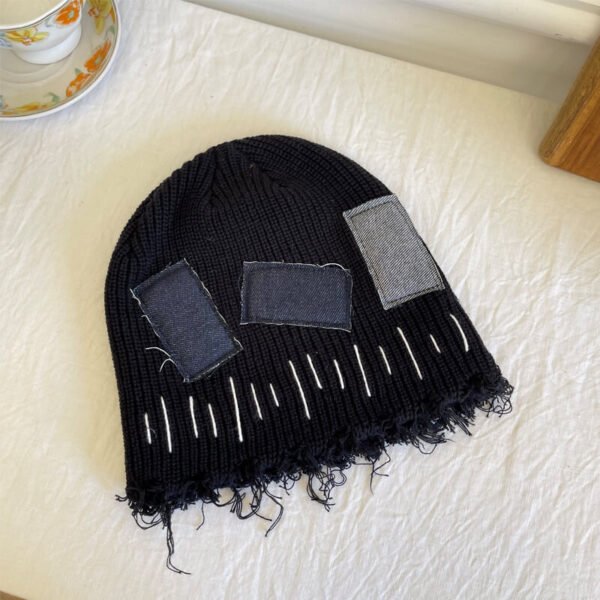






This custom knit hat translates a distressed streetwear attitude through disciplined stitch control. The supplied image shows parallel rib columns, three contrasting patches, repeated light accents, and a deliberately loose lower edge, creating a product where manufacturing consistency must support, not erase, the intended irregularity.
Gauge Sets the Visual Baseline
The hat's rib structure is the first quality signal because the vertical columns remain legible from crown through body. A controlled knitting gauge keeps stretch, surface density, and column spacing visually stable, allowing the distressed hem to read as designed variation.
For development, VeeWen should define an acceptable gauge range against the approved sample, then inspect crown shaping and cuff opening together. Excessively tight knitting can suppress the relaxed character, while loose knitting may distort patch alignment and expose inconsistent spacing.
Topstitching Must Hold the Contrast
The front patches introduce three different dark and light surfaces, so their attachment becomes more noticeable than on a plain hat. Even stitch length and balanced thread tension can secure the panels while preserving the handmade-looking edges visible in the reference.
The buyer should decide whether visible attachment lines are part of the identity or should recede into the base yarn. That choice affects thread color, needle placement, stitch density, and how confidently the patch edges withstand repeated stretch.
Raw Edges Need a Controlled Limit
Loose yarn ends are concentrated along the lower edge, with some strands extending farther than others. This creates movement and age, but uncontrolled unraveling could change the opening circumference, obscure the patches, or make production units appear unrelated.
VeeWen's sample checkpoint should establish a fringe map using maximum strand length, trim boundaries, and acceptable loose-end frequency. The target is not identical fringe on every piece; it is a repeatable envelope that protects the intended raw-edge character.
Patch Placement Balances Irregularity
The image presents one angled patch beside two more horizontal panels, producing asymmetry across the front. That imbalance gives the hat a developed look, yet the panel spacing still needs a repeatable reference so the composition does not drift toward accidental crowding.
During approval, mark each patch with a placement grid referenced from the center rib and lower edge. This allows controlled angle and spacing variation while preserving the recognizable visual hierarchy across the production run.
VeeWen Workflow Converts Texture Into Tolerances
VeeWen's product-development workflow should translate the reference into a gauge swatch, patch-placement board, and raw-edge limit sheet before the complete sample is approved. These documents connect the visible argument to measurable checkpoints without flattening the product's deliberately distressed surface.
At sample review, the buyer should inspect the hat on a head form and laid flat. Confirm crown symmetry, stretch recovery expectations, patch security, and fringe behavior together, because a successful result depends on their interaction rather than any isolated detail.
Approve the Distressed-Control Balance
The strongest commercial version will look irregular at the hem and patch edges while remaining consistent in rib rhythm, front composition, and attachment security. That balance gives buyers a recognizable accessory story that can be repeated across colorways without becoming sterile.
Before placing the style into a collection, approve one physical standard showing gauge, patch angles, thread treatment, cuff opening, and fringe boundaries. Record all remaining composition and fiber details as development decisions, not assumptions drawn from the photograph.
Buyer Questions
Can the patch arrangement be changed for a private-label collection?
Yes. Patch count, shape, angle, and placement can be developed as a new layout, subject to sample approval and the agreed attachment method.
How should the raw edge be specified?
Define a controlled fringe envelope with maximum strand length, trimming boundaries, and acceptable variation, then review the result on the approved sample.
Is the displayed fiber composition confirmed?
No. The image establishes appearance and construction direction only; fiber composition, yarn specification, and care requirements must be confirmed during development.
What is the commercial minimum?
The exact commercial minimum is MOQ: 100 pieces per style, with final development details confirmed through the approved product specification.
Approve the Knit Control Standard
Send VeeWen your target head fit, patch artwork, and color direction to develop the gauge swatch, placement board, and raw-edge sample for review.


Reviews
There are no reviews yet.