

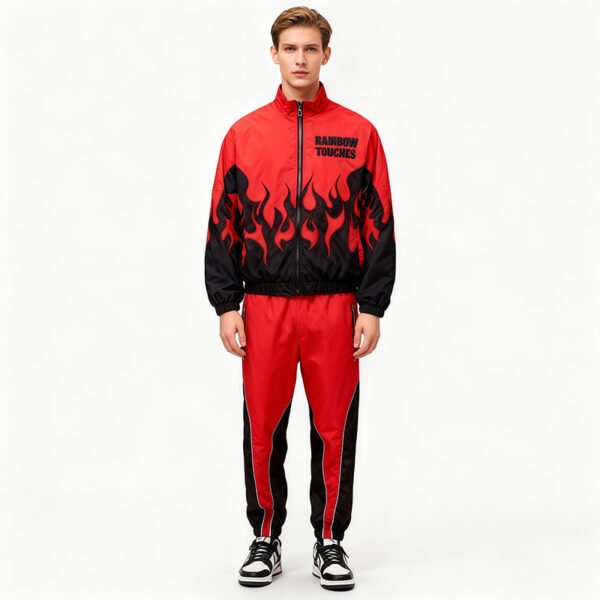





This matching red and black tracksuit is developed around a practical containment question: how should exposed fabric edges, printed transitions, and elasticated openings remain controlled during active movement? The visible flame layout gives the answer commercial importance because durability must protect the set's graphic identity.
Why Edge Containment Matters Here
A tracksuit experiences repeated flexing at cuffs, hems, waistlines, and ankles. The image shows gathered openings at each of these zones, so development should use controlled seam allowances and secure finishing to prevent edge exposure from becoming a visible wear point.
The flame graphic adds another risk: any waviness, seam torque, or edge distortion can interrupt the sharp silhouette of the print. Containment therefore supports both physical resilience and visual continuity, especially where black and red surfaces meet under movement.
Reading the Supplied Product Evidence
The supplied rear view shows a red upper jacket transitioning into black lower sleeves and body areas, with red flame shapes crossing that darker field. This makes the lower jacket construction a key inspection zone for seam alignment, edge capture, and print registration.
The trousers repeat the red-black contrast through long side panels and narrow vertical accents. Their elasticated ankles visibly gather the fabric above the footwear, creating a compact termination that should be checked for balanced recovery and comfortable movement.
Development Trade-Offs to Resolve
More containment can improve resistance to fraying and shape loss, but additional folds, binding, or dense stitching may increase bulk at openings. On this design, excessive thickness could disturb the clean gathered profile visible at the cuffs, hem, and trouser ankles.
A smoother edge treatment may preserve mobility and comfort while offering less protection if the raw allowance is not captured securely. VeeWen's sample review should compare hand feel, recovery, seam appearance, and print interruption before the buyer approves the final construction route.
VeeWen Workflow Checkpoint
VeeWen can translate the image-led concept into a development brief that maps every exposed-edge risk: jacket cuffs, gathered hem, trouser ankles, side-panel seams, and the flame artwork's crossing points. The brief should identify which details require construction confirmation rather than assumption.
During prototype review, the buyer should inspect the garment inside and outside, then request targeted revisions where raw edges shift, elastic channels twist, or graphics lose alignment. Approval should follow a signed sample checkpoint covering containment details, fit movement, and artwork placement.
Print and Construction Interaction
The flame motif is not isolated to one small chest area; it occupies the jacket's visible rear and lower sleeve region. That scale means seam placement, pressing, and edge control must be considered together, because construction movement can change how the artwork reads.
The black base makes the red flames visually dominant, while the red upper body creates a strong transition above them. Buyers should confirm whether the selected print process maintains clean boundaries after assembly handling and whether finishing leaves the contrast visually consistent.
Buyer Approval Decision
The correct approval question is not simply whether the set looks striking in a static image. It is whether the contained edges preserve shape, comfort, and graphic coherence after the intended movement and care conditions are defined for the program.
Before placing the commercial order, approve a sealed construction specification and a representative pre-production sample. Confirm material, elastic behavior, seam finishing, print tolerances, size grading, and care instructions, with MOQ: 100 pieces per style recorded in the brief.
Buyer Questions
What is the main development risk for this tracksuit?
The primary risk is uncontrolled raw-edge behavior at elasticated openings and panel seams, where movement or laundering could affect shape, comfort, and the flame graphic's visual continuity.
Which areas should the first sample emphasize?
Prioritize jacket cuffs, gathered hem, trouser ankles, side-panel seams, and flame transitions. These zones reveal whether edge containment, elastic recovery, and artwork registration work together.
Is the fabric composition already verified?
No. The supplied evidence does not state fiber percentages, fabric weight, stretch content, or performance testing, so those specifications should remain To Confirm during development.
What must be approved before production?
Approve a representative pre-production sample and written specification covering materials, containment construction, print tolerances, fit grading, care instructions, and MOQ: 100 pieces per style.
Approve the Edge-Controlled Set Brief
Send your target materials, size range, artwork files, and use conditions to begin review. VeeWen can then align containment details, sample checkpoints, and MOQ: 100 pieces per style for approval.


Reviews
There are no reviews yet.