









This custom short sleeve plaid shirt is developed around a deliberate tension: plated hardware should look settled against the woven plaid, while crack-print treatment supplies controlled surface age. The visible collar, button, stitching, and rust-navy repeat create a clear approval framework for OEM development.
Plaid Ground and Visual Hierarchy
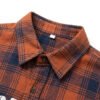
The image shows a warm rust-orange plaid intersected by navy lines across the collar, yoke area, placket, and front body. That continuity makes the woven pattern the primary visual field, leaving treatment and hardware responsible for controlled emphasis.
Because plaid already contains repeated directional lines, the crack-print artwork should be positioned where it adds irregularity without obscuring the repeat. VeeWen development should map artwork boundaries against plaid placement before approving screens, ensuring the collar and button zone remain legible.
Hardware Plating Decision
The visible dark button introduces a compact, high-contrast point beneath the collar. A restrained plated finish can reinforce the shirt's worn direction, while excessive gloss could read as decorative hardware detached from the matte-looking plaid surface shown.
The approval checkpoint is a paired physical review of button samples and treated fabric. Compare dark matte, satin, and brighter plated options for reflection, edge wear, and color interaction, then record the selected finish beside the approved artwork reference.
Crack-Print Mechanism
Crack-print treatment creates visual age through a printed film or ink surface that breaks along designed lines as the garment flexes or is processed. The image evidence confirms the requested direction, but not the ink system, cracking scale, or final coverage.
A controlled result requires separating intentional fracture from uncontrolled loss. VeeWen should test artwork density, ink deposit, curing conditions, and laundering simulations during sampling, because a dramatic initial crack may become excessive where the front folds around the placket.
Collar, Placket, and Stitch Control
The close-up clearly shows a pointed collar, buttoned front placket, overlapping plaid lines, and light-colored stitching around key edges. These construction details create boundaries that can either sharpen the treatment or expose misalignment when artwork crosses seams.
Development should therefore lock collar point dimensions, placket width, stitch appearance, and plaid matching before final surface approval. The garment treatment should respect these boundaries, while the button size and placement must preserve comfortable closure and a clean neckline presentation.
VeeWen Development Workflow
VeeWen can turn this argument into a focused development sequence: confirm the plaid reference, define crack-print artwork, select plated button directions, and review how each choice behaves together on a sewn sample rather than isolated swatches.
At the buyer checkpoint, request one coordinated sample showing approved plaid placement, collar construction, button finish, and treatment coverage. Record acceptable visual irregularity, reject excessive cracking, and confirm whether the chosen hardware remains appropriate after handling and care review.
Commercial Approval and Trade-Offs
The main trade-off is expressive aging versus repeatable presentation. More aggressive crack treatment may increase visual impact but can reduce consistency across panels, while quieter treatment preserves the plaid and makes hardware selection more influential.
Approve the style when the button finish supports the intended age direction, the crack print remains readable without damaging construction clarity, and plaid alignment meets the agreed standard. Then release the technical pack using MOQ: 100 pieces per style as the commercial baseline.
Buyer Questions
What should be approved first for this shirt?
Approve the plaid reference and button finish direction first, then evaluate crack-print artwork on sewn panels because seams and pattern placement affect perceived scale.
Can the crack print cover the entire shirt?
Coverage can be developed, but it should be reviewed against plaid density and construction boundaries; broad coverage may reduce pattern clarity and increase visual inconsistency.
What hardware information is still needed?
Confirm button material, dimensions, attachment method, plating sheen, color, and care performance before bulk approval, since the image alone cannot verify those technical details.
What is the stated minimum order?
The commercial baseline for this record is MOQ: 100 pieces per style, with final specifications and quotation confirmed during VeeWen development.
Approve the Hardware and Treatment Direction
Send the target plaid reference, preferred button sheen, and crack-print artwork direction to VeeWen for a coordinated sample review and technical approval at MOQ: 100 pieces per style.


Reviews
There are no reviews yet.