


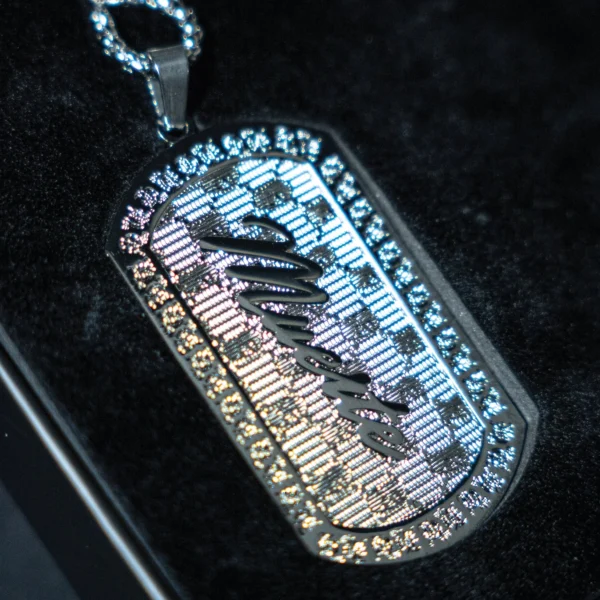


This development record translates a compact tag-and-medallion visual into a snap-front sweatshirt direction. The design opportunity lies in managing closure pull resistance while preserving a clean graphic front, comfortable opening force, and dependable attachment around concentrated hardware-inspired details for repeatable production.
Design Translation from the Supplied Visual
The supplied image presents a rectangular tag beside a circular medallion, both attached through compact metal connectors. For a sweatshirt, that relationship can become a front graphic language, with controlled hardware-inspired placement instead of literal jewelry replication.
The visual is high-contrast, reflective, and close-cropped, so the development should preserve its dark-versus-silver impact through approved artwork, trims, or controlled embellishment. Final decoration must be selected after reviewing hand feel, wash exposure, and attachment practicality on sweatshirt fabric.
Closure Pull Resistance as the Core Mechanism
Snap or button pull resistance is governed by fastener setting, cap geometry, fabric thickness, reinforcement, and opening angle. Excessive force can distort the placket, while insufficient force can create accidental opening during layering, movement, or repeated handling.
The first approval sample should therefore measure opening behavior across the intended size range and after repeated manual cycles. The buyer should review whether the closure feels deliberate, whether the fabric remains flat, and whether the attachment area shows stretching or tearing.
Localized Reinforcement Around Weight
Tag-inspired details concentrate visual and physical load at specific front points, even when the final execution uses embroidery, molded trims, or lightweight metal components. Reinforcement should be planned beneath each closure and attachment zone to distribute force across the sweatshirt body.
This approach introduces trade-offs: heavier detailing can strengthen the visual statement but may increase drape distortion, laundering complexity, or wearer discomfort. A lighter trim package may improve usability, while a denser package may better support the intended reflective focal point.
Fit and Opening Behavior Across Sizes
A relaxed sweatshirt silhouette gives the closure area room to move, but grading can still change placket tension and opening force. Larger sizes may pull differently across the chest, while smaller sizes can feel tighter around the same fastener spacing and reinforcement dimensions.
VeeWen's development workflow should map closure placement, snap spacing, and reinforcement dimensions onto the graded pattern before sample approval. The buyer should assess the smallest and largest planned sizes first, because those extremes reveal proportion and pull-resistance problems earliest.
VeeWen Development Workflow Checkpoint
VeeWen can convert this visual direction into a development package by separating the sweatshirt block, artwork placement, closure specification, and hardware-inspired trim reference. That structure keeps the pull-resistance axis visible rather than allowing decoration decisions to obscure the functional requirement.
At the sample review, the buyer should approve one physical closure configuration, one reinforcement method, and one decoration route together. Any change to fabric weight, placket thickness, or trim mass should trigger another pull review before the style moves toward bulk preparation.
Approval Trade-Offs Before Bulk Preparation
The commercial decision is not simply whether the sweatshirt opens and closes. It is whether the opening force, visual density, comfort, and durability communicate the intended product position without creating avoidable repair, laundering, or fit concerns for the target customer.
Approve the style when the closure stays secure during normal movement, opens without excessive effort, and leaves the front surface stable. Record the accepted fastener, reinforcement, decoration, and graded-size behavior so production teams can work from one controlled standard.
Buyer Questions
Can this concept be developed as a sweatshirt despite the supplied jewelry image?
Yes. The image can guide the graphic, reflective contrast, and attachment-inspired language, while the sweatshirt block and closure system are developed separately for wearability.
How should snap pull resistance be approved?
Review opening force, accidental release, fabric distortion, and reinforcement condition across graded sizes, then document the accepted fastener and setting configuration.
Can the metal-inspired detail be made lighter?
Yes. Printed, embroidered, molded, or lightweight trim alternatives can reduce weight, but each route requires separate hand-feel, appearance, and attachment review.
What is the minimum order quantity?
MOQ: 100 pieces per style. Final quantities, color breakdown, and specifications should be confirmed after the approved sample and production documentation.
Approve the Closure Direction
Send the target sweatshirt silhouette, artwork references, preferred fastener feel, and planned size range. VeeWen can then organize the closure trial, reinforcement review, and sample checkpoint around measurable buyer decisions.


Reviews
There are no reviews yet.