


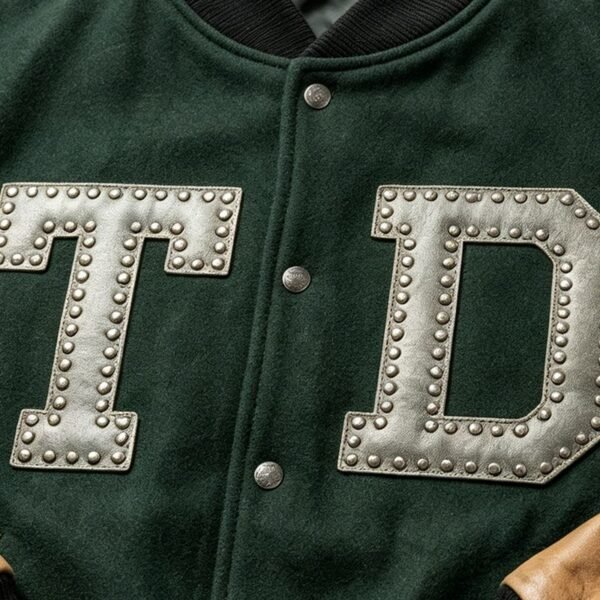
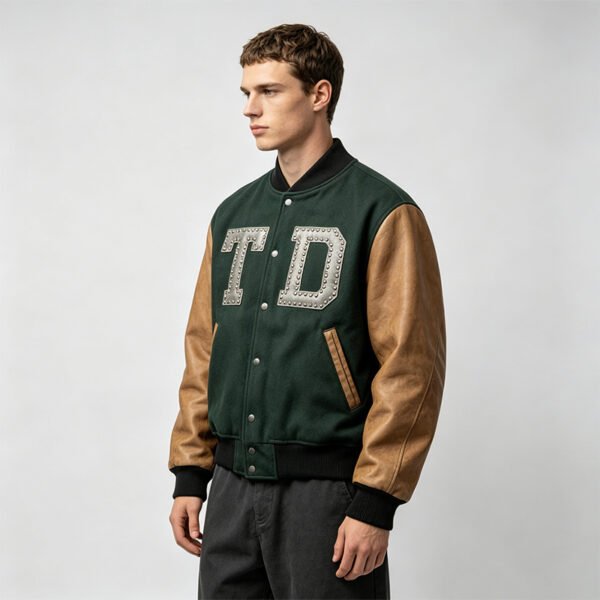
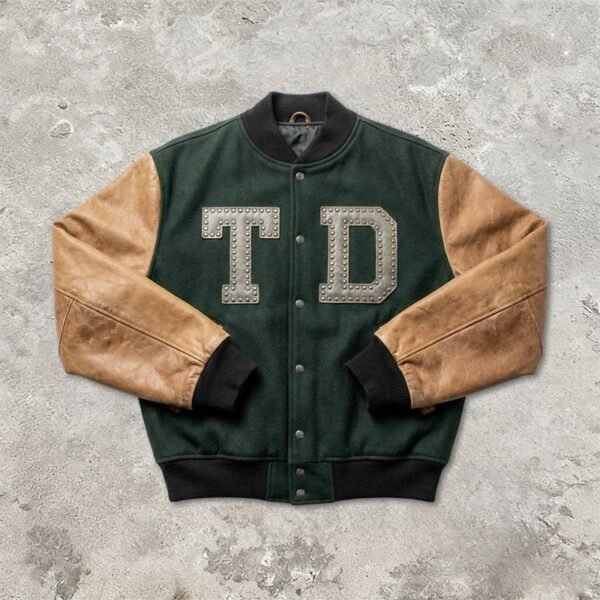
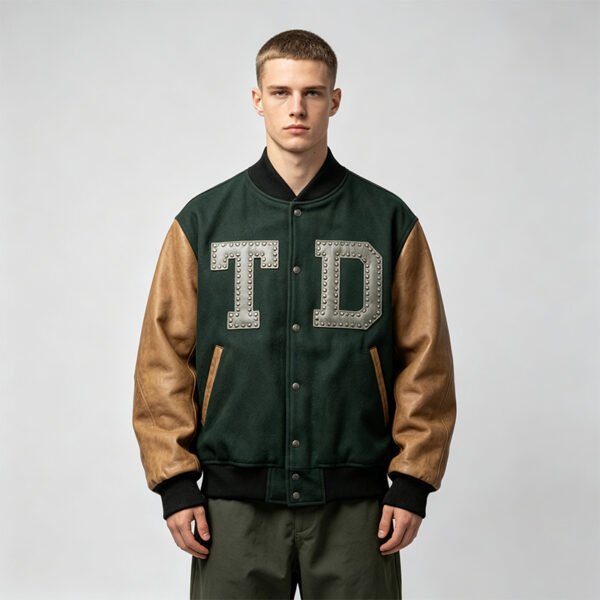


Built around post-process measurement recovery, this custom varsity jacket concept treats mixed-material assembly as a fit-control problem. The supplied close-up shows a dark green outer panel, black rib collar, satin lining, and snap hardware, giving buyers clear checkpoints for dimensional approval before bulk production begins.
Why Recovery Matters at Mixed-Material Junctions
The key risk in a green body joined to black rib components is dimensional drift after pressing, stitching, and finishing. PU leather can respond differently from textile rib, so recovered measurements should be compared against the approved pattern at post-process checkpoints before size grading is released.
That comparison should capture chest width, body length, sleeve length, cuff opening, and collar recovery after the jacket has settled. The visible rib collar is substantial and vertically textured, making stretch relaxation especially important; measurement records should distinguish relaxed dimensions from wearer-entry dimensions during development.
Reading the Supplied Construction Evidence
The close-up provides a construction map: dark green outer material meets black rib at the collar, while smooth dark lining sits inside the neckline. Those interfaces should be sampled as separate tolerance zones, because seam turn, edge compression, and lining attachment can alter measurements.
Rivet or patch placement, where present in the broader source description, adds another recovery checkpoint because applied components can pull localized panels or interfere with seam balance. Approval should therefore review decorated and undecorated measurements separately, with placement locked only after the base shell has stabilized.
Turning the Axis into a Development Handoff
A post-process measurement sheet should record the jacket after operations that can change shape: panel joining, collar insertion, lining installation, snap attachment, pressing, and packing simulation. The purpose is not merely inspection; it establishes which operation created variance and directs the next pattern or method correction.
For VeeWen development, this axis converts visual approval into a repeatable handoff: the tech pack identifies reference points, measurement states, and recovery limits at each material junction. A buyer should review the protocol with the sample, so approval covers behavior after processing, not appearance alone.
Managing Rib Collar Recovery
The image shows a rib collar with pronounced vertical channels and a soft-looking transition into the green shell. That structure may support entry comfort, but it introduces stretch recovery variables. Measure collar opening before and after relaxation, then confirm compatibility with the approved neck proportion.
The black rib also frames the satin-like lining visible beneath it, so the neckline cannot be assessed as an isolated trim component. VeeWen's sample review should check whether lining tension, collar attachment, and snap-front alignment remain stable together, especially when opened, worn, or folded.
Controlling Applied Decoration Effects
Rivet details and leather patch embroidery are identified in the source wording, although the supplied close-up primarily confirms the collar, lining, snap, and surface contrast. Applied decoration should be treated as a load and balance question: its position, mass, and attachment method can influence recovery around panels.
During development, VeeWen can isolate the undecorated shell, then add patches or rivets before repeating the measurement set. This sequencing helps the buyer see whether a visual feature changes length, width, or drape, creating a clear approval gate for decoration placement and reinforcement details.
Commercial Approval and Production Release
Commercially, the exact minimum is MOQ: 100 pieces per style. That quantity should be planned against the approved size run, colorway, decoration map, and recovery tolerances, because each additional combination can expand sampling and measurement workload even when the core jacket pattern remains unchanged.
The buyer's decision checkpoint is a measured approval sample: confirm shell dimensions, collar recovery, lining behavior, hardware alignment, and decoration placement after finishing. Once those records match the target, VeeWen can carry the agreed construction logic into the production tech pack and size-set review.
Buyer Questions
What details are visibly confirmed by the supplied image?
Yes. The supplied close-up visibly supports a dark green body, black rib collar, smooth dark lining, hanger loop, and metal snap; other construction details should follow the source reference and remain subject to sample confirmation.
What does post-process measurement recovery mean?
Post-process recovery means measuring the garment after shaping, joining, pressing, hardware attachment, and related finishing steps. It reveals dimensional change at material junctions, allowing the pattern, method, or tolerance to be corrected before size-set approval.
Which material and decoration details still require confirmation?
The source wording identifies PU leather, patches, embroidery, and rivets, while the image confirms selected trim and surface cues. Exact composition, backing, decoration method, and durability requirements should be written into the technical package after sampling.
What is the commercial minimum for development planning?
VeeWen's development review should approve the measured sample, construction sequence, decoration map, and recovery tolerances first. The commercial release then uses MOQ: 100 pieces per style, with final specifications confirmed in the production documentation.
Approve the Recovery-Controlled Jacket Sample
Send your target measurements, artwork or trim map, preferred color references, and size range to VeeWen. We can develop the recovery checkpoints around your approved jacket shell and return a sample package ready for technical review and MOQ: 100 pieces per style planning.


Reviews
There are no reviews yet.